Non Resident Landlord Scheme: How to Avoid Double Taxation
What is the Non-Resident Landlord Scheme?
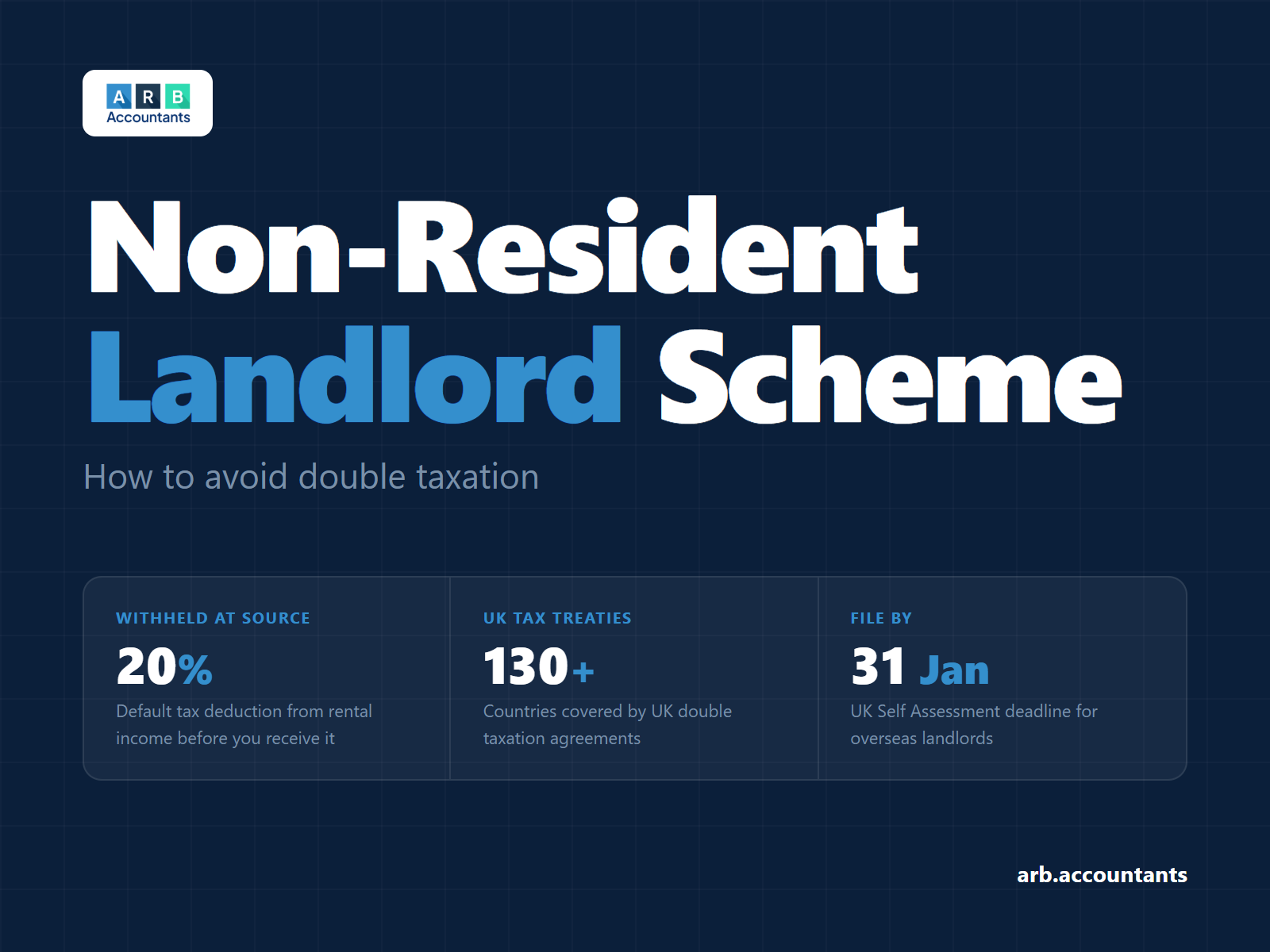
The Non-Resident Landlord Scheme (NRLS) is HMRC's system for collecting tax on UK rental income paid to landlords who live outside the UK. By default, your letting agent or tenant must deduct 20% tax from your rent before paying it to you. You can apply to opt out of this using form NRL1, receiving income gross and settling any tax yourself through Self Assessment. Either way, you still need to file a UK tax return and, if your country of residence also taxes the income, double taxation treaties ensure you are not taxed twice on the same rent.
Non-Resident Landlord Scheme at a Glance
- The default rule is 20% tax deducted at source by your letting agent or tenant before they pay rent to you.
- You can apply to opt out using form NRL1 (individuals), NRL2 (companies), or NRL3 (trustees) and receive your rental income gross.
- Tax deducted at source does not replace the obligation to file a UK Self Assessment return. You still need to do that every year.
- The UK has double taxation treaties with over 130 countries. Most give the UK the primary right to tax UK rental income and allow you to offset UK tax against any liability in your country of residence.
- Non-resident landlords have been liable to UK Capital Gains Tax on UK property sales since 2015, and all UK property since 2019.
What is the Non-Resident Landlord Scheme?
The Non-Resident Landlord Scheme, introduced in 1996, is the HMRC framework governing how UK Income Tax is collected on rental income paid to landlords who live outside the UK. It applies to individuals, companies, trustees and partnerships.
The trigger is your “usual place of abode.” If you spend more than six months of the year outside the UK, your usual place of abode is considered to be overseas and the scheme applies to your UK rental income, regardless of your nationality or tax residency status.
The scheme exists because HMRC cannot easily pursue overseas landlords for unpaid tax once rental income has left the UK. By collecting tax at source through letting agents and tenants, HMRC ensures the liability is settled before the money goes abroad.
How the Default Scheme Works
Under the default NRLS rules, your letting agent is required to deduct basic rate Income Tax (currently 20%) from your net rental income before paying the remainder to you. They pay the withheld tax to HMRC every quarter and file an annual return showing what they have deducted.
If you do not use a letting agent and your tenant pays you directly, the same obligation falls on the tenant. They must withhold 20% and pay it to HMRC. In practice, many tenants are unaware of this obligation, which is why letting agents often fill the role.
One of the most common misconceptions among overseas landlords is that this deduction at source settles their UK tax obligations. It does not. The 20% withheld is an advance payment against your liability, not a final settlement. You still need to file a UK Self Assessment return every year, declare your rental income, deduct your allowable expenses, and calculate the correct tax. If the amount deducted exceeds your actual liability (because your expenses are high or your profit falls within your allowances), HMRC will refund the difference. If you owe more, you pay the balance.
The NRL1 Form: How to Receive Income Without Tax Deducted
The NRL1 form is HMRC’s application for individual non-resident landlords who want to receive their UK rental income gross, without tax being deducted before it reaches them. Companies apply using form NRL2, and trustees use NRL3.
Applying does not exempt you from UK tax. It simply changes who is responsible for handling the payment. Instead of your agent or tenant withholding 20% on your behalf, you take on full responsibility for calculating and paying any tax owed through your annual Self Assessment return.
To be approved, HMRC looks at your compliance history. Your UK tax affairs need to be up to date, meaning any outstanding returns have been filed and any tax due has been paid. If HMRC is satisfied, they write to your letting agent or tenant instructing them to pay your rent without deduction. This approval stays in place until you notify HMRC of any change.
The main practical reason to apply is cash flow. If your allowable expenses are high relative to your rental income, or your income falls within your available Personal Allowance, you could be receiving less money each month than you are actually entitled to under the default rules, with a refund only coming once you file your annual return. Receiving the income gross avoids that delay.
How Double Taxation Treaties Work for Non-Resident Landlords
Double taxation happens when two countries both have the legal right to tax the same income. As a non-resident landlord, you may face this if your country of residence also taxes worldwide income, including your UK rental income.
The UK has double taxation treaties with over 130 countries. These treaties set out which country has the primary taxing right over different types of income. For UK rental income, treaties almost always give the UK the primary right to tax. Your country of residence then has to give you credit for the UK tax you have paid, so you are not taxed twice on the same money.
In practice, this means you declare your UK rental income in your country of residence as usual, but you offset the UK tax paid against your local tax liability on the same income. The exact mechanism varies by country and treaty, so you need to understand how both systems work and what documentation your local tax authority requires.
Where there is no double taxation treaty between the UK and your country of residence, the risk of double taxation is real. Some countries offer unilateral relief (a credit for foreign taxes paid regardless of treaty), but not all do. If you are based in a country without a UK treaty, specialist advice on both sides is particularly important.
What Tax Can Non-Resident Landlords Deduct?
Non-resident landlords can deduct the same allowable expenses as UK-resident landlords when calculating their taxable rental profit.
Letting agent fees and property management costs are fully deductible. So are repairs and maintenance to keep the property in good condition, insurance premiums, ground rent and service charges, professional fees including accountancy, council tax and utility bills when the landlord rather than the tenant pays them, and the cost of advertising for tenants.
Mortgage interest is treated differently for individual residential landlords since the Section 24 restriction was fully phased in from 2020. Individuals can no longer deduct mortgage interest directly from their rental income. Instead, they receive a tax credit worth 20% of the interest paid. This effectively removes any additional tax relief for higher and additional rate taxpayers on the interest element. Companies are not subject to this restriction and can still deduct mortgage interest in full.
Capital improvements, such as extensions or loft conversions that add value to the property, are not deductible against rental income. They may reduce a Capital Gains Tax liability when the property is eventually sold.
Capital Gains Tax for Non-Resident Landlords
Since April 2015, non-resident landlords have been liable to UK Capital Gains Tax on the sale of UK residential property. Since April 2019, this extended to all UK property, including commercial. This is an area many overseas landlords are not aware of until they are in the process of selling.
When you sell UK property as a non-resident, you must report the disposal to HMRC within 60 days of completion and pay any tax due at that point. This applies even if you make no overall gain. Failure to report in time results in penalties.
The annual CGT exempt amount and applicable rates depend on your individual circumstances. If your country of residence also taxes the gain, your double taxation treaty will again determine how credit is given for UK CGT paid.
UK Self Assessment Obligations for Non-Resident Landlords
Every non-resident landlord with UK rental income must register for UK Self Assessment and file a tax return for every year they receive that income. This obligation exists whether or not tax is being deducted at source and regardless of the amount of income.
You register at GOV.UK and receive a Unique Taxpayer Reference number. Online returns must be filed and any balance of tax paid by 31 January following the end of the tax year. If your Self Assessment bill exceeds £1,000, payments on account toward the following year are also required at that point.
Non-UK residents sometimes ask whether they can claim the UK Personal Allowance. The answer depends on nationality and the terms of any applicable double taxation treaty. UK nationals are generally entitled to the full Personal Allowance (£12,570 for 2025/26). Nationals of countries with treaties that include a personal allowance clause may also qualify. If you are unsure, this is worth confirming before you file, as it can make a material difference to your liability.
What Letting Agents and Tenants Must Do
Letting agents and tenants are not passive in this arrangement. The NRLS places obligations on them directly.
If you use a letting agent, the agent must register with HMRC as a non-resident landlord agent, deduct 20% tax from your net rental income each quarter, and file a quarterly return with HMRC. They give you a certificate each year showing how much was deducted, which you use when completing your Self Assessment return.
If you have no letting agent and your tenant pays you rent directly, the tenant becomes responsible for deducting and paying the tax. Tenants whose quarterly rent is below £100 are generally exempt from this requirement.
Once you have NRL1 approval from HMRC, your agent or tenant receives written notification from HMRC that they can pay you without deduction. They keep this notice on file. If approval is later withdrawn, HMRC notifies them again and deductions resume.
What Happens If You Have Not Been Complying
Many non-resident landlords discover their UK tax obligations late, sometimes years after they started renting out a UK property. The common pattern is assuming that tax deducted by a letting agent covers everything, or not knowing that UK tax applies at all.
If you have missed UK Self Assessment returns, the starting point is to get compliant as soon as possible. Voluntary disclosure to HMRC before they contact you consistently results in lower penalties than waiting to be found. HMRC has access to letting agent data and property ownership records, and is increasingly active in identifying overseas landlords who are not filing.
Frequently Asked Questions
What is the Non-Resident Landlord Scheme?
The Non-Resident Landlord Scheme is HMRC’s framework for collecting tax on UK rental income paid to landlords who live outside the UK. Under the default rules, letting agents or tenants deduct 20% tax from rental income before paying it to the landlord. Landlords can apply to opt out and receive income gross instead.
Who counts as a non-resident landlord?
Anyone whose usual place of abode is outside the UK and who receives UK rental income. HMRC considers your usual place of abode to be outside the UK if you spend more than six months of the year abroad. It applies to individuals, companies, trustees and partnerships.
What is the NRL1 form?
Form NRL1 is the HMRC application for individual non-resident landlords to receive UK rental income without tax deducted at source. Once approved, your letting agent or tenant pays rent to you gross and you settle any tax owed through your UK Self Assessment return. Companies use NRL2 and trustees use NRL3.
How do I apply for the NRL1 form?
Download form NRL1 from GOV.UK and submit it to HMRC. HMRC will check your compliance record and, if approved, notify your letting agent or tenant that they can pay rent without deducting tax. Processing typically takes two to three weeks.
Do non-resident landlords still need to file a UK tax return?
Yes. Whether or not tax is deducted at source, you still need to file a UK Self Assessment return reporting your rental income and allowable expenses. Tax deducted at source is not a final settlement of your UK tax liability.
How do double taxation treaties prevent paying tax twice?
The UK has double taxation treaties with over 130 countries. Most give the UK the primary right to tax UK rental income. Your country of residence then gives you credit for the UK tax paid, so the same income is not taxed again there. You need to file correctly in both countries and claim the relief.
What expenses can non-resident landlords deduct?
The same allowable expenses as UK-resident landlords: letting agent fees, repairs and maintenance, insurance, mortgage interest (as a 20% tax credit for individuals under Section 24), ground rent, service charges, and professional fees including accountancy. Capital improvements are not deductible against rental income.
Can non-resident landlords claim the Personal Allowance?
It depends. UK nationals and some other qualifying individuals may be entitled to the UK Personal Allowance of £12,570. Whether you qualify depends on your nationality and the terms of any double taxation treaty between the UK and your country of residence.
What happens if my letting agent does not deduct tax and I have not applied for NRL1 approval?
Your letting agent becomes liable for the tax that should have been deducted. If there is no letting agent and the tenant does not deduct tax, the landlord remains liable. If you have not filed UK tax returns, interest and penalties apply to any undeclared income.
Do I need to pay Capital Gains Tax when I sell my UK property as a non-resident?
Yes. Non-resident landlords have been subject to UK Capital Gains Tax on UK residential property since April 2015, and on all UK property since April 2019. You must report any disposal to HMRC within 60 days of completion and pay any tax due at that point.
Get Expert Help With Non-Resident Landlord Tax
ARB Accountants advises non-resident landlords across the UK and internationally. Whether you need to get registered, file outstanding returns, apply for NRL1 approval, or navigate double taxation between the UK and your country of residence, we handle the detail so you do not miss obligations or overpay.
Free 60-minute consultation. ACCA-chartered. Working with overseas landlords since 2008.
Book a free consultation or call 01702 345 207.
Frequently Asked Questions
What is the Non-Resident Landlord Scheme?
The Non-Resident Landlord Scheme (NRLS) is the HMRC framework that governs UK tax on rental income paid to landlords who live outside the UK. Under the default rules, letting agents or tenants must deduct 20% tax from the rent before passing it to the landlord and pay it to HMRC. Landlords can apply to opt out of this and receive income gross instead.
Who counts as a non-resident landlord?
Anyone whose usual place of abode is outside the UK and who receives UK rental income. HMRC considers your usual place of abode to be outside the UK if you spend more than six months of the year abroad. It applies to individuals, companies, trustees and partnerships.
What is the NRL1 form?
Form NRL1 is the HMRC application for individual non-resident landlords to receive UK rental income without tax deducted at source. Once approved, your letting agent or tenant pays rent to you gross and you settle any tax owed through your UK Self Assessment return. Companies use NRL2 and trustees use NRL3.
How do I apply for the NRL1 form?
Download form NRL1 from GOV.UK and submit it to HMRC. HMRC will check your compliance record and, if approved, notify your letting agent or tenant that they can pay rent without deducting tax. Processing typically takes two to three weeks.
Do non-resident landlords still need to file a UK tax return?
Yes. Whether or not tax is deducted at source, you still need to file a UK Self Assessment return reporting your rental income and allowable expenses. The deduction at source is not a final settlement of your UK tax liability.
How do double taxation treaties prevent paying tax twice?
The UK has double taxation treaties with over 130 countries. Most give the UK the primary right to tax UK rental income. Your country of residence then gives you credit for the UK tax paid, so the same income is not taxed again there. You need to file correctly in both countries and claim the relief.
What expenses can non-resident landlords deduct?
The same allowable expenses as UK-resident landlords: letting agent fees, repairs and maintenance, insurance, mortgage interest (as a 20% tax credit for individuals under Section 24), ground rent, service charges, and professional fees including accountancy. Capital improvements are not deductible.
Can non-resident landlords claim the Personal Allowance?
It depends. UK nationals and some other qualifying individuals may be entitled to the UK Personal Allowance of £12,570, which covers the first portion of income tax-free. Whether you qualify depends on your nationality and the terms of any double taxation treaty between the UK and your country of residence. This is worth checking with a tax adviser.
What happens if my letting agent does not deduct tax and I have not applied for NRL1 approval?
Your letting agent becomes liable for the tax that should have been deducted. If there is no letting agent and the tenant does not deduct tax, the landlord remains liable. HMRC can pursue both parties. If you have not filed UK tax returns, interest and penalties apply to any undeclared income.
Do I need to pay Capital Gains Tax when I sell my UK property as a non-resident?
Yes. Non-resident landlords have been subject to UK Capital Gains Tax on UK residential property since April 2015, and on all UK property since April 2019. You must report any disposal to HMRC within 60 days of completion and pay any tax due at that point.
About The Author

Saurabh Bedi | Director
Saurabh is a tax advisor at ARB Accountants, specialising in Self-Assessment and small business tax. He's dedicated to making tax simple and stress-free, helping clients stay compliant and confident with HMRC.
Qualifications & Experience
- Fellow of Chartered Certified Accountants (ACCA)
- MSc Chartered Certified Accountancy 2008
- Working in accountancy since 2008