Self Assessment Sole Trader: How to Pay Less Tax Legally
Do sole traders have to do Self Assessment?
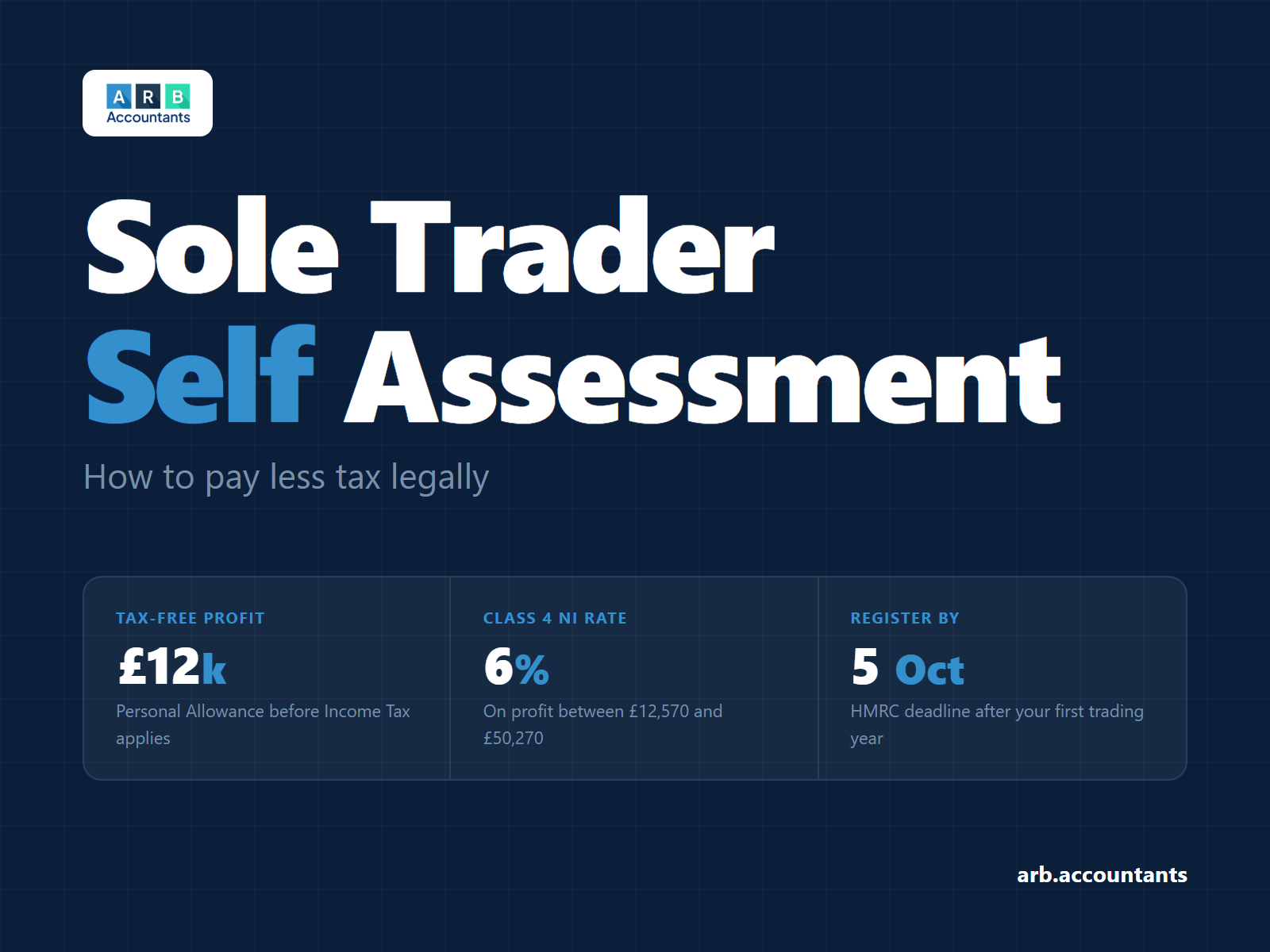
Yes. Every sole trader in the UK must register for Self Assessment with HMRC, file an annual tax return, and pay Income Tax and National Insurance on their profit. You must register by 5 October following the end of your first trading year. With the right approach, claiming every allowable expense and planning around key allowances, most sole traders pay significantly less than they initially expect.
Sole Trader Self Assessment at a Glance
- Register with HMRC by 5 October following your first trading year, not when you start trading.
- You pay Income Tax on profit above £12,570 and Class 4 National Insurance at 6% on profit up to £50,270.
- Every allowable business expense reduces your taxable profit directly, so thorough record-keeping is one of the most effective legal ways to lower your bill.
- If your tax bill exceeds £1,000, HMRC requires advance payments on account toward the following year. This catches many new sole traders off guard.
- Class 2 National Insurance was abolished in April 2024. Sole traders now only pay Class 4 NI.
What is Self Assessment for Sole Traders?
Self Assessment is the system HMRC uses to collect tax on income that is not automatically deducted through an employer’s payroll. As a sole trader, no one deducts tax from your earnings before you receive them, so it is your responsibility to report your income, deduct your allowable expenses, calculate what you owe, and pay it.
Every year you are self-employed, you file a Self Assessment return showing your total trading income, your allowable expenses, and your resulting profit. HMRC uses that figure to calculate your Income Tax and Class 4 National Insurance for the year. If you also have employment income, rental income, or savings interest above a certain threshold, those go on the same return.
How to Set Up as a Sole Trader with HMRC
Setting up as a sole trader is the most straightforward business structure in the UK. There is no company registration, no Companies House filing, and no minimum capital requirement. You register with HMRC as self-employed and that is largely it.
You can trade under your own name or choose a business name. If you use a business name, it cannot include words like “limited,” “Ltd,” or “PLC,” as those imply a different legal structure.
To register, you need a Government Gateway account and you complete the registration at GOV.UK. HMRC posts your Unique Taxpayer Reference (UTR) within about 10 working days. You need that number every time you file, so keep it somewhere safe.
The registration deadline is 5 October following the end of the tax year in which you started trading. The UK tax year runs 6 April to 5 April. So if you started working for yourself in November 2025, you must register by 5 October 2026. Missing this date can result in a penalty even if you owe no tax.
If your annual turnover exceeds £90,000, you must also register for VAT separately. Below that threshold it is optional, though it can be worth considering if your customers are mainly VAT-registered businesses.
Opening a separate business bank account is not a legal requirement, but it makes record-keeping significantly cleaner and reduces the risk of errors on your return. Most sole traders who try to use a single personal account for everything find it becomes difficult to manage quickly.
What Does a Sole Trader Self Assessment Return Include?
Your Self Assessment return has two main parts as a sole trader: the core tax return and the self-employment supplementary pages, known as SA103. On the self-employment pages you report your gross trading income, your allowable expenses, and the resulting net profit. You also declare any capital allowances on business equipment you have purchased, and any losses from previous years you want to carry forward.
HMRC uses your profit figure to calculate your Income Tax and Class 4 National Insurance, combines this with any other income you have declared, and produces your total bill. You can file online through your HMRC account any time between the end of the tax year (5 April) and 31 January the following year.
Allowable Expenses: What Sole Traders Can Claim
The most effective legal route to a lower tax bill is claiming every expense you are entitled to. An allowable expense is one that is wholly and exclusively for the purposes of your trade. You cannot claim personal costs, but you can claim the business proportion of expenses that are partly personal.
Office costs such as stationery, postage, printer ink and software you use for work are straightforward. Equipment like computers, phones and tools may be deducted as expenses or claimed through capital allowances depending on how you use them.
For travel, you can claim the cost of getting to client meetings, work sites, or any other business location. You cannot claim commuting between home and a regular fixed workplace. If you use your own car for business journeys, the easiest approach is HMRC’s approved mileage rate: 55p per mile for the first 10,000 miles in a tax year from 6 April 2026, and 25p per mile after that.
Working from home as a sole trader lets you claim a proportion of your household costs, including heating, electricity and broadband, based on the rooms used and the time spent working. Alternatively, HMRC’s simplified expenses offer a flat rate starting at £10 per month when you work 25 or more hours at home per month, rising to £18 or £26 depending on hours worked. For most sole traders, the flat rate is simpler to apply and produces a comparable result.
Wages paid to employees or subcontractors, advertising and website costs, professional fees including accountancy, legal fees related to your business, and insurance premiums for your trade are all allowable. Training costs can also be claimed if they update your existing skills for your current business, though training to qualify in a different trade or profession does not qualify.
Legal Ways to Pay Less Tax as a Sole Trader
Claiming expenses is just the starting point. Several other strategies can reduce a sole trader’s tax bill significantly without doing anything HMRC would question.
Pension contributions are one of the most powerful. Money paid into a personal pension comes off your taxable profit before tax is calculated, and the pension provider claims basic-rate tax relief on top of what you pay in. A sole trader contributing £800 to a pension effectively costs just £640 after relief. Higher-rate taxpayers can claim additional relief through their Self Assessment return. The compounding benefit over time makes this worth starting as early as possible.
The Annual Investment Allowance lets you deduct the full cost of qualifying equipment, machinery, or tools in the year you buy them rather than spreading the deduction over several years. The current limit is £1 million per year, well above what most sole traders spend. Timing a significant purchase to fall before 5 April means the deduction lands in the current tax year rather than the next one.
If your total trading income is £1,000 or less, the trading allowance eliminates your tax liability without needing to track individual expenses at all. If your income exceeds £1,000 but your actual business expenses are below that figure, you can still elect to use the £1,000 trading allowance instead of claiming the real costs.
Married sole traders should also check whether Marriage Allowance applies. If your profit falls below the £12,570 Personal Allowance, you may be able to transfer up to £1,260 of your unused allowance to a spouse or civil partner who pays the basic rate of tax, cutting the household tax bill by up to £252 a year.
Finally, the timing of income and expenses around the tax year end on 5 April can make a meaningful difference. If a large payment from a client can reasonably be invoiced after 5 April, the income falls into next year’s return rather than this one. Bringing forward a planned equipment purchase to before 5 April means the deduction reduces this year’s profit.
Key Deadlines for Sole Trader Self Assessment
Missing a deadline costs money regardless of whether you actually owe any tax.
- 5 October: Register with HMRC in the year after you started trading. This is a one-off deadline for your first year only.
- 31 October: Deadline for paper Self Assessment returns.
- 31 January: Deadline for online returns and payment of all tax owed for the previous tax year.
- 31 July: Second payment on account due (if applicable).
Payments on account are something many new sole traders discover late and find alarming. When your Self Assessment bill exceeds £1,000, HMRC does not just collect what you owe for the past year. It also collects an advance instalment toward next year’s estimated bill at the same time. That instalment is half of this year’s tax bill, due on 31 January alongside the current year’s payment. A second instalment for the other half follows on 31 July. In practice, this means your first large tax payment as a sole trader can be up to one and a half times what you expected. Budgeting for this from your first year of trading avoids a serious cash flow problem.
Common Mistakes That Cost Sole Traders Money
Trying to reconstruct the year’s accounts in January, days before the deadline, is the most common and costly mistake. Missing receipts, forgotten expenses, and rushed returns all lead to higher bills and potential errors that HMRC may later question. Keeping records monthly makes the annual return straightforward.
Registering late is another avoidable penalty. The 5 October registration deadline exists even if you are not yet ready to file your return. Missing it can trigger a fine regardless of whether any tax is owed.
Many sole traders also underestimate or forget about payments on account entirely. Once the first large bill arrives, some try to apply for a reduction by arguing next year’s income will be lower, which is possible but requires care. Planning for payments on account from the start is simpler.
Claiming personal expenses, even accidentally, invites HMRC scrutiny. If you are unsure whether something qualifies, the test is whether the cost was incurred wholly and exclusively for your business. If there is any personal benefit, only the business proportion is allowable, and you need to be able to justify the split if asked.
Frequently Asked Questions
Do sole traders have to do Self Assessment?
Yes. Every sole trader must register for Self Assessment with HMRC and file an annual tax return, even if they made a loss or owe no tax. The only exception is if total trading income was £1,000 or less under the trading allowance.
When do I need to register as a sole trader with HMRC?
By 5 October following the end of the tax year in which you started trading. The UK tax year runs 6 April to 5 April. Miss this deadline and HMRC can charge a penalty.
How do I set up as a sole trader?
Register online with HMRC at gov.uk/register-for-self-assessment. You do not need to register at Companies House. You will receive a Unique Taxpayer Reference (UTR) number within about 10 working days, which you need to file your return.
How much tax does a sole trader pay?
You pay Income Tax on profit above the £12,570 Personal Allowance: 20% up to £50,270, 40% up to £125,140, and 45% above that. You also pay Class 4 National Insurance at 6% on profit between £12,570 and £50,270, and 2% above that.
What can I claim as a sole trader?
Any expense that is wholly and exclusively for your business. This includes tools and equipment, business travel, work clothing, phone and broadband used for business, marketing, professional fees, bank charges, and the business use of your home.
What is the Self Assessment deadline for sole traders?
You must file your return online by 31 January and pay any tax owed by the same date. Paper returns must be filed by 31 October. If your tax bill exceeds £1,000, HMRC will also require advance payments on account.
Can I reduce my sole trader tax bill legally?
Yes. Claim all allowable expenses, use simplified expenses where they apply, make pension contributions which reduce your taxable profit, use the trading allowance if your expenses are under £1,000, and consider timing large purchases before the end of the tax year.
Do sole traders pay National Insurance?
Yes. Sole traders pay Class 4 National Insurance on their annual profit: 6% on profit between £12,570 and £50,270, and 2% above that. Class 2 National Insurance was abolished from April 2024.
What records do I need to keep as a sole trader?
All records of income such as invoices, receipts and bank statements, and all business expenses including receipts, mileage logs and invoices. HMRC can request records going back six years, so keep everything organised even after you have filed.
What happens if I miss the Self Assessment deadline?
An automatic £100 penalty applies immediately after the filing deadline, even if no tax is owed. Further penalties of £10 per day apply after three months, rising to percentage-based penalties for longer delays. Interest also accrues on unpaid tax.
Get Expert Help With Sole Trader Self Assessment
ARB Accountants handles Self Assessment for sole traders across Essex and the UK. We make sure your return is accurate, every allowable expense is claimed, and your tax bill is as low as legally possible. From first registration through to annual filing, we take care of everything so you can focus on your business.
Free 60-minute consultation. ACCA-chartered. Helping sole traders get compliant and pay less tax since 2008.
Book a free consultation or call 01702 345 207.
Frequently Asked Questions
Do sole traders have to do Self Assessment?
Yes. Every sole trader must register for Self Assessment with HMRC and file an annual tax return, even if they made a loss or owe no tax. The only exception is if total trading income was £1,000 or less under the trading allowance.
When do I need to register as a sole trader with HMRC?
By 5 October following the end of the tax year in which you started trading. The UK tax year runs 6 April to 5 April. Miss this deadline and HMRC can charge a penalty.
How do I set up as a sole trader?
Register online with HMRC at gov.uk/register-for-self-assessment. You do not need to register at Companies House. You will receive a Unique Taxpayer Reference (UTR) number within about 10 working days, which you need to file your return.
How much tax does a sole trader pay?
You pay Income Tax on profit above the £12,570 Personal Allowance: 20% up to £50,270, 40% up to £125,140, and 45% above that. You also pay Class 4 National Insurance at 6% on profit between £12,570 and £50,270, and 2% above that.
What can I claim as a sole trader?
Any expense that is wholly and exclusively for your business. This includes tools and equipment, business travel, work clothing, phone and broadband used for business, marketing, professional fees, bank charges, and the business use of your home.
What is the Self Assessment deadline for sole traders?
You must file your return online by 31 January and pay any tax owed by the same date. Paper returns must be filed by 31 October. If your tax bill exceeds £1,000, HMRC will also require advance payments on account.
Can I reduce my sole trader tax bill legally?
Yes. Claim all allowable expenses, use simplified expenses where they apply, make pension contributions which reduce your taxable profit, use the trading allowance if your expenses are under £1,000, and consider timing large purchases before the end of the tax year.
Do sole traders pay National Insurance?
Yes. Sole traders pay Class 4 National Insurance on their annual profit: 6% on profit between £12,570 and £50,270, and 2% above that. Class 2 National Insurance was abolished from April 2024.
What records do I need to keep as a sole trader?
All records of income such as invoices, receipts and bank statements, and all business expenses including receipts, mileage logs and invoices. HMRC can request records going back six years, so keep everything organised even after you have filed.
What happens if I miss the Self Assessment deadline?
An automatic £100 penalty applies immediately after the filing deadline, even if no tax is owed. Further penalties of £10 per day apply after three months, rising to percentage-based penalties for longer delays. Interest also accrues on unpaid tax.
About The Author

Saurabh Bedi | Director
Saurabh is a tax advisor at ARB Accountants, specialising in Self-Assessment and small business tax. He's dedicated to making tax simple and stress-free, helping clients stay compliant and confident with HMRC.
Qualifications & Experience
- Fellow of Chartered Certified Accountants (ACCA)
- MSc Chartered Certified Accountancy 2008
- Working in accountancy since 2008