Sole Trader Tax Return UK: How to Complete and File Your Self Assessment
How do I complete a sole trader tax return?
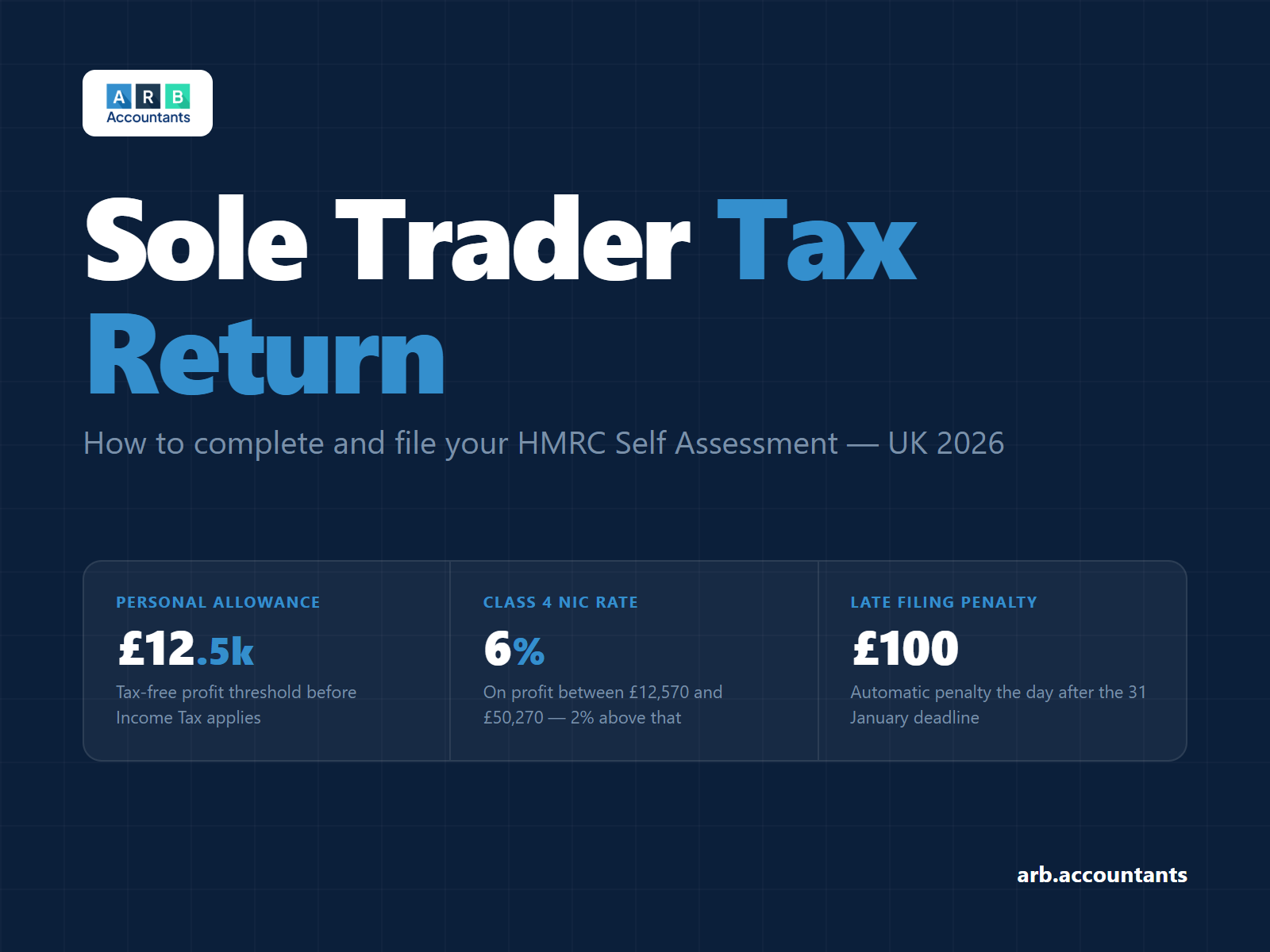
Log in to your HMRC online account, complete the SA100 main return and SA103 self-employment pages, enter your gross income and allowable expenses, and submit by 31 January following the end of the tax year. You pay Income Tax on profit above the £12,570 personal allowance and Class 4 National Insurance on profit between £12,570 and £50,270. Missing the 31 January deadline triggers an automatic £100 penalty even if you owe nothing.
Sole Trader Tax Return at a Glance
- File your Self Assessment return online by 31 January, or by 31 October for paper returns.
- Register with HMRC by 5 October in the year after you started trading if your income exceeded £1,000.
- Income Tax applies on profit above £12,570. Class 4 National Insurance applies at 6% on profit between £12,570 and £50,270, and 2% above that.
- Claiming every allowable expense reduces your profit and therefore your tax bill directly.
- If your bill exceeds £1,000, HMRC also collects advance payments on account for the following year. This often surprises first-year sole traders.
- Making Tax Digital for Income Tax replaces the annual return with quarterly digital updates for sole traders earning above £50,000 from April 2026.
What is a Sole Trader Tax Return?
A sole trader tax return is the annual Self Assessment return you file with HMRC to report your trading income and expenses, declare your profit, and pay the resulting Income Tax and National Insurance. Unlike an employed person, whose employer deducts tax before paying their salary, a sole trader receives income gross and is responsible for calculating and paying their own tax each year.
The return itself has two parts: the SA100 main return, which covers all your income sources, and the SA103 self-employment supplementary pages, where you record your business income and expenses in detail. HMRC uses the profit figure from SA103 to calculate your tax and National Insurance. You can file both online through your HMRC Government Gateway account.
The tax year in the UK runs 6 April to 5 April. Your return covers the whole of that period and must be filed, and any tax paid, by 31 January the following year. So your return for the year ending 5 April 2026 is due and payable by 31 January 2027.
Who Needs to File a Sole Trader Tax Return?
You must register for Self Assessment and file a return if your trading income in a tax year exceeded £1,000. That £1,000 threshold is the trading allowance. Below it, you have no tax liability and no filing obligation. Above it, you must register even if your profit after expenses means you owe little or no actual tax.
You are still required to file a return even in a year when you make a loss. Recording a loss is useful because you can carry it forward to reduce a future year’s profit, which is worth doing.
You may also need to file a return as a sole trader if any of the following apply, even if your trading income was below £1,000:
- You have other untaxed income, such as rental income, investment income, or significant savings interest
- You are a higher-rate taxpayer with income above the basic rate band
- You have income from a partnership
- You claimed Child Benefit while earning over £60,000 (the High Income Child Benefit Charge threshold from 6 April 2024)
- HMRC has sent you a notice to file
If you are unsure whether you need to file, HMRC’s online tool at GOV.UK allows you to check based on your circumstances.
How to Register for Self Assessment as a Sole Trader
Before you can file a sole trader tax return, you need to register for Self Assessment with HMRC. The deadline for registration is 5 October following the end of the tax year in which you started trading. The UK tax year runs 6 April to 5 April, so if you started trading at any point between 6 April 2025 and 5 April 2026, you must register by 5 October 2026.
Registering is straightforward and entirely online. You need a Government Gateway account. If you do not have one, you can create it during the registration process. HMRC posts your Unique Taxpayer Reference (UTR), a 10-digit number, to your registered address within about 10 working days. You cannot file a return without it.
Late registration can trigger a penalty, so do not wait. Even if you are not ready to file, registering on time protects you from that exposure.
If you were previously registered for Self Assessment but stopped trading and deregistered, you will need to re-register before filing again.
SA103S or SA103F: Which Self-Employment Pages Do You Need?
The self-employment supplementary pages come in two versions. SA103S is the short version for sole traders with annual turnover below £85,000. It is simpler and quicker to complete. SA103F is the full version for traders with turnover of £85,000 or above, or for those with more complex affairs, such as capital allowances claims on expensive equipment or adjustments for prior-year losses.
Most sole traders, particularly those in their early years or with modest turnover, will use SA103S. HMRC’s online system will guide you to the right version when you file.
On the self-employment pages you report:
- Turnover: your gross trading income before expenses
- Allowable expenses: the total of all qualifying business costs, either itemised or as a single figure depending on the form version
- Net profit or loss: turnover minus expenses
- Capital allowances: deductions for the cost of equipment, vehicles, and other capital assets
- Goods taken for personal use: the value of any goods from your stock you kept for yourself
HMRC uses the net profit figure to calculate Income Tax and Class 4 National Insurance in your tax computation.
What to Include as Income on Your Sole Trader Tax Return
Your trading income is everything you received from your self-employment during the tax year. This means all payments from customers or clients, whether paid in cash, by bank transfer, through online platforms, or by any other method. If you use the cash basis of accounting (the default for sole traders with turnover under £150,000), you report income when it is received rather than when it is invoiced.
If you switched from employment to self-employment during the year, you will also have employment income from your old job that goes on the main SA100 return. HMRC will already hold figures from your P60. The two income sources are assessed together against your personal allowance.
Other income that may need to go on your return includes rental income, dividends, significant savings interest, overseas income, and capital gains from the sale of assets. These are all entered on separate supplementary pages of the SA100.
Allowable Expenses: What Goes on Your Sole Trader Return
Allowable expenses are costs you incurred wholly and exclusively for your business. Deducting them from your turnover reduces your profit, which directly reduces your tax bill. This is why thorough record-keeping throughout the year makes such a significant difference to your final bill.
The main categories of allowable expense for sole traders are:
Cost of sales covers materials, stock, and direct labour costs you paid to others to deliver your services or products.
Office and admin costs include stationery, postage, software subscriptions, printer supplies, and other day-to-day office expenses used for work.
Travel and vehicle costs include business mileage, train or bus fares for client visits, parking for work journeys, and vehicle running costs for the business proportion of a mixed-use car. The simplest approach for mileage is HMRC’s approved mileage rate: 55p per mile for the first 10,000 business miles in a tax year from April 2026, and 25p per mile beyond that.
Premises costs cover rent for a business premises, business rates, water, gas and electricity for the premises, and security. For home-based sole traders, you can claim the business proportion of household bills or use HMRC’s flat rate for home working.
Advertising and marketing includes website costs, online advertising, printed materials, and any other costs of promoting your business.
Professional fees covers accountancy, bookkeeping, legal advice related to the business, and professional membership subscriptions relevant to your trade.
Insurance for the business, such as professional indemnity, public liability, or business contents.
Wages and subcontractors if you pay employees, freelancers, or subcontractors to work in your business.
You cannot claim costs that have a personal element, unless you can clearly separate the business proportion. Everyday meals, clothing you could wear outside work, and gym memberships are examples of costs HMRC consistently disallows.
How Income Tax and National Insurance Are Calculated
Once you have your profit, HMRC applies your personal allowance before calculating tax. The personal allowance for 2025/26 and 2026/27 is £12,570. Profit up to this amount is tax-free.
The Income Tax rates above the personal allowance are:
| Band | Profit | Rate |
|---|---|---|
| Basic rate | £12,571 to £50,270 | 20% |
| Higher rate | £50,271 to £125,140 | 40% |
| Additional rate | Above £125,140 | 45% |
For Class 4 National Insurance, the rates applied to your profit are:
| Band | Profit | Rate |
|---|---|---|
| Below lower profits limit | Up to £12,570 | 0% |
| Main rate | £12,571 to £50,270 | 6% |
| Upper rate | Above £50,270 | 2% |
Class 2 National Insurance was abolished in April 2024. Sole traders no longer pay it, though you may choose to make voluntary contributions to protect your State Pension entitlement if your profit is below the lower profits threshold.
Your total bill is Income Tax plus Class 4 NI, calculated by HMRC on the same profit figure. HMRC shows you a breakdown when you submit.
Example: A sole trader with £35,000 profit in 2025/26 would pay roughly:
- Income Tax: 20% on £35,000 minus £12,570 = 20% of £22,430 = £4,486
- Class 4 NI: 6% on £35,000 minus £12,570 = 6% of £22,430 = £1,346
- Total: approximately £5,832 before any additional allowances or deductions
Payments on Account: What They Are and When They Are Due
Payments on account are one of the most common sources of confusion for sole traders filing their first return with a substantial bill.
When your Self Assessment bill exceeds £1,000 and less than 80% of your tax has already been collected at source (for example through PAYE), HMRC does not just collect what you owe for the year you have just reported. It also collects advance payments toward next year’s estimated bill.
The advance is based on 50% of your current year’s tax bill. HMRC collects the first 50% on 31 January alongside your current year payment. The second 50% is due on 31 July.
For example: if your 2025/26 Self Assessment bill is £6,000, your payment due on 31 January 2027 would be £6,000 (for 2025/26) plus £3,000 (first payment on account for 2026/27), a total of £9,000. The second payment on account of £3,000 follows on 31 July 2027.
If your income in the following year is likely to be significantly lower, you can apply to reduce your payments on account. This carries a risk: if your income is actually higher, HMRC charges interest on the underpaid amount.
Deadlines for Sole Trader Tax Returns
| Deadline | What it covers |
|---|---|
| 5 October | Register with HMRC in the year after you started trading (one-off, first year only) |
| 31 October | Paper Self Assessment return for the previous tax year |
| 31 January | Online Self Assessment return and all tax owed for the previous tax year |
| 31 July | Second payment on account for the current tax year |
The 31 January and 31 October dates apply every year you are self-employed. The 5 October deadline applies only once, in the year you first start trading above the £1,000 threshold.
What Happens If You File or Pay Late
HMRC applies automatic penalties for late filing and late payment regardless of whether any tax is owed.
For late filing:
- Immediate £100 penalty on the day after the deadline
- An additional £10 per day after three months, for up to 90 days (maximum £900)
- A further 5% of the tax due or £300 at six months, whichever is higher
- A further 5% of the tax due or £300 at twelve months, whichever is higher
For late payment:
- 5% of unpaid tax at 30 days, six months, and twelve months
- Daily interest on unpaid tax from 1 February
If you have a genuine reasonable excuse, such as a serious illness or bereavement, you can appeal a penalty. HMRC considers these on a case-by-case basis.
Making Tax Digital for Sole Traders
Making Tax Digital for Income Tax (MTD for ITSA) will change how sole traders with higher incomes report to HMRC. Rather than a single annual return, affected sole traders will need to:
- Keep digital records using MTD-compatible software
- Submit quarterly updates to HMRC showing income and expenses
- Submit an end-of-period statement confirming the full-year figures
- File a final declaration (replacing the annual Self Assessment return)
MTD for ITSA becomes mandatory from 6 April 2026 for sole traders with gross trading or property income over £50,000 per year. It extends to those with income over £30,000 from April 2027. The thresholds are based on gross income, not profit, so a sole trader with high turnover but modest margins may be in scope sooner than expected.
Sole traders below those thresholds continue on the standard annual Self Assessment return for now.
If you are likely to be affected, the time to get the right software and habits in place is before the mandate arrives, not after.
Using an Accountant for Your Sole Trader Tax Return
There is no legal requirement to use an accountant to file your sole trader tax return. Many sole traders with simple affairs manage their own returns using HMRC’s online service.
Where using a sole trader accountant typically pays for itself is in the detail: correctly identifying every allowable expense, knowing when to use capital allowances versus expensing directly, timing purchases to maximise deductions, and structuring pension contributions to get the full tax relief. The difference between a return prepared by someone who knows every allowable deduction and one filed without that knowledge can easily exceed the accountancy fee.
If your circumstances are more involved, perhaps because you have multiple income sources, have changed structure during the year, are behind on previous years, or are approaching the threshold that triggers MTD for ITSA, an accountant is worth the engagement beyond cost alone.
A good sole trader accountant does not just file your return. They review your position proactively throughout the year and advise on decisions before you make them, not after.
Frequently Asked Questions
What is a sole trader tax return?
A sole trader tax return is the annual Self Assessment return filed with HMRC to report your trading income and expenses, calculate your profit, and pay Income Tax and Class 4 National Insurance on that profit. It consists of the SA100 main return and SA103 self-employment supplementary pages. You file it once a year covering the period 6 April to 5 April.
Do I need to do a tax return as a sole trader?
Yes, if your trading income exceeded £1,000 in the tax year. That threshold is the trading allowance. If you earned more than £1,000, you must register for Self Assessment with HMRC by 5 October following the end of the tax year and file a return even if your profit is low or you owe no tax.
How do I complete a sole trader tax return?
Log in to your HMRC online account, navigate to Self Assessment, and complete the SA100 main return plus the SA103 self-employment pages. Enter your gross trading income, deduct your allowable expenses to arrive at your profit, then confirm any other income. HMRC calculates your tax and National Insurance from the figures you enter. The return must be submitted and any tax paid by 31 January.
What is the HMRC sole trader tax return deadline?
The online filing deadline is 31 January following the end of the tax year (5 April). Payment of all tax owed is also due by 31 January. If you prefer to file a paper return, that deadline is 31 October. Missing either deadline triggers an automatic £100 penalty, even if you owe no tax.
What expenses can I include on a sole trader tax return?
You can include any cost that is wholly and exclusively for your business. Common examples include raw materials, tools and equipment, advertising, website costs, professional fees such as accountancy, insurance, business travel, and the business proportion of phone and home working costs. Personal expenses are not allowable.
Do sole traders pay National Insurance on their tax return?
Yes. Class 4 National Insurance is calculated through Self Assessment at 6% on profit between £12,570 and £50,270, and 2% on profit above that. Class 2 National Insurance was abolished in April 2024. HMRC calculates your Class 4 liability automatically from the profit you declare.
What is a payment on account for sole traders?
Payments on account are advance payments toward next year’s estimated tax bill. When your Self Assessment bill exceeds £1,000, HMRC collects an extra advance of half your current-year bill on 31 January, then another half on 31 July. Your first large tax payment as a sole trader can be up to one and a half times what you expected as a result.
What happens if I file my sole trader tax return late?
An automatic £100 penalty applies on the day after the deadline, even if you owe no tax. Additional daily penalties of £10 start after three months. Further percentage-based penalties apply at six months and twelve months, plus interest on any unpaid tax.
Need help with your sole trader tax return?
Our team at ARB Accountants prepares and files sole trader Self Assessment returns for clients across Essex and beyond. We make sure every allowable expense is claimed, your payments on account are planned for, and your return is filed correctly and on time.
Talk to a sole trader accountantFrequently Asked Questions
What is a sole trader tax return?
A sole trader tax return is the annual Self Assessment return filed with HMRC to report your trading income and expenses, calculate your profit, and pay Income Tax and Class 4 National Insurance on that profit. It consists of the SA100 main return and SA103 self-employment supplementary pages. You file it once a year covering the period 6 April to 5 April.
Do I need to do a tax return as a sole trader?
Yes, if your trading income exceeded £1,000 in the tax year. That threshold is the trading allowance. If you earned more than £1,000, you must register for Self Assessment with HMRC by 5 October following the end of the tax year and file a return even if your profit is low or you owe no tax.
How do I complete a sole trader tax return?
Log in to your HMRC online account, navigate to Self Assessment, and complete the SA100 main return plus the SA103 self-employment pages. You enter your gross trading income, deduct your allowable expenses to arrive at your profit, then confirm any other income. HMRC calculates your tax and National Insurance from the figures you enter. The return must be submitted and any tax paid by 31 January.
What is the HMRC sole trader tax return deadline?
The online filing deadline is 31 January following the end of the tax year (5 April). Payment of all tax owed is also due by 31 January. If you prefer to file a paper return, that deadline is 31 October. Missing either deadline triggers an automatic £100 penalty, even if you owe no tax.
What expenses can I include on a sole trader tax return?
You can include any cost that is wholly and exclusively for your business. Common examples include raw materials, tools and equipment, advertising, website costs, professional fees such as accountancy, insurance, business travel, and the business proportion of phone and home working costs. Personal expenses are not allowable. Use HMRC's simplified expenses for mileage, home working, and living in business premises if you prefer a flat rate over calculating actual costs.
Do sole traders pay National Insurance on their tax return?
Yes. Class 4 National Insurance is calculated through Self Assessment. You pay 6% on profit between £12,570 and £50,270, and 2% on profit above that. Class 2 National Insurance was abolished in April 2024, so sole traders no longer pay it. HMRC calculates your Class 4 liability automatically from the profit you declare and shows it alongside your Income Tax on the payment summary.
What is a sole trader tax return accountant?
A sole trader tax return accountant is an accountant who prepares and files your Self Assessment return on your behalf. They review your income and expenses, identify every allowable deduction, calculate your tax position, and submit your return to HMRC. Using an accountant is not a legal requirement, but many sole traders find the saving from correctly claimed expenses more than covers the accountancy fee.
What is a payment on account for sole traders?
Payments on account are advance payments toward next year's estimated tax bill. When your Self Assessment bill exceeds £1,000, HMRC collects an extra advance of half your current-year bill at the same time (due 31 January), then another half on 31 July. This catches many first-year sole traders off guard: your first large tax payment can be up to one and a half times what you expected. If you expect lower income next year, you can apply to reduce your payments on account.
What is Making Tax Digital for sole traders?
Making Tax Digital for Income Tax (MTD for ITSA) is an HMRC programme that requires sole traders to keep digital records and submit quarterly updates to HMRC rather than a single annual return. It becomes mandatory from 6 April 2026 for sole traders with gross trading or property income over £50,000, and from April 2027 for those with income over £30,000. The annual tax return is replaced by four quarterly updates plus an end-of-period statement.
What happens if I file my sole trader tax return late?
An automatic £100 penalty applies immediately if you miss the 31 January online deadline, even if you owe no tax. If your return is more than three months late, HMRC charges an additional £10 per day for up to 90 days (up to £900). Returns six months late attract a further penalty of 5% of the tax due or £300, whichever is higher. Interest also accrues on any unpaid tax from 1 February onwards.
Can I file a sole trader tax return myself without an accountant?
Yes. HMRC's online Self Assessment service is free and designed for individuals to file themselves. Many sole traders with straightforward income and expenses manage their own returns without difficulty. Where it typically becomes worth using an accountant is when you have multiple income sources, significant capital expenditure, irregular income making payments on account hard to judge, or if you are behind on previous years.
About The Author

Saurabh Bedi | Director
Saurabh is a tax advisor at ARB Accountants, specialising in Self-Assessment and small business tax. He's dedicated to making tax simple and stress-free, helping clients stay compliant and confident with HMRC.
Qualifications & Experience
- Fellow of Chartered Certified Accountants (ACCA)
- MSc Chartered Certified Accountancy 2008
- Working in accountancy since 2008