UK Tax Brackets 2026/27: Income Tax Bands, Rates and Allowances
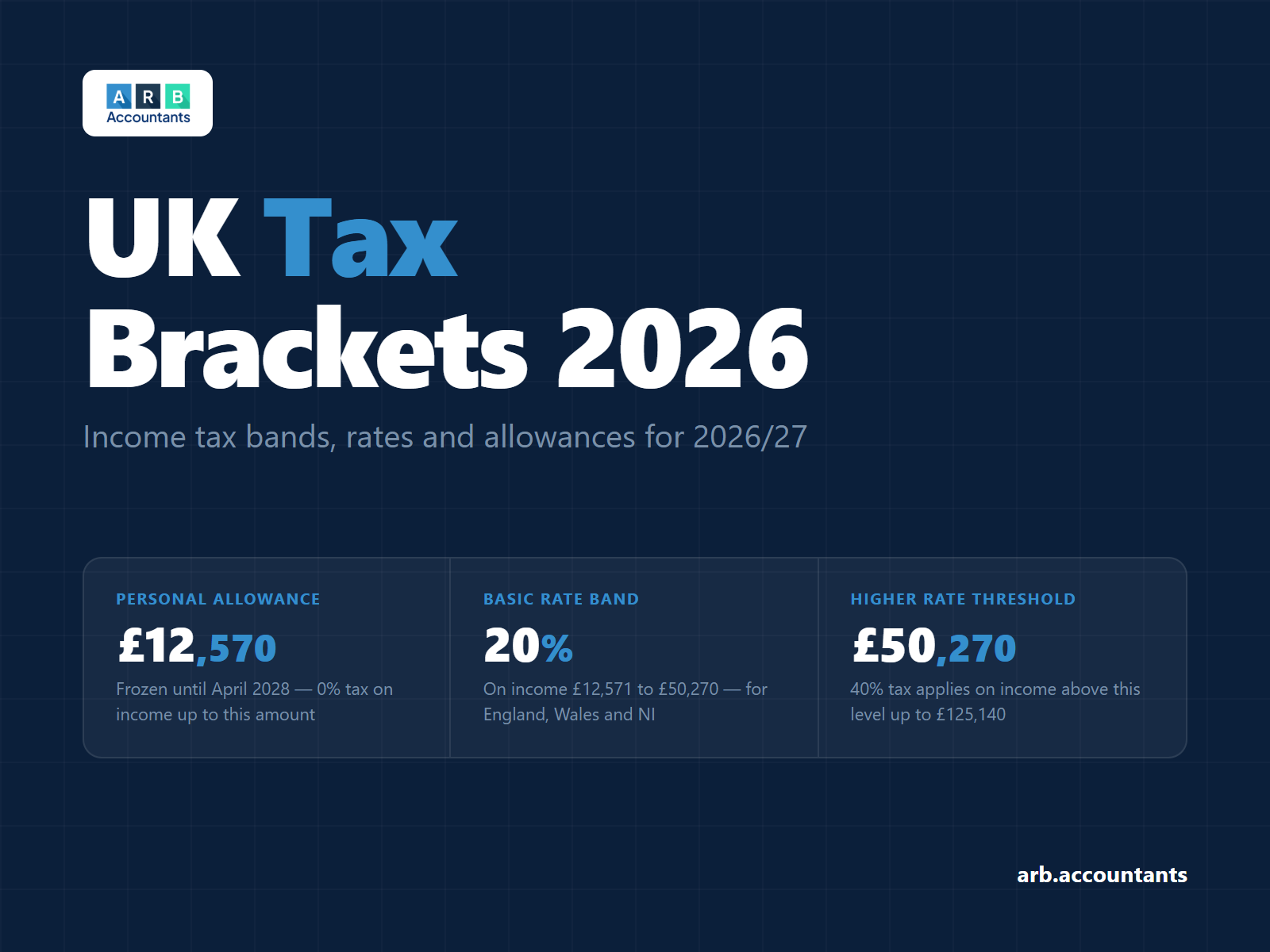
UK income tax brackets 2026/27 at a glance
The table below shows the income tax bands for England, Wales and Northern Ireland for the 2026/27 tax year (6 April 2026 to 5 April 2027), as published by HMRC.
| Band | Total income | Tax rate |
|---|---|---|
| Personal Allowance | Up to £12,570 | 0% |
| Basic rate | £12,571 to £50,270 | 20% |
| Higher rate | £50,271 to £125,140 | 40% |
| Additional rate | Above £125,140 | 45% |
Source: GOV.UK — Income Tax rates and Personal Allowances
Scottish taxpayers are subject to different bands set by the Scottish Parliament. These are covered in a separate section below.
The personal allowance for 2026/27
The personal allowance is £12,570 for 2026/27.
This allowance has been frozen since April 2021 and is legislated to remain at £12,570 until April 2028. Because wages typically rise with inflation while the threshold stays fixed, more taxpayers are pulled into the basic rate band each year, and more basic rate taxpayers are crossing into the higher rate band. HMRC describes this as fiscal drag.
The personal allowance taper
If your adjusted net income exceeds £100,000, the personal allowance is reduced by £1 for every £2 over that threshold:
- At £110,000 income: allowance reduced to £7,570 (£100,000 + £10,000 excess; allowance reduced by £5,000)
- At £125,140 income: allowance is nil
The effective marginal rate of tax on income between £100,000 and £125,140 is 60%, because each additional pound both generates a 40% higher rate tax charge and withdraws 50p of personal allowance (which would have shielded 50p from tax at 40%).
Marriage Allowance
If one partner in a marriage or civil partnership earns below the personal allowance, they can transfer up to £1,260 of unused allowance to their partner, reducing the recipient’s tax bill by up to £252. The lower earner must be a non-taxpayer; the recipient must be a basic rate taxpayer.
What changed in the tax brackets for 2026/27?
The income tax bands themselves are unchanged from 2025/26. All three main thresholds (£12,570 / £50,270 / £125,140) are the same.
The significant changes for 2026/27 elsewhere in the tax system are:
Dividend tax rates increased. The basic rate dividend tax rate rose from 8.75% to 10.75%. The higher rate rose from 33.75% to 35.75%. The additional rate remains 39.35%. The dividend allowance remains at £500. This affects owner-managed company directors and investors who receive dividend income.
Business Asset Disposal Relief rate increased. The CGT rate on qualifying business disposals under BADR rose from 14% (in 2025/26) to 18% (2026/27), applicable on gains up to the £1 million lifetime limit.
VCT income tax relief reduced. Relief on Venture Capital Trust investments fell from 30% to 20% for 2026/27 subscriptions.
National Living Wage increased. The NLW rose from £12.21 per hour to £12.71 per hour (for workers aged 21 and over) from 1 April 2026. The rate for 18 to 20 year olds increased to £10.85, and the rate for under 18s and apprentices to £8.00 per hour.
Scottish income tax brackets 2026/27
Scotland has had its own income tax rates and thresholds since 2017/18. The Scottish Parliament sets the rates on non-savings and non-dividend income for Scottish taxpayers, while savings and dividend income remains subject to UK-wide rates.
The Scottish Budget for 2026/27 was presented in January 2026. For confirmed 2026/27 Scottish bands, check the Scottish Government website directly. The 2025/26 Scottish income tax bands (as confirmed on GOV.UK) were:
| Band | Taxable income above PA | Rate |
|---|---|---|
| Starter rate | Up to £2,827 | 19% |
| Basic rate | £2,828 to £14,921 | 20% |
| Intermediate rate | £14,922 to £31,092 | 21% |
| Higher rate | £31,093 to £62,430 | 42% |
| Advanced rate | £62,431 to £125,140 | 45% |
| Top rate | Above £125,140 | 48% |
Scottish taxpayers with income above around £43,000 pay more tax than equivalent English taxpayers, because the intermediate rate (21%) and higher rate (42%) thresholds are both lower than in the rest of the UK. The gap is most pronounced for taxpayers earning between £43,000 and £50,270, where an English taxpayer pays 20% but a Scottish taxpayer pays 42%.
National Insurance rates 2026/27
National Insurance is separate from income tax but taken from the same payslip. The key Class 1 thresholds and rates are:
Employees (Class 1 primary):
| Earnings | Rate |
|---|---|
| Below £12,570 per year (£242 per week) | 0% |
| £12,570 to £50,270 per year | 8% |
| Above £50,270 per year | 2% |
Employers (Class 1 secondary):
| Earnings | Rate |
|---|---|
| Below £5,000 per year (£96 per week) | 0% |
| Above £5,000 per year | 15% |
The employer secondary threshold was reduced from £9,100 to £5,000 from April 2025, and the rate increased from 13.8% to 15%. This represents a significant increase in employer cost for businesses with salaried employees.
The Employment Allowance offsets employer NICs up to £10,500 per year for eligible businesses.
Self-employed (Class 4):
| Profits | Rate |
|---|---|
| Below £12,570 | 0% |
| £12,570 to £50,270 | 6% |
| Above £50,270 | 2% |
Class 2 NI for the self-employed is now voluntary for those with profits below the small profits threshold of £7,105 per year. The flat rate is £3.65 per week.
Dividend tax rates 2026/27
Dividend income is taxed at different rates from employment income. The rates for 2026/27 are:
| Rate | Rate applied | Applies when |
|---|---|---|
| Dividend allowance | 0% | First £500 of dividend income |
| Basic rate | 10.75% | Dividend income falling in the basic rate band |
| Higher rate | 35.75% | Dividend income falling in the higher rate band |
| Additional rate | 39.35% | Dividend income above £125,140 |
The rates increased for 2026/27. In 2025/26 the basic and higher dividend rates were 8.75% and 33.75% respectively.
Dividend income is stacked on top of other income, so a director-shareholder who takes a salary to the personal allowance and dividends above that will pay 10.75% on dividends within the basic rate band and 35.75% on any dividends pushing them into the higher rate band.
Capital Gains Tax rates 2026/27
Capital gains are taxed separately from income, using the annual exempt amount and a separate rate schedule.
Annual exempt amount: £3,000 for individuals and personal representatives of estates. Trusts receive £1,500.
CGT rates for 2026/27:
| Gain type | Basic rate taxpayer | Higher/additional rate taxpayer |
|---|---|---|
| Residential property | 18% | 24% |
| Other assets | 18% | 24% |
| Carried interest | N/A from 2026/27 | N/A from 2026/27 |
| Trusts and estates | — | 24% |
Gains that fall within an individual’s unused basic rate band are taxed at 18%. Gains that exceed the basic rate band — or for higher or additional rate taxpayers — are taxed at 24%.
Business Asset Disposal Relief (BADR)
BADR applies a reduced rate to qualifying business disposals such as selling a trading business, shares in a personal company, or assets used in a business. For 2026/27 the BADR rate is 18%, increased from 14% in 2025/26. The lifetime limit remains £1 million.
Investors’ Relief
Investors’ Relief applies a similar reduced rate to gains on qualifying unlisted shares held for at least three years. The lifetime limit is £1 million. Rates follow BADR.
Savings income: starting rate and Personal Savings Allowance
Savings income (bank and building society interest, NS&I interest) has two preferential tax treatments:
Savings starting rate: 0% on up to £5,000 of savings income. This is only available when non-savings income (employment, pensions, property) does not exceed the personal allowance plus £5,000. For most people in work, the starting rate is not relevant because their salary already uses up this band.
Personal Savings Allowance (PSA): This is the amount of savings interest that can be received tax-free each year:
- Basic rate taxpayers: £1,000
- Higher rate taxpayers: £500
- Additional rate taxpayers: £0 (no allowance)
Interest above the PSA is added to income and taxed at the taxpayer’s marginal rate. Most banks and NS&I no longer deduct tax at source, so interest above the PSA must be declared on Self Assessment.
ISA and pension allowances for 2026/27
These tax-efficient wrappers sit outside the income tax bands entirely.
ISA allowance: £20,000 total per year. This can be split between:
- Cash ISA
- Stocks and shares ISA
- Innovative Finance ISA
- Lifetime ISA (capped at £4,000 of the £20,000)
Income and gains within an ISA are completely free from income tax and CGT.
Junior ISA and Child Trust Fund: £9,000 per year.
Pension annual allowance: £60,000, or 100% of earnings if lower. Contributions attract income tax relief at the taxpayer’s marginal rate, making pension saving particularly valuable for higher and additional rate taxpayers. Unused allowance from the previous three tax years can be carried forward. For taxpayers with adjusted income above £260,000, the allowance tapers by £1 for every £2 above that threshold, down to a minimum of £10,000 (subject to a £200,000 threshold income test).
Inheritance Tax
While not an income tax, IHT interacts with the estate planning decisions of higher earners.
For 2026/27:
- Nil-rate band: £325,000
- Residence nil-rate band: £175,000 (applying when a residence is passed to direct descendants)
- Rate: 40% on the value of the estate above the available nil-rate bands
- If at least 10% of the estate is left to charity, the rate is reduced to 36%
Spouses and civil partners can inherit unused nil-rate band from their partner, giving a potential combined threshold of £1 million for a married couple passing a home to children.
Other key rates and thresholds
Corporation Tax (for owner-managed companies):
- 19% on annual profits up to £50,000
- 25% on annual profits above £250,000
- Marginal relief applies between £50,000 and £250,000 (effective marginal rate 26.5%)
- These thresholds are divided by the number of associated companies
VAT:
- Standard rate: 20%
- Reduced rate (domestic fuel, some energy-saving materials): 5%
- Registration threshold: £90,000 taxable turnover
- Deregistration threshold: £88,000
Child Benefit and the High Income Child Benefit Charge: The charge applies where either parent has adjusted net income above £60,000. It is 1% of the Child Benefit received for every £200 of income above £60,000. At £80,000 or above, the full benefit is clawed back.
Frequently asked questions
What are the UK income tax brackets for 2026?
For England, Wales and Northern Ireland in 2026/27: personal allowance 0% up to £12,570; basic rate 20% on income £12,571 to £50,270; higher rate 40% on income £50,271 to £125,140; additional rate 45% on income above £125,140. Scotland has its own six-band structure set by the Scottish Parliament.
What is the UK basic rate tax band for 2026/27?
The basic rate band covers income from £12,571 to £50,270, a taxable range of £37,700. Income within this band is taxed at 20%. The band is unchanged from 2025/26.
At what income does the 40% tax rate kick in for 2026?
The 40% higher rate applies to income above £50,270 in 2026/27 (for England, Wales and Northern Ireland taxpayers). Equivalently, it applies once taxable income — income after the personal allowance — exceeds £37,700.
What is the 45% income tax threshold for 2026/27?
The additional rate of 45% applies to income above £125,140 in 2026/27. This threshold has been in place since April 2023 when it was reduced from £150,000. It remains frozen for 2026/27.
Have the UK income tax brackets changed from 2025/26 to 2026/27?
The three income tax band boundaries (£12,570, £50,270 and £125,140) are unchanged. The key tax changes for 2026/27 include higher dividend tax rates (basic rate up to 10.75%, higher rate up to 35.75%), the Business Asset Disposal Relief CGT rate rising to 18%, and the VCT income tax relief reducing from 30% to 20%.
What is the personal allowance for 2026/27?
£12,570, unchanged since April 2021. It is set to remain at this level until at least April 2028 under current legislation. For taxpayers with income above £100,000, it reduces progressively to nil at £125,140.
How are UK income tax brackets calculated?
Income tax brackets are applied progressively. The first £12,570 is tax-free. The next £37,700 (from £12,571 to £50,270) is taxed at 20%. The next £74,870 (from £50,271 to £125,140) is taxed at 40%. Income above £125,140 is taxed at 45%. Each band applies only to the income within that range — not to all income.
What are the Scottish income tax rates for 2026/27?
Scotland sets its own income tax bands. For 2025/26 these were: starter 19%, basic 20%, intermediate 21%, higher 42%, advanced 45% and top 48%. The 2026/27 Scottish bands were set in the Scottish Budget in January 2026. Check the Scottish Government website for the confirmed 2026/27 figures.
Get Personalised Tax Advice for 2026/27
Tax brackets tell you the rate — but your actual liability depends on your income mix, pension contributions, dividends, rental income and available reliefs. ARB Accountants provides personal tax planning for employees, directors, landlords and the self-employed.
ACCA-chartered. Fixed fees. Free 60-minute initial consultation.
Book a free consultation or call 01702 345 207.
Frequently Asked Questions
What are the UK tax brackets for 2026/27?
For England, Wales and Northern Ireland in 2026/27: personal allowance (0%) up to £12,570; basic rate (20%) on income £12,571 to £50,270; higher rate (40%) on income £50,271 to £125,140; additional rate (45%) on income above £125,140. Scottish taxpayers have different bands — see the Scottish income tax section below.
What is the income tax personal allowance for 2026/27?
The personal allowance for 2026/27 is £12,570. It has been frozen at this level since April 2021 and is set to remain frozen until April 2028. For taxpayers with adjusted net income above £100,000, the allowance tapers by £1 for every £2 of excess income, reaching zero at £125,140.
At what income does the higher rate of tax apply in 2026?
The higher rate of 40% applies to income above £50,270 in 2026/27. More precisely, it applies once your taxable income (income minus the personal allowance) exceeds £37,700. The higher rate continues up to total income of £125,140, above which the additional rate of 45% applies.
Have UK tax brackets changed for 2026/27?
The income tax bands themselves are unchanged from 2025/26, but the personal allowance freeze means that workers receiving pay rises continue to be pulled into higher bands in real terms. The main changes for 2026/27 are: dividend tax rates increased (basic rate from 8.75% to 10.75%; higher rate from 33.75% to 35.75%); Business Asset Disposal Relief CGT rate increased from 14% to 18%; and the VCT income tax relief rate reduced from 30% to 20%. National Living Wage rose to £12.71 per hour from April 2026.
What are the Scottish income tax brackets for 2026/27?
Scotland sets its own income tax rates and bands through Holyrood. For 2025/26, Scottish taxpayers paid: starter rate 19% (up to £2,827 of taxable income); basic rate 20% (£2,828 to £14,921); intermediate rate 21% (£14,922 to £31,092); higher rate 42% (£31,093 to £62,430); advanced rate 45% (£62,431 to £125,140); top rate 48% (above £125,140). Check the Scottish Government website for the confirmed 2026/27 bands.
What is the dividend tax rate for 2026/27?
For 2026/27 the first £500 of dividend income is covered by the dividend allowance and taxed at 0%. Above the allowance, the rates are: 10.75% (basic rate taxpayers); 35.75% (higher rate taxpayers); 39.35% (additional rate taxpayers). These rates increased from 2025/26, when they were 8.75%, 33.75% and 39.35% respectively.
What are the Capital Gains Tax rates for 2026/27?
For 2026/27, capital gains on most assets are taxed at 18% (for gains falling in the basic rate band) or 24% (for gains falling in the higher or additional rate band). The annual exempt amount is £3,000. Business Asset Disposal Relief applies a 18% rate (increased from 14% in 2025/26) on qualifying business gains up to a £1 million lifetime limit.
What are the National Insurance rates for 2026/27?
Employee Class 1 NI: 8% on earnings between the primary threshold (£12,570 per year) and the upper earnings limit (£50,270 per year), and 2% on earnings above £50,270. Employer Class 1 NI: 15% on earnings above the secondary threshold (£5,000 per year). Self-employed Class 4 NI: 6% on profits between £12,570 and £50,270, and 2% above £50,270.
What is the savings starting rate for 2026/27?
The savings starting rate is 0% on up to £5,000 of savings income. It is only available if your non-savings income (earnings, pension, rental income) does not exceed £12,570 plus £5,000. For most working-age taxpayers with any employment or self-employment income, the starting rate is not available. Above the starting rate band, the personal savings allowance applies: £1,000 for basic rate taxpayers and £500 for higher rate taxpayers. Additional rate taxpayers receive no personal savings allowance.
What is the ISA allowance for 2026/27?
The total ISA subscription limit for 2026/27 is £20,000. This can be spread across a cash ISA, a stocks and shares ISA, an innovative finance ISA, or a combination. The Lifetime ISA annual limit is £4,000 (counting within the £20,000 total). The Junior ISA and Child Trust Fund annual limit is £9,000.
About The Author

Saurabh Bedi | Director
Saurabh is a tax advisor at ARB Accountants, specialising in Self-Assessment and small business tax. He's dedicated to making tax simple and stress-free, helping clients stay compliant and confident with HMRC.
Qualifications & Experience
- Fellow of Chartered Certified Accountants (ACCA)
- MSc Chartered Certified Accountancy 2008
- Working in accountancy since 2008