VAT on Food: Common Mistakes That Cost Businesses Money
The basic rule — and why it breaks down so quickly
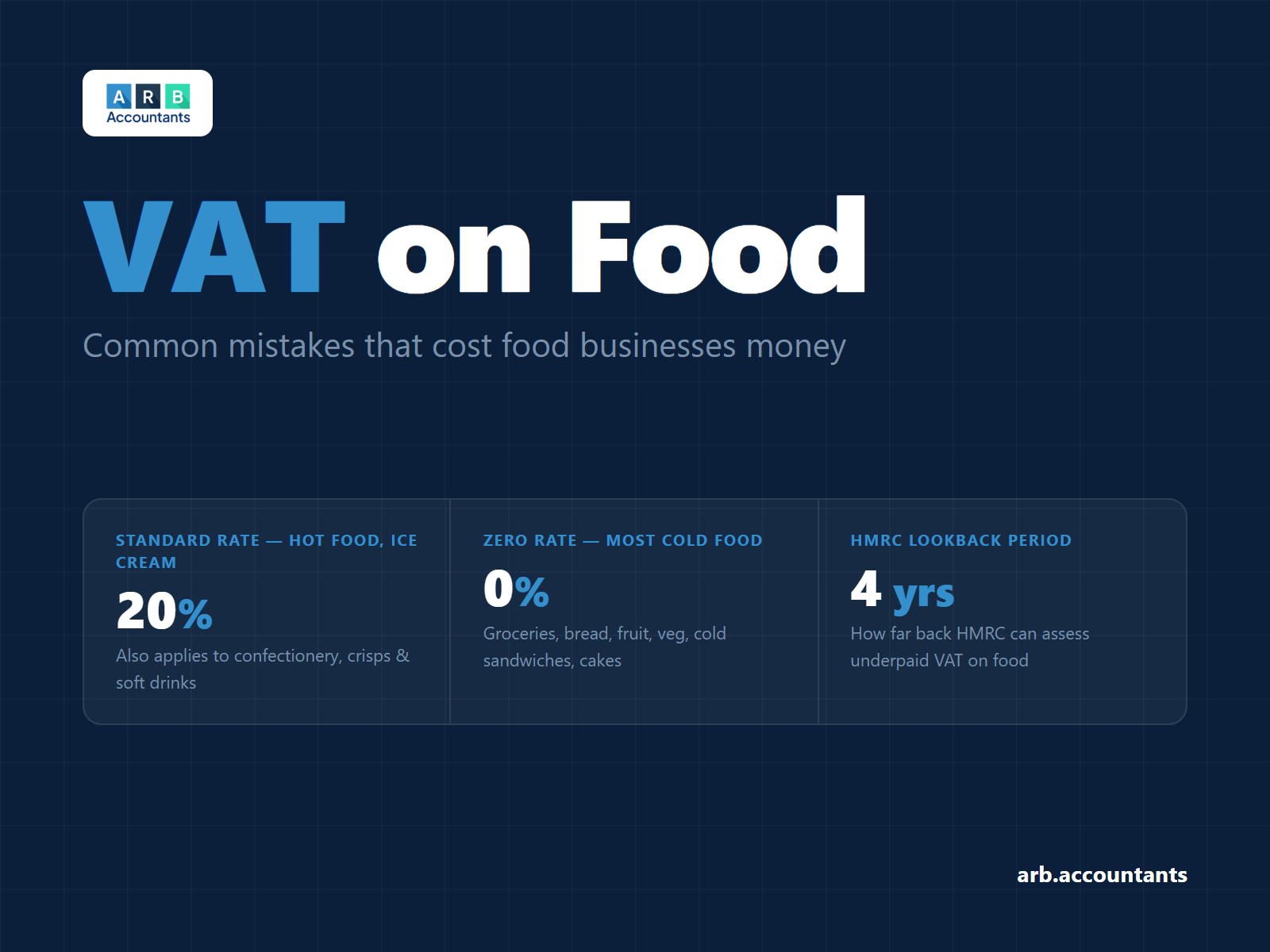
Under Schedule 8 Group 1 of the VAT Act 1994, food for human consumption is zero-rated. This is the starting point. The problem is that the same schedule lists ten categories of exceptions where the standard 20% rate applies instead. Food VAT law has been the subject of more HMRC tribunal cases than almost any other area of VAT, including the now-famous Jaffa Cake ruling and the Pringles case.
The exceptions exist because Parliament chose to zero-rate basic groceries while applying VAT to luxury and discretionary food items. The boundary between those categories is where the disputes arise, and where businesses make expensive mistakes.
What is standard-rated at 20%? The key categories
Hot food
Food that is hot at the point of sale is standard-rated if it was heated for the purpose of being consumed hot. The test has three limbs: the food was heated to enable it to be consumed hot; or it was kept hot after being heated; or it was sold while still hot above ambient temperature.
This catches hot pasties from a bakery, rotisserie chickens, hot soup, chips, hot sandwiches, toasted paninis and any other food a business heats with the intention of serving it warm. It does not catch food that is cold at the point of sale simply because it was once cooked — a cold cooked chicken from a supermarket chiller is zero-rated.
The most common mistake here is food businesses that heat food and sell it but believe they are selling “food” rather than “hot food”. The distinction is entirely about temperature at the point of sale and the reason for heating.
Ice cream VAT — always standard-rated
Ice cream is standard-rated at 20% under the VAT Act 1994. This applies to:
- Traditional dairy ice cream in any format (tubs, cones, bars)
- Ice lollies
- Sorbets and water ices
- Frozen yogurt
- Soft-serve ice cream
- Ice cream cakes
The rule applies regardless of how the ice cream is sold — a supermarket selling tubs of ice cream charges 20% VAT, as does an ice cream van, a restaurant serving dessert, or a café selling cones. Many small food retailers and ice cream manufacturers assume that because ice cream is frozen it must follow the same rules as other frozen food. It does not. Ice cream is a specific named exception and has been standard-rated since UK VAT was introduced in 1973.
What is not affected: Products that happen to be frozen but are not ice cream — frozen peas, frozen bread dough, frozen ready meals — follow their normal VAT treatment based on what they are, not because they are frozen.
Chocolate VAT and confectionery
Chocolate and confectionery are standard-rated at 20%. HMRC defines confectionery as products made primarily from sugar, chocolate or similar sweetening substances, including:
- Chocolate bars and truffles
- Sweets, mints and toffees
- Chocolate-coated nuts, raisins and seeds
- Candied and crystallised fruit
- Marshmallows
The crucial cake versus biscuit distinction. Plain biscuits are zero-rated. Biscuits wholly or partly coated in chocolate are standard-rated confectionery. This distinction led to the famous Jaffa Cake tribunal in 1991, when HMRC argued that Jaffa Cakes were chocolate-covered biscuits (and therefore standard-rated). United Biscuits won, convincing the tribunal that Jaffa Cakes are cakes. The decisive factors: they have a soft sponge base that goes hard when stale (like a cake, not a biscuit), they were originally sold in cake tins, and they more closely resemble a small cake than a biscuit in character.
Chocolate cake and cakes with chocolate. Cakes — even those with chocolate coating, chocolate sponge or chocolate decoration — are zero-rated. A chocolate birthday cake is zero-rated. A chocolate brownie is zero-rated. Chocolate fudge cake is zero-rated. The product must be classified overall as a cake, not as confectionery, for the zero-rate to apply.
Cooking chocolate and cocoa. Dark cooking chocolate, cocoa powder and similar baking ingredients used in home or commercial cooking are zero-rated when sold as ingredients. When chocolate is incorporated into a finished confectionery product sold direct to consumers, the final product is standard-rated.
Crisps and savoury snacks
Crisps, potato snacks, popcorn and similar products made from potato, cereals or plant protein that have been roasted, fried or puffed are standard-rated at 20%. This was the subject of the Pringles litigation (Procter & Gamble v HMRC, Court of Appeal 2009), where HMRC successfully argued that Pringles were crisps despite containing only about 42% potato. The court applied a purposive interpretation of the legislation.
Nuts (plain, uncoated) are zero-rated. Nuts that are roasted, salted or coated become standard-rated snacks. Popcorn is standard-rated. Pretzels are standard-rated. Seeds sold as health food for consumption are typically zero-rated.
Carbonated drinks and most soft drinks
Fruit juices, squashes, carbonated soft drinks, energy drinks and sports drinks are standard-rated. Milk (including flavoured milk), tea, coffee and cocoa as bought in ingredient form are zero-rated. But a ready-made iced coffee drink in a bottle, a flavoured water with added sugars, or a carbonated energy drink is standard-rated.
VAT on cooking — how it works for food businesses
The phrase “VAT on cooking” is often searched by food business owners trying to understand whether the act of preparing food affects its VAT status. The answer is: sometimes, in the most consequential way possible.
Buying cooking ingredients: Flour, sugar, butter, eggs, oil, herbs, spices, raw meat and raw vegetables are all zero-rated when bought as food ingredients. A baker buying bags of flour, a restaurant buying raw chicken, or a home cook buying olive oil pays no VAT on these purchases. This is true whether the buyer is a consumer or a business.
Selling prepared or cooked food: The VAT treatment of the output depends on what you sell and how you sell it. If you buy zero-rated flour and butter, bake a cake and sell it cold as a cake, the output is zero-rated. If you buy zero-rated potatoes and oil, fry chips and sell them hot, the output is standard-rated at 20% — not because of the ingredients, but because you are selling hot food in the course of catering or food service.
This is where food businesses — particularly new catering, bakery and street food operations — make the most costly errors. They register for VAT, reclaim VAT on their zero-rated ingredient purchases, and then fail to charge 20% on their hot food sales. HMRC can assess the underpaid VAT for up to four years with interest.
Catering and retail — the split that trips up food businesses
The distinction between retail food sales (mostly zero-rated) and catering sales (standard-rated) is where the most money is at stake for businesses that do both.
A supermarket selling a cold pre-made sandwich is making a zero-rated retail food supply. The same supermarket has a hot food counter selling hot chicken and hot wedges — those sales are standard-rated. If the business fails to split these correctly in its VAT accounting, it will either over-report or under-report VAT on every return.
What counts as catering:
- Restaurant and café meals (food consumed on the premises)
- Hot takeaway food
- Event catering and hospitality services
- Vending machine sales of hot food and drinks
- Canteen sales at standard rate
What remains zero-rated retail:
- Cold food sold for home consumption
- Pre-packaged grocery items
- Cold sandwiches, salads and wraps sold cold
- Bakery items sold cold (bread, cakes, cold pastries)
Many food businesses — particularly farm shops, delis, bakeries and market stalls — sell both types. They need a clear system to identify and record which sales are standard-rated and which are zero-rated, or face a combined VAT error on every return they file.
The Jaffa Cake principle — how HMRC tests grey-area products
The Jaffa Cake case established the approach HMRC and tribunals use to classify disputed food products. For any product sitting at the boundary between zero-rated and standard-rated categories, the tribunal looks at:
- Physical characteristics — what does the product look and feel like?
- Ingredients and composition — what is it made from, in what proportions?
- How it is marketed and sold — is it positioned as a cake, a biscuit, a snack?
- How it behaves when stale — cakes go hard, biscuits go soft
- Consumer perception — what would the average person consider it to be?
Businesses that create new food products — particularly in the snack, confectionery and bakery space — should work through this analysis before setting their VAT rate. A mislabelled product that HMRC reclassifies after three years of trading creates a significant retrospective liability.
Common mistakes that cost businesses money
Treating all food as zero-rated. The default assumption that “food is VAT-free” leads to systematic under-reporting on hot food, ice cream, confectionery and drinks. Every sale at the wrong rate compounds the error.
Not splitting hot and cold sales. Bakeries selling both hot sausage rolls and cold cakes, delis with both cold counter and hot food, cafés with both cold sandwiches and hot paninis — all need a clear point-of-sale split or a reliable daily apportionment method.
Misclassifying mixed supplies. A Christmas hamper containing both zero-rated food (biscuits, jam, tea) and standard-rated items (chocolates, wine, crisps) is a mixed supply. The standard-rated portion must be identified and 20% VAT applied to that part only. Applying a single rate to the whole hamper — either 0% or 20% — is wrong.
Applying the wrong rate to ice cream products. Ice cream retailers and café owners who class their sales as cold food and apply 0% are making a fundamental error. All ice cream is standard-rated.
Changing recipes or preparation methods without reviewing VAT. A bakery that starts selling hot filled rolls from a warming cabinet, or a deli that adds a hot food station, has changed the VAT status of those sales. Failing to update the VAT accounting from that point creates a growing liability.
Not correcting historical errors. Businesses that identify a past error often do nothing, hoping HMRC will not notice. A proactive correction through the next VAT return (for errors up to £10,000 net) or a formal error correction notification (for larger errors) is always better than waiting for HMRC to raise an assessment, which will include interest and may include penalties.
What to do if you have been charging the wrong rate
If you discover you have been applying the wrong VAT rate to food products, the approach depends on the direction and size of the error.
Overcharged VAT (charged 20% on zero-rated food): You have collected more VAT from customers than HMRC is entitled to. You should correct this, repay affected customers where possible, and adjust your VAT account. HMRC does not generally penalise overclaims, but you must correct them.
Undercharged VAT (charged 0% on standard-rated food): You owe HMRC the VAT that should have been charged. You can correct errors up to £10,000 (net VAT) on your next VAT return by adjusting box 1. For larger errors, submit form VAT652 to HMRC. Either way, you will owe the net VAT plus interest calculated from the date it was due.
What affects the penalty level: Errors that arose from a genuine misunderstanding of a complex area — food VAT qualifies — are typically treated as careless rather than deliberate. Careless errors attract lower penalties (0–30% of the unpaid tax) than deliberate under-reporting (20–70% or higher). Disclosing before HMRC contacts you, and cooperating fully, are the two factors that reduce penalties most reliably.
Frequently Asked Questions
Is food VAT-rated or zero-rated in the UK?
Most food for human consumption is zero-rated (0% VAT). The standard-rated exceptions at 20% are: hot food, ice cream and frozen confectionery, confectionery (chocolates and sweets), crisps and savoury snacks, carbonated drinks and most soft drinks, and food supplied as catering.
Is VAT charged on ice cream?
Yes. Ice cream, ice lollies, sorbets and frozen yogurt are all standard-rated at 20% regardless of where or how they are sold.
Is there VAT on chocolate?
Yes. Chocolate and confectionery are standard-rated at 20%. Chocolate-covered biscuits are standard-rated. Cakes with chocolate — including Jaffa Cakes and chocolate cake — are zero-rated because they are classified as cakes, not confectionery.
What is the VAT on hot food?
Hot food sold at above ambient temperature for consumption hot is standard-rated at 20%. Cold food sold cold — even if it was once cooked — is zero-rated. The test is temperature and intention at the point of sale.
Is cooking VAT zero-rated?
Cooking ingredients (flour, sugar, butter, oil, spices) are zero-rated. But if you cook food and sell it hot, the output is standard-rated regardless of the zero-rated inputs.
Are restaurant meals subject to VAT?
Yes. All food supplied in the course of catering — restaurant meals, café food, hot takeaway, event catering — is standard-rated at 20%.
Are cakes zero-rated for VAT?
Yes. Cakes — including chocolate cake, sponge, birthday cake and Jaffa Cakes — are zero-rated. Biscuits wholly or partly coated in chocolate are standard-rated confectionery.
Are cold sandwiches zero-rated?
Yes, if sold cold for takeaway consumption. Hot sandwiches, toasted sandwiches and hot paninis are standard-rated at 20%.
What are the most common food VAT mistakes?
Treating all food as zero-rated, not splitting hot and cold sales, misclassifying mixed supplies (e.g. gift hampers), applying 0% to ice cream, and not updating VAT treatment when preparation methods change.
What happens if I have charged the wrong VAT rate on food?
For undercharged VAT, you owe the difference to HMRC plus interest. Correct errors up to £10,000 net on your next return; submit VAT652 for larger errors. Voluntary disclosure before HMRC contacts you reduces penalties. Overcharged VAT must be refunded to customers and adjusted in your VAT account.
Not Sure About Your Food VAT Position?
VAT on food is one of the most litigated areas of UK tax law, and the cost of getting it wrong compounds with every return. ARB Accountants reviews VAT accounting for food businesses, caterers, bakeries and retailers — identifying errors before HMRC does and putting the right systems in place going forward.
ACCA-chartered. Fixed fees. Free 60-minute consultation.
Book a free consultation or call 01702 345 207.
Frequently Asked Questions
Is food VAT-rated or zero-rated in the UK?
Most food for human consumption is zero-rated (0% VAT) in the UK under Schedule 8 Group 1 of the VAT Act 1994. However, several categories are standard-rated at 20%: hot food supplied hot for consumption, ice cream and frozen confectionery, confectionery including chocolates and sweets, crisps and most savoury snacks, carbonated drinks and most soft drinks, and food supplied in the course of catering.
Is VAT charged on ice cream?
Yes. Ice cream is standard-rated at 20% VAT. HMRC treats ice cream, ice lollies, sorbets, frozen yogurt and similar frozen confectionery as standard-rated regardless of how they are sold. This is one of the most commonly misunderstood food VAT rules — many food business owners assume frozen food is zero-rated, but ice cream is a specific exception.
Is there VAT on chocolate?
Yes. Chocolate and products made from or coated in chocolate are classified as confectionery and are standard-rated at 20%. This includes chocolate bars, truffles, chocolate-coated nuts and chocolate-covered biscuits. However, cakes with a chocolate topping or coating — including Jaffa Cakes — are zero-rated because they are classified as cakes, not confectionery.
Is there VAT on hot food?
Yes. Hot food is standard-rated at 20% if it was heated for the purpose of being consumed hot, kept hot after heating, or sold while still hot above ambient temperature. This includes hot pasties, hot sandwiches, hot chips and hot takeaway meals. Cold food sold cold — even if it was once heated — is generally zero-rated.
Is cooking VAT zero-rated?
Cooking ingredients — flour, sugar, butter, oil, herbs, spices — are zero-rated when purchased as food for home preparation. However, if you are a food business that heats or cooks food and sells it hot, the output is standard-rated even though the raw ingredients were zero-rated. The act of cooking food for hot consumption converts a zero-rated ingredient supply into a standard-rated catering or hot food supply.
Are restaurant meals subject to VAT?
Yes. All food and drink supplied in the course of catering — restaurant meals, café food, event catering, hot takeaway food — is standard-rated at 20% regardless of what the food is. Even foods that would be zero-rated in a supermarket (bread, vegetables, salads) become standard-rated when supplied as part of a restaurant meal, because the catering element makes the whole supply standard-rated.
Is there VAT on cakes?
No. Cakes are zero-rated for VAT purposes. This includes chocolate cake, sponge cake, birthday cakes and — famously — Jaffa Cakes, which HMRC tried to classify as biscuits (standard-rated confectionery) but lost in the 1991 tribunal. The key distinction is between cakes (zero-rated) and biscuits wholly or partly coated in chocolate (standard-rated).
Are cold sandwiches VAT-exempt?
Cold sandwiches sold cold for takeaway consumption are zero-rated. The key is that they must be cold at the point of sale. A hot panini, toasted sandwich or hot wrap is standard-rated. A cold pre-made sandwich from a chiller cabinet is zero-rated. If a café sells both hot and cold sandwiches, they must apply different VAT rates to each type.
What are the most common VAT mistakes food businesses make?
The most common food VAT mistakes are: treating all food as zero-rated (missing the hot food, confectionery and ice cream exceptions), incorrectly splitting catering and retail sales, applying the wrong rate to mixed supplies (e.g. a gift hamper with both zero-rated and standard-rated items), failing to apply 20% VAT to hot food sold from a cold food premises, and not updating VAT accounting when a product's recipe or preparation method changes its classification.
What happens if I have been charging the wrong VAT rate on food?
If you have been overcharging VAT (charging 20% on zero-rated food), you should correct this through a VAT adjustment on your next return and repay customers. If you have been undercharging (charging 0% on standard-rated food), you are liable for the VAT that should have been charged and collected, plus interest and potentially penalties. Voluntary disclosure to HMRC before they raise an assessment consistently results in lower penalties. Getting specialist VAT advice to review your product lines is the fastest way to identify and correct errors.
About The Author

Saurabh Bedi | Director
Saurabh is a tax advisor at ARB Accountants, specialising in Self-Assessment and small business tax. He's dedicated to making tax simple and stress-free, helping clients stay compliant and confident with HMRC.
Qualifications & Experience
- Fellow of Chartered Certified Accountants (ACCA)
- MSc Chartered Certified Accountancy 2008
- Working in accountancy since 2008