Benefit in Kind Tax UK: What It Is, How It's Calculated and What You Pay
What is benefit in kind tax?
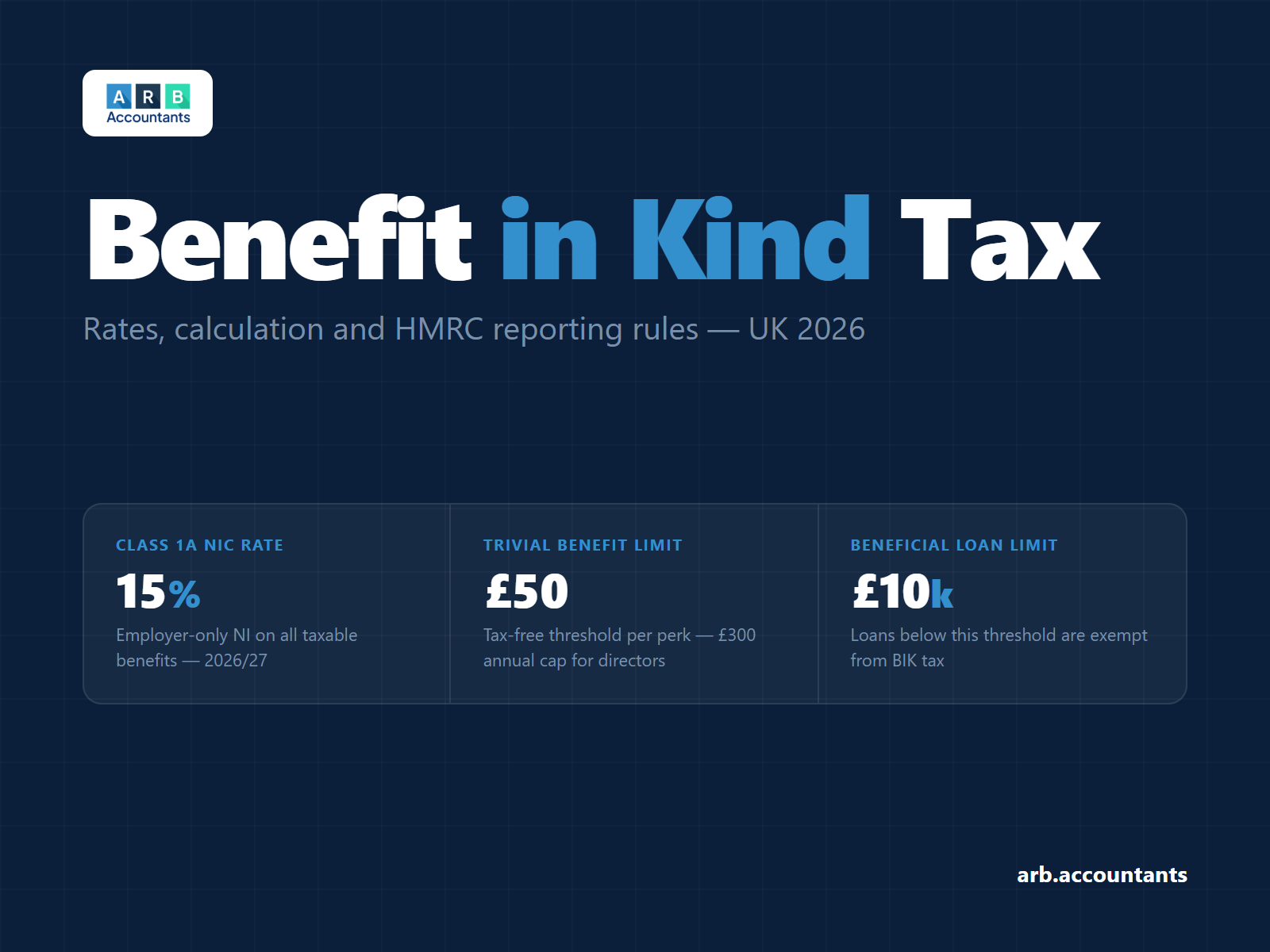
Benefit in kind (BIK) tax is Income Tax on non-cash perks your employer provides, such as a company car, private medical insurance, or an interest-free loan. HMRC assigns each benefit a taxable value using its own rules, and you pay Income Tax on that value at your marginal rate (20%, 40% or 45%). Your employer pays Class 1A National Insurance on the same value at 15% for 2026/27. Benefits are reported on P11D forms by 6 July each year, though payrolling is set to become mandatory for most benefits from April 2027.
Benefit in Kind Tax at a Glance
- Income Tax on benefits is charged on the “cash equivalent” value HMRC assigns to each perk, not the value you personally place on it.
- Your marginal rate applies: 20% for basic rate taxpayers, 40% for higher rate, 45% for additional rate.
- Employers pay Class 1A National Insurance at 15% on taxable benefits. Employees do not pay NIC on most benefits.
- P11D forms are due by 6 July each year. Payrolling removes the need for P11Ds and collects tax monthly instead.
- Mandatory payrolling of most benefits through payroll replaces P11D reporting from 6 April 2027.
- Not everything an employer provides is taxable. Trivial benefits (£50 or less), staff canteen meals, one mobile phone, and workplace parking are among the exempt categories.
What is Benefit in Kind Tax?
A benefit in kind is any non-cash perk your employer provides that has a monetary value: a company car you can use privately, private medical insurance, a gym membership, or a low-interest loan. Because these perks represent a financial gain, HMRC treats them as a form of income and charges Income Tax on them.
What makes BIK tax different from ordinary salary tax is the valuation. HMRC sets its own rules for calculating the taxable value, known as the “cash equivalent,” for each type of benefit. That figure does not always match what you would pay for the same thing on the open market. The company car rules, for example, use a CO2-based percentage of the car’s list price rather than its rental value.
Both the employee and the employer have obligations. The employee pays Income Tax on the benefit through their PAYE tax code or Self Assessment return. The employer pays Class 1A National Insurance on the value of the benefit and is responsible for identifying, valuing, and reporting each taxable benefit to HMRC each year.
How Benefit in Kind Tax is Calculated
The calculation has two steps.
Step 1: Work out the cash equivalent. HMRC provides valuation rules for each type of benefit. For company cars, the cash equivalent is the P11D list price of the car multiplied by a CO2 percentage rate. For beneficial loans, it is the interest that would have been charged at the official HMRC rate minus any interest actually paid. For most other benefits, such as private medical insurance or gym memberships, it is the cost to the employer of providing the benefit.
Step 2: Apply your Income Tax rate. Once you have the cash equivalent, you multiply it by your marginal rate of Income Tax: 20% (basic rate), 40% (higher rate), or 45% (additional rate). That is the annual tax you owe on the benefit.
Example: An employee receives private medical insurance with an annual premium cost to the employer of £1,200. They are a basic rate taxpayer.
- Cash equivalent: £1,200
- BIK tax: £1,200 x 20% = £240 per year
- Employer’s Class 1A NIC: £1,200 x 15% = £180 per year
The employee’s tax is typically collected by HMRC adjusting their PAYE tax code, not by an additional bill.
Benefit in Kind Tax Rates
There is no single BIK tax rate. What you pay depends on:
| Your tax band | Profit | BIK Income Tax rate |
|---|---|---|
| Basic rate | £12,571 to £50,270 | 20% |
| Higher rate | £50,271 to £125,140 | 40% |
| Additional rate | Above £125,140 | 45% |
Your employer pays Class 1A National Insurance at 15% on the total value of all taxable benefits for 2026/27. This is an employer-only cost; employees do not pay National Insurance on most benefits in kind.
For company cars, there is an additional percentage rate based on CO2 emissions that is applied to the car’s P11D value to arrive at the taxable cash equivalent (see the company car section below).
Common Benefits in Kind and How They Are Valued
Company Car
A company car is the most common and often most significant benefit in kind. The taxable value is calculated as:
P11D value x CO2 percentage = cash equivalent
The P11D value is the manufacturer’s list price including optional extras and delivery charges, but excluding road tax and the first registration fee. The CO2 percentage rises with emissions: fully electric vehicles attract a 2% rate for 2025/26 rising incrementally each year, while high-emission petrol or diesel cars can attract rates of 37% or higher. HMRC publishes a full table of rates for each tax year.
If your employer also pays for fuel used for your private journeys, you pay tax on a separate fuel benefit charge. The fuel benefit is calculated by multiplying a fixed charge (set each year by HMRC) by the same CO2 percentage as the car.
Electric and hybrid cars attract significantly lower BIK rates than petrol or diesel equivalents, which is why company car schemes have shifted heavily toward EVs. The government has confirmed EV rates will rise slightly each year through to 2027/28, but they remain far below the rates for combustion-engine vehicles.
Private Medical Insurance
If your employer pays private medical or dental insurance premiums on your behalf, you pay Income Tax on the annual cost of those premiums. The cash equivalent is the full premium cost to your employer, including any employer loading or group scheme rates. The fact that the premium cost to your employer may be lower than a personal policy does not reduce your taxable value.
Annual health check-ups or eye tests provided by your employer are exempt.
Beneficial Loans
If your employer provides you with a loan at no interest or below the official HMRC interest rate, the difference between the interest you pay and the official rate is a taxable benefit. For 2025/26 the official rate is set by HMRC and updated periodically.
The beneficial loan exemption means no tax applies where the total outstanding loan balance does not exceed £10,000 at any point during the tax year. Above that threshold, the full loan is assessable, not just the amount above £10,000.
Employer-Provided Accommodation
Living in accommodation provided by your employer is a taxable benefit unless a specific exemption applies. Agricultural workers living on farms, caretakers living on-site, and certain other roles where living in the property is necessary to perform the job can qualify for exemption.
The taxable value depends on the annual value of the property or the rent your employer pays, whichever is higher. Where the property cost your employer more than £75,000, an additional charge applies based on the excess above that figure.
Gym Memberships
A gym membership paid for by your employer is a taxable benefit. The cash equivalent is the cost of the membership to your employer. The exception is where the gym is on the employer’s premises and available to all staff, which can qualify for exemption.
Mobile Phones
One mobile phone provided to an employee is exempt from BIK tax. This applies to the phone itself and the contract, covering both business and personal use. If your employer provides a second phone, that one is taxable.
Staff Entertainment and Gifts
An annual staff party or similar event is exempt from BIK tax provided it costs £150 or less per head per year and is open to all employees. If multiple events are held in the year, the combined cost must remain within £150 per head. Exceeding the limit by even a small amount makes the entire event taxable, not just the excess.
Small gifts or perks that meet the trivial benefit rules (cost of £50 or less, not cash or a voucher, not a performance reward, not contractual) are entirely exempt. Directors of close companies have a combined annual cap of £300 on trivial benefits.
Class 1A National Insurance for Employers
Employers pay Class 1A National Insurance on the total value of most taxable benefits in kind. This is an employer-only cost: employees do not pay National Insurance on benefits (unless the benefit is equivalent to cash, in which case standard NIC rules apply as though it were salary).
The rate for 2026/27 is 15% of the total cash equivalent of all taxable benefits.
Key dates for employers:
| Deadline | Action |
|---|---|
| 6 July | Submit P11D forms for each employee; submit P11D(b) declaring total Class 1A liability |
| 6 July | Give a copy of P11D to each employee |
| 19 July | Pay Class 1A NIC by cheque |
| 22 July | Pay Class 1A NIC electronically |
Failure to report or pay on time results in penalties and interest. HMRC can also charge penalties where benefits are incorrectly valued.
How Benefits in Kind Are Reported to HMRC
P11D Forms
The traditional method is to report all taxable benefits on a P11D form for each employee at the end of the tax year. The P11D lists each benefit, its taxable value, and the method of valuation used. A P11D(b) is then submitted to declare the employer’s total Class 1A NIC liability.
Employees who file a Self Assessment return must also include BIK values on their return. HMRC usually pre-populates these figures from the P11D, but you should always check the values are correct.
Payrolling Benefits
Rather than reporting at year end, payrolling collects the tax on benefits through the monthly payroll. The employer includes the taxable value of each benefit in the employee’s gross pay for PAYE purposes and deducts the resulting tax each month. This means employees have a more accurate tax position throughout the year rather than receiving a large PAYE code adjustment in arrears.
Employers using payrolling do not need to submit P11D forms for the payrolled benefits, but they must still submit a P11D(b) to report and pay the Class 1A NIC.
Mandatory Payrolling from April 2027
From 6 April 2027, payrolling of most benefits in kind through the Full Payment Submission becomes mandatory. P11D forms will no longer be accepted for the benefits in scope. The initial mandatory scope covers:
- Company cars and fuel
- Vans and van fuel
- Employer-provided medical benefits
Most remaining benefits follow from April 2028. Employment-related loans and accommodation will move to mandatory payrolling at a later date confirmed by HMRC, though employers will be able to voluntarily payroll these from April 2027. HMRC is expected to open the new voluntary registration service in November 2026 for employers who want to get ahead of the mandate.
Employers who currently rely on P11D forms need to ensure their payroll software supports the new FPS real-time reporting before April 2027.
Benefits in Kind That Are Tax-Free
Not all employer-provided perks are taxable. HMRC exempts the following from both Income Tax and National Insurance:
- Meals in a staff canteen available to all employees
- Hot drinks and water provided at work
- One mobile phone per employee (including calls and data)
- Workplace car parking
- Annual staff parties costing £150 or less per head
- Childcare vouchers from approved schemes
- Employer pension contributions to a registered pension scheme
- Work-related training that updates existing skills
- Private medical insurance for employees working abroad
- Annual health check-ups or eye tests
- Small gifts and perks meeting the trivial benefit rules (£50 or less)
Tips for Reducing Your Benefit in Kind Tax
Choose lower-emission vehicles. The difference in BIK tax between a petrol car and an electric vehicle at the same P11D value is substantial. At a 2% EV rate versus 25% for a mid-emission petrol car, an EV can reduce annual BIK tax on the same list-price car by thousands of pounds per year for a higher-rate taxpayer.
Use the trivial benefit exemption. Gifts to employees of £50 or less that do not constitute a performance reward are completely tax-free. This is a low-cost way to recognise staff without a tax consequence for either side.
Take advantage of exempt benefits. Pension contributions, cycle-to-work schemes, childcare vouchers, and canteen meals are all tax-efficient. Structuring a package to use more exempt benefits and less taxable BIK directly reduces both the employee’s tax bill and the employer’s Class 1A NIC.
Keep loan balances below £10,000. If your employer lends you money, keeping the total outstanding balance below £10,000 at all times avoids any beneficial loan BIK charge entirely.
Make capital contributions to company cars. An employee can pay a capital contribution toward the cost of a company car, which reduces the P11D value and therefore the taxable cash equivalent. The maximum contribution that is counted in the P11D calculation is £5,000.
Frequently Asked Questions
What is benefit in kind tax?
Benefit in kind (BIK) tax is Income Tax charged on non-cash perks your employer provides, such as a company car, private medical insurance, or an interest-free loan. HMRC assigns each benefit a taxable value using its own rules, and you pay Income Tax on that value at your marginal rate (20%, 40% or 45%). Your employer pays Class 1A National Insurance on the same value at 15% (2026/27 rate).
How much is benefit in kind tax?
The amount depends on the taxable value of the benefit and your Income Tax rate. For example: private medical insurance costing your employer £1,500 per year would create a BIK tax bill of £300 for a basic rate taxpayer (20%) or £600 for a higher rate taxpayer (40%). Your employer also pays Class 1A NIC of £225 (15% of £1,500) separately.
What is the benefit in kind tax rate?
There is no single rate. You pay Income Tax on benefits at your marginal rate: 20%, 40% or 45%. Your employer pays Class 1A NIC at 15% on the total value of all taxable benefits provided. Company cars have an additional CO2-based percentage rate used to calculate their taxable value, ranging from 2% for electric vehicles to over 37% for high-emission models.
What counts as a benefit in kind?
Any non-cash benefit with a monetary value: company cars, private medical insurance, gym memberships, beneficial loans above £10,000, employer-provided accommodation, childcare not from an approved scheme, additional mobile phones, and performance-related gifts. Cash and cash vouchers are treated as earnings rather than BIK and attract both employer and employee NIC.
Do I pay NI on benefits in kind?
No. As an employee you do not pay National Insurance on most benefits in kind. Your employer pays Class 1A NIC at 15% on the value of taxable benefits. Only cash-equivalent payments and cash vouchers attract employee NIC.
What is a P11D and when is it due?
A P11D is the annual form your employer submits to HMRC reporting all taxable benefits provided to each employee. The deadline is 6 July following the end of the tax year. P11D forms are being phased out as payrolling becomes mandatory from April 2027.
Which benefits in kind are tax-free?
Tax-free benefits include: staff canteen meals, one mobile phone, workplace parking, annual staff parties (£150 or less per head), childcare vouchers, employer pension contributions, work-related training, medical treatment abroad, and small perks costing £50 or less that meet the trivial benefit rules.
When does mandatory payrolling of benefits start?
Most benefits must be payrolled from 6 April 2027. Company cars, fuel, vans, and employer-provided medical benefits are in the first wave. Most other benefits follow from April 2028. Loans and accommodation will follow later but can be voluntarily payrolled from April 2027.
Need help managing benefits in kind for your business?
ARB Accountants helps employers and employees understand their BIK obligations, correctly value all taxable benefits, file P11Ds on time, and prepare for the move to mandatory payrolling in 2027.
Talk to our tax teamFrequently Asked Questions
What is benefit in kind tax?
Benefit in kind (BIK) tax is Income Tax charged on non-cash perks that an employer provides to an employee, such as a company car, private medical insurance, or an interest-free loan. Because these perks have a monetary value, HMRC treats them as taxable income. The employee pays Income Tax on the taxable value of the benefit, and the employer separately pays Class 1A National Insurance contributions on the same value.
How much is benefit in kind tax?
The amount of BIK tax you pay depends on two things: the taxable value of the benefit and your Income Tax rate. The taxable value is the 'cash equivalent' of the benefit as calculated under HMRC rules. You then pay Income Tax on that value at your marginal rate: 20% if you are a basic rate taxpayer, 40% if higher rate, or 45% if additional rate. Your employer pays Class 1A National Insurance at 15% (2026/27 rate) on the same value separately.
What is the benefit in kind tax rate?
There is no single BIK tax rate. You pay Income Tax on the taxable value of each benefit at your personal marginal rate: 20% (basic), 40% (higher), or 45% (additional). Your employer pays Class 1A NIC at 15% on the total value of all benefits provided. For company cars, there is an additional CO2-based percentage rate used to calculate the taxable value itself, ranging from 2% for fully electric vehicles to over 37% for high-emission petrol cars.
What counts as a benefit in kind?
Any non-cash benefit provided by an employer that has a monetary value. Common examples include: company cars and fuel, private medical or dental insurance, gym memberships, beneficial loans (above £10,000), employer-provided accommodation, childcare not provided through an exempt scheme, mobile phones beyond one per employee, and gifts or vouchers above the trivial benefit threshold. Cash payments and cash vouchers are treated as earnings, not BIK, so they attract National Insurance contributions from both employer and employee.
Do I pay National Insurance on benefits in kind?
As an employee, you generally do not pay National Insurance on benefits in kind. That is one of the tax-efficiency advantages of receiving benefits rather than equivalent cash. Your employer pays Class 1A National Insurance on the value of most taxable benefits at 15% (2026/27). The exception is where a benefit is equivalent to cash, such as cash vouchers or non-exempt items exchanged for cash, which are treated as earnings and attract the normal NIC rules.
What is a P11D form and when is it due?
A P11D is the form your employer submits to HMRC to report taxable benefits and expenses provided to each employee during the tax year. It is due by 6 July following the end of the tax year (5 April). Your employer must also give you a copy so you can check the values on your Self Assessment return if you file one. If your employer payrolls benefits instead, no P11D is submitted for those benefits, but a P11D(b) is still needed to declare the Class 1A NIC liability.
What benefits in kind are tax-free?
HMRC exempts a number of benefits from tax. Tax-free benefits include: meals in a staff canteen (available to all staff), hot drinks and water at work, one mobile phone per employee, workplace car parking, Christmas parties costing £150 or less per head, childcare vouchers from approved schemes, employer pension contributions, work-related training, employer-funded eye tests, and medical insurance for employees working abroad. Small gifts or perks costing £50 or less that meet the trivial benefit rules are also exempt.
What is a trivial benefit?
A trivial benefit is a minor perk that is exempt from Income Tax and National Insurance. To qualify: it must cost the employer £50 or less, it must not be cash or a cash voucher, it must not be given as a reward for work or performance, and it must not be contractual. If all conditions are met, neither you nor your employer pays any tax on it. Directors of close companies face an annual cap of £300 on trivial benefits in total.
What is Class 1A National Insurance on benefits?
Class 1A is the National Insurance contribution paid by employers on most taxable benefits in kind. The rate for 2026/27 is 15%. Only the employer pays Class 1A, not the employee. It is calculated on the total cash equivalent value of all taxable benefits provided during the tax year. Employers must report the Class 1A liability on form P11D(b) by 6 July and pay it by 22 July (electronically) or 19 July (cheque).
What is payrolling benefits in kind?
Payrolling is a method of collecting Income Tax on benefits in kind through the employee's regular payroll rather than through a year-end P11D and PAYE code adjustment. The employer includes the taxable value of benefits in the employee's gross pay each month and deducts the resulting tax in real time. This gives employees a more accurate tax position throughout the year. Payrolling is currently optional but becomes mandatory for most benefits from 6 April 2027.
When does mandatory payrolling of benefits start?
Mandatory payrolling of most benefits in kind through payroll begins on 6 April 2027. From that date, employers must report company cars, car fuel, vans, van fuel, and employer-provided medical benefits through the Full Payment Submission in real time rather than on P11D forms. Most remaining benefits follow from April 2028. Employment-related loans and accommodation will follow at a later date but can be voluntarily payrolled from April 2027. HMRC expects to open a new voluntary registration service in November 2026.
About The Author

Saurabh Bedi | Director
Saurabh is a tax advisor at ARB Accountants, specialising in Self-Assessment and small business tax. He's dedicated to making tax simple and stress-free, helping clients stay compliant and confident with HMRC.
Qualifications & Experience
- Fellow of Chartered Certified Accountants (ACCA)
- MSc Chartered Certified Accountancy 2008
- Working in accountancy since 2008