
Company Car vs Car Allowance: Which Is Better?
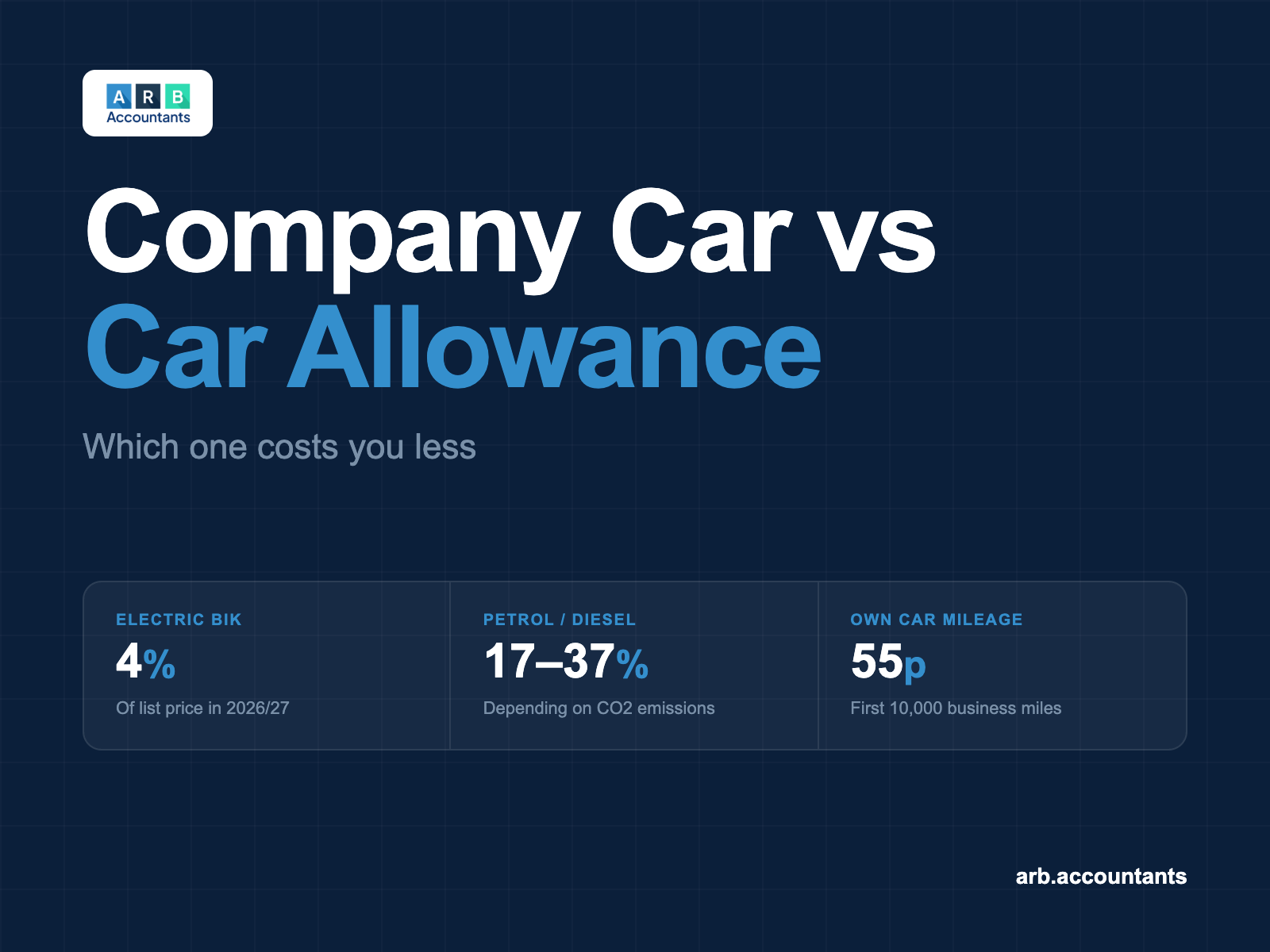
Company car or car allowance?
It comes down to the car. A car allowance is salary, taxed at your marginal rate with National Insurance on top, so £6,000 costs a higher rate taxpayer about £2,520 in tax and NI. A company car is taxed on a percentage of list price, and for a fully electric car that percentage is just 4% in 2026/27. On a £45,000 EV that's a £1,800 benefit, costing a higher rate taxpayer £720 a year. For petrol and diesel, where the percentage runs to 37%, the allowance usually wins.
Company car vs allowance at a glance
- Allowance is salary: income tax plus employee and employer NI.
- Company car is taxed on list price × benefit percentage.
- Electric: 4% in 2026/27, rising to 5% in 2027/28. Petrol and diesel: 17% to 37%.
- Business mileage on your own car: 55p for the first 10,000 miles.
- Free private fuel is taxed on £29,200 × the same percentage, and rarely worth it.
Table Of Contents
- The Fundamental Difference
- How a Car Allowance Is Taxed
- How a Company Car Is Taxed
- The Electric Car Effect
- How to Run the Comparison
- Worked Examples
- The Mileage Difference
- Free Fuel Is Usually a Trap
- What Employers Should Weigh
- Directors of Their Own Company
- Get Help Deciding
The Fundamental Difference
A car allowance is cash. It's salary by another name, taxed exactly like salary, and the car is yours: you buy it, insure it, maintain it and carry the depreciation. A company car is a benefit. The employer owns or leases it, usually covers running costs, and you're taxed on a percentage of its list price regardless of what it cost your employer.
That structural difference explains why the answer has flipped over the last decade. When benefit percentages were high across the board, taking cash and buying your own car was usually better. The introduction of very low rates for electric vehicles reversed that for anyone willing to drive one.
The comparison is genuinely close for mid-range petrol and diesel cars, and not close at all at either extreme.
How a Car Allowance Is Taxed
As ordinary salary. It goes through payroll, attracts income tax at your marginal rate and employee National Insurance, and the employer pays employer National Insurance on top. There is no special treatment of any kind.
For a higher rate taxpayer receiving a £6,000 allowance:
| Allowance | £6,000 |
| Income tax at 40% | −£2,400 |
| Employee NI at 2% | −£120 |
| Net in your pocket | £3,480 |
That £3,480 has to fund the car entirely: purchase or finance, insurance, servicing, tyres, VED, and the depreciation, which is usually the largest cost and the one people forget because it doesn’t arrive as a bill.
Two things often missed:
- It’s usually pensionable. Because it’s salary, a car allowance typically counts for pension contributions and auto-enrolment, raising both your contributions and the employer’s. Cash-positive for your pension, cash-negative for your take-home.
- It counts towards thresholds. It’s part of adjusted net income, so it can push you over £50,270, £60,000 for the High Income Child Benefit Charge, or £100,000 where the personal allowance tapers. A company car benefit counts too, but at 4% of list price rather than the full cash amount.
How a Company Car Is Taxed
The taxable benefit is the P11D list price × the appropriate percentage. You then pay income tax on that benefit at your marginal rate. Your employer pays Class 1A National Insurance on the same figure.
The P11D price is the manufacturer’s list price including VAT, delivery and any optional extras fitted. Critically, it’s before any discount your employer negotiated. A £50,000 car bought for £42,000 is still taxed on £50,000, which is why heavily discounted cars can be worse value than the purchase price suggests.
The appropriate percentage is set by CO2 emissions, and for plug-in hybrids by electric-only range as well:
| Car type | 2026/27 percentage |
|---|---|
| Fully electric | 4% |
| Plug-in hybrid | Depends on emissions and electric range |
| Petrol and diesel | 17% to 37% |
Diesel cars not meeting the RDE2 standard carry a 4 percentage point supplement, capped at the 37% maximum.
The Electric Car Effect
At 4%, an electric company car is taxed on a fraction of its value. On a £45,000 EV the benefit is £1,800, costing a higher rate taxpayer £720 a year. The equivalent petrol car at 30% would produce a £13,500 benefit and a £5,400 tax bill, seven and a half times more.
The rate is scheduled to rise, but gently: 3% in 2025/26, 4% in 2026/27, 5% in 2027/28. Even at 5% the gap against petrol and diesel remains enormous.
Two further advantages stack on top:
- Salary sacrifice works for EVs. Electric cars were specifically excluded when the rules removed most salary sacrifice advantages, so you can give up gross salary for the car and be taxed only on the 4%. This is the cheapest route to a company car available to most employees.
- No fuel benefit issue. Electricity provided by an employer for charging a company car at the workplace isn’t a taxable fuel benefit, so the fuel trap below doesn’t apply.
For the employer there’s a capital allowances point too: a new and unused zero emission car qualifies for a 100% first year allowance, the one exception to cars being excluded from AIA and full expensing.
How to Run the Comparison
Six steps, and do it over three or four years rather than one:
- Price the allowance. Deduct income tax at your marginal rate and 2% employee NI to get the net cash.
- Price the car you’d actually buy with that cash: finance or purchase, insurance, servicing, tyres, VED, and realistic depreciation.
- Find the benefit percentage for the company car on offer.
- Calculate the benefit: P11D price × percentage, then × your marginal rate.
- Add what the company car covers that you’d otherwise pay: insurance, maintenance, VED, breakdown cover.
- Add business mileage on both sides at the relevant rate.
The single year comparison misleads in both directions. Benefit percentages rise on a published schedule, so a company car gets gradually more expensive. Depreciation is front-loaded, so a privately owned car is most expensive in year one and cheapest in year five.
Worked Examples
Higher rate taxpayer, £6,000 allowance vs a £45,000 electric company car:
| Car allowance | Electric company car | |
|---|---|---|
| Taxable amount | £6,000 (salary) | £1,800 (4% of £45,000) |
| Income tax at 40% | £2,400 | £720 |
| Employee NI at 2% | £120 | £0 |
| Your annual tax | £2,520 | £720 |
| Net cash received | £3,480 | £0 |
| Running costs you bear | Everything | Usually little or none |
The allowance leaves you £3,480 to fund a £45,000 car. It won’t. The company car costs £720 a year in tax and covers the running costs. For an electric car this isn’t close.
Same taxpayer, £45,000 petrol car at 30%:
| Car allowance | Petrol company car | |
|---|---|---|
| Taxable amount | £6,000 | £13,500 (30% of £45,000) |
| Income tax at 40% | £2,400 | £5,400 |
| Employee NI at 2% | £120 | £0 |
| Your annual tax | £2,520 | £5,400 |
| Net cash received | £3,480 | £0 |
Now the allowance looks better: you’re £2,880 a year better off on tax and hold £3,480 of cash, against which you fund the car. Whether it actually wins depends on how cheaply you can run a car and how much depreciation you absorb, but the direction has reversed entirely.
The Mileage Difference
This is where an allowance claws back ground for high-mileage drivers.
On your own car (allowance), business mileage can be reimbursed tax free at the approved rates: 55p per mile for the first 10,000 business miles from 6 April 2026, then 25p. If your employer pays less, you can claim tax relief on the difference.
On a company car, approved rates don’t apply. The employer can reimburse fuel at HMRC’s advisory fuel rates, which are much lower because they cover fuel only, not the cost of the car.
For someone driving 15,000 business miles a year, the approved mileage payments are worth £6,750 tax free. That’s a substantial figure and it can outweigh the benefit in kind advantage even on an electric car. High business mileage pushes the answer towards the allowance; low mileage pushes it towards the company car.
Free Fuel Is Usually a Trap
Where an employer pays for private fuel, a separate benefit arises: £29,200 × the same appropriate percentage for 2026/27. It's a fixed figure regardless of how much fuel you actually use, so low private mileage means paying tax on fuel you never had.
On a car at 30%, the fuel benefit is £8,760, costing a higher rate taxpayer £3,504 a year in tax. To break even you’d need to be using around £3,500 of private fuel annually, which is a great deal of private driving.
For most employees, refusing free private fuel and paying for it personally is cheaper. The exception is genuinely very high private mileage, which is rarer than the number of people who accept free fuel would suggest.
Electricity for charging a company car at the workplace is not a taxable fuel benefit, so this doesn’t apply to EVs.
What Employers Should Weigh
The decision isn’t only the employee’s:
- Employer NI. A car allowance attracts employer National Insurance on the full amount. A company car attracts Class 1A on the benefit, which for an EV is a fraction of the figure.
- Corporation tax relief. Lease payments and running costs are deductible, subject to a restriction for higher emission cars. Purchases attract capital allowances, with 100% first year allowance for new zero emission cars.
- Pension cost. An allowance is usually pensionable, so it raises employer pension contributions too.
- Administration. Company cars mean P11D reporting or payrolling benefits, fleet management and insurance. Allowances are simpler but you carry grey fleet risk: you must still check that employees driving on business have valid licences, insurance and roadworthy vehicles.
- Recruitment. An EV salary sacrifice scheme is a genuinely attractive benefit at low net cost to the business.
Directors of Their Own Company
For an owner-managed company the same rules apply, but you’re on both sides of the decision, which changes how to think about it.
The electric company car is usually the clear winner. The company gets a 100% first year allowance on a new zero emission car, deducts running costs, and pays Class 1A on a 4% benefit. You pay income tax on that same small benefit. Compared with extracting cash as salary or dividends and buying a car personally, the gap is wide.
For petrol and diesel, it usually isn’t worth it. The benefit charge on a director’s car frequently exceeds the value of the tax relief the company gets, and taking the money out as dividends and buying privately is often cheaper. Our guides to salary vs dividends and leasing an electric car through a limited company cover the surrounding decisions.
Get Help Deciding
The comparison is arithmetic, but it has enough moving parts that people get it wrong in both directions: taking an allowance when an EV would have been far cheaper, or accepting a high-emission company car because it felt like a perk.
ARB Accountants runs this comparison for directors and employees, covering the tax on both sides, the mileage position, and the employer cost, over the realistic life of the arrangement rather than a single year.
Not sure which to take?
Free 60-minute consultation. Tell us the car, your salary and your business mileage, and we'll tell you which option costs less and by how much over four years. ACCA-chartered.
Read next
- Leasing an electric car through a limited company: the director’s version of this decision
- AIA and full expensing: why cars are treated differently
- Payrolled benefits on your payslip: how the benefit shows up in your tax code
- Salary vs dividends: extracting cash to buy privately instead
Frequently Asked Questions
Is a company car or car allowance better?
It depends almost entirely on the car. For a fully electric car the company car is usually far cheaper, because the benefit in kind is only 4% of list price in 2026/27 against a car allowance taxed as full salary. For a petrol or diesel car with higher emissions, where benefit rates run up to 37%, the allowance often wins.
How is a car allowance taxed?
As ordinary salary. It goes through payroll, is subject to income tax at your marginal rate and employee National Insurance, and the employer pays employer National Insurance on it. There is no special treatment, which is the fundamental reason it compares badly against a low-emission company car.
How is a company car taxed?
You pay income tax on a benefit in kind, calculated as the car's P11D list price multiplied by an appropriate percentage based on CO2 emissions. The employer pays Class 1A National Insurance on the same figure. You are taxed on the benefit, not on the cost of the car to your employer.
What is the benefit in kind rate for electric cars in 2026/27?
4% of list price for fully electric cars, up from 3% in 2025/26 and rising to 5% in 2027/28. Petrol and diesel cars sit between 17% and 37% depending on emissions, which is why the electric company car remains substantially cheaper.
Can I claim mileage if I get a car allowance?
Yes. Because the car is yours, business mileage can be reimbursed tax free at HMRC's approved rates, 55p per mile for the first 10,000 business miles from 6 April 2026 and 25p after that. If your employer pays less than the approved rate, you can claim tax relief on the shortfall.
Can I claim mileage on a company car?
Not at the approved rates, which only apply to your own vehicle. If you pay for fuel on business journeys in a company car, the employer can reimburse you at HMRC's advisory fuel rates without a tax charge. Those rates are much lower because they cover fuel only, not the cost of the car.
Is free fuel on a company car worth having?
Usually not for petrol or diesel. The fuel benefit is calculated on a fixed figure of £29,200 for 2026/27 multiplied by the same percentage as the car benefit, regardless of how much fuel you actually use. Unless your private mileage is very high, you pay more tax than the fuel is worth.
Does a car allowance affect my pension?
Often yes, and it is easy to miss. Because it is salary, a car allowance is usually pensionable and counts towards earnings for auto-enrolment purposes, which increases both your contributions and your employer's. A company car is a benefit in kind and is not pensionable.
Does the company car benefit depend on what my employer paid?
No, and this surprises people. The benefit is based on the manufacturer's list price including VAT, delivery and any options fitted, before any discount your employer negotiated. A heavily discounted car is taxed on the undiscounted price.
What about salary sacrifice for an electric car?
Electric cars are specifically excluded from the rules that removed most salary sacrifice tax advantages, so you give up gross salary in exchange for the car and are taxed only on the 4% benefit. This is the cheapest route to a company car for most employees and the reason EV salary sacrifice schemes have grown so quickly.
Can I have a company car through my own limited company?
Yes, and the same rules apply to a director as to any employee. The company gets corporation tax relief on running costs and capital allowances on the purchase, and a new unused zero emission car qualifies for a 100% first year allowance. For an owner-managed company, the electric route is usually the most efficient.
What happens if I use the company car very little?
The benefit is based on availability, not use. If the car is available for private use it is taxed in full, however little you drive it. The charge is only reduced if the car is genuinely unavailable for a continuous period of 30 days or more, or if you make a private use contribution to your employer.
About The Author

Saurabh Bedi | Director
Saurabh is a tax advisor at ARB Accountants, specialising in Self-Assessment and small business tax. He's dedicated to making tax simple and stress-free, helping clients stay compliant and confident with HMRC.
Qualifications & Experience
- Fellow of Chartered Certified Accountants (ACCA)
- MSc Chartered Certified Accountancy 2008
- Working in accountancy since 2008