Business Property Relief Changes 2026: BPR Cap Explained
What is changing for Business Property Relief in 2026?
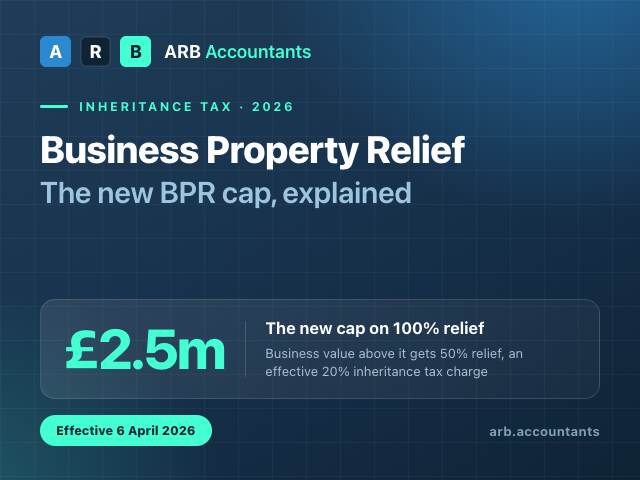
From 6 April 2026, 100% Business Property Relief is capped. The first £2.5 million of combined business and agricultural property in your estate still passes free of inheritance tax. Anything above that gets 50% relief instead of 100%, which means an effective 20% inheritance tax charge on the excess. Shares that are "not listed" on a recognised stock exchange, including AIM shares, drop to 50% relief with no allowance at all.
For decades, a trading business could pass to the next generation free of inheritance tax. Business Property Relief made that possible. From 6 April 2026 it no longer fully does. A £2.5 million cap now limits 100% relief, and business value above it is taxed. This guide explains what Business Property Relief is, exactly what is changing, who pays more, and what you can still do before April.
If you own a limited company, run a business as a sole trader, or hold a share in a partnership, this change affects what your family inherits. Our tax advice team has been reworking succession plans for business owners across Southend, Essex and London since the Autumn Budget 2024. The rules below are what those plans are now built on.
Table Of Contents
- What is Business Property Relief?
- What is changing from April 2026?
- How the new £2.5 million allowance works
- Business Property Relief conditions: what still qualifies
- The change to “not listed” shares and AIM holdings
- Who is affected, and how much extra tax is at stake
- What you can do before April 2026
- Common mistakes we see
- How we can help
What is Business Property Relief?
Business Property Relief is an inheritance tax relief. It reduces the value of qualifying business assets when they pass on death, or when they are given away during your lifetime.
Inheritance tax is normally charged at 40% on the value of an estate above the nil-rate band. For a business owner, that is a serious problem. A company with no spare cash can still be worth millions on paper. Without relief, a family could inherit a profitable business and then have to sell part of it, or borrow against it, just to pay the tax.
Business Property Relief was introduced to stop that. The idea behind it, set out in the Inheritance Tax Act 1984, was that a genuine trading business should be able to pass to the next generation without being broken up to settle a tax bill.
Until April 2026 the relief works at two rates:
- 100% relief on an interest in an unincorporated business, such as a sole trader business or a partnership share, and on unquoted shares in a trading company
- 50% relief on certain other assets, such as a controlling shareholding in a quoted company, or land and buildings used by a business you control
In simple terms, a well-run trading company has been able to pass down with no inheritance tax at all. That is the position that ends on 6 April 2026.
What is changing from April 2026?
The government announced the change at the Autumn Budget 2024, then revised one of the figures. This is what is now in force.
A £2.5 million cap on 100% relief. From 6 April 2026, 100% Business Property Relief applies only to the first £2.5 million of qualifying property in an estate. The cap is shared with Agricultural Property Relief, so it covers the combined value of business and agricultural assets.
The cap started life as a £1 million allowance. On 23 December 2025 the government raised it to £2.5 million per person. The higher figure is the one in force, and it is the one your planning should be built around.
50% relief above the cap. Value above £2.5 million no longer gets 100% relief. It gets 50%. Half the value above the cap is exposed to inheritance tax at 40%. That is an effective rate of 20% on the excess.
A drop in relief for “not listed” shares. Shares admitted to trading on a market but “not listed” on a recognised stock exchange, which is the category most AIM shares fall into, drop from 100% relief to 50%. There is no allowance for these. More on this below.
A transferable allowance. The £2.5 million allowance is per person, and any unused part can pass to a surviving spouse or civil partner. A married couple can therefore shelter up to £5 million of qualifying business and agricultural property at 100% relief.
The allowance sits on top of existing reliefs. The £2.5 million is separate from the standard nil-rate band of £325,000 and the residence nil-rate band of £175,000. It does not replace them.
An extended instalment option. From 6 April 2026, inheritance tax on any property that qualifies for Business Property Relief or Agricultural Property Relief can be paid in ten equal annual instalments, interest-free.
HMRC expects around 1,100 estates a year to pay more inheritance tax because of these changes. That is a small number nationally. But if your business is one of them, the bill is large.
How the new £2.5 million allowance works
The mechanics are simpler than they sound. Take the qualifying business and agricultural property in the estate, apply 100% relief to the first £2.5 million, and apply 50% relief to the rest.
Take a director who owns 100% of a trading company. The shares are valued at £4 million. They have held the company for more than two years, so it qualifies for Business Property Relief.
Before 6 April 2026: 100% relief applies to the full £4 million. The inheritance tax on the business is £0.
From 6 April 2026:
- First £2.5 million: 100% relief, no tax
- Remaining £1.5 million: 50% relief, so £750,000 is taxable
- Inheritance tax at 40% on £750,000: £300,000
So a business that would have passed tax-free now carries a £300,000 inheritance tax bill. The effective rate on the £1.5 million above the cap is 20%.
Now the same business owned by a married couple. Say the combined qualifying business is worth £5 million and is structured to pass first to the surviving spouse, then to the children.
- On the first death, the spouse exemption covers everything. The £2.5 million allowance is unused, so it transfers to the survivor.
- On the second death, the survivor has their own £2.5 million plus the transferred £2.5 million. That is a £5 million allowance.
- The whole £5 million qualifies for 100% relief. Inheritance tax on the business: £0.
This is why the transferable allowance matters so much, and why the ownership structure of a business is now part of the tax planning, not just a legal detail.
If that same couple’s business were worth £7 million, the first £5 million would get 100% relief and the remaining £2 million would get 50% relief. That leaves £1 million taxable, and £400,000 of inheritance tax.
Business Property Relief conditions: what still qualifies
The £2.5 million cap changes the rate of relief. It does not change the conditions for getting relief in the first place. Those conditions are unchanged, and they still decide whether an asset qualifies at all.
It must be relevant business property. The relief covers specific categories of asset. The main ones for business owners are:
- An interest in an unincorporated business, such as a sole trader business or a partnership share
- Unquoted shares in a company
- Land, buildings, plant or machinery used by a company you control or a partnership you are part of
The business must be mainly trading. This is the test that catches people out. Business Property Relief is for trading businesses, not investment vehicles. A business that consists wholly or mainly of dealing in land or buildings, dealing in stocks, shares or securities, or making and holding investments does not qualify. A buy-to-let property company, for example, is an investment business and gets no relief.
The word “mainly” matters. A trading company that also holds some investments can still qualify, as long as the trade is the main activity. But large cash balances or investment property held inside a trading company can dilute the relief, and “excepted assets” that are not used for the trade are stripped out before relief is given.
You must have owned it for two years. The asset usually has to have been owned for at least two years before death or transfer. There are exceptions, for example where one business asset replaces another, or where assets pass between spouses.
A common mistake we see is an owner assuming their company qualifies because it “is a business.” It depends on what the business actually does with its money. If you are not certain which side of the trading-versus-investment line your company sits on, that is worth checking now, while there is still time to act.
The change to “not listed” shares and AIM holdings
There is a second change that gets less attention than the £2.5 million cap, and for some people it bites harder.
Shares that are admitted to trading on a market but are “not listed” on a recognised stock exchange currently get 100% Business Property Relief. AIM, London’s market for smaller and growing companies, is the obvious example. AIM shares have long been a popular inheritance tax planning tool for exactly this reason.
From 6 April 2026, those shares drop from 100% relief to 50%. And the £2.5 million allowance does not apply to them. Fifty per cent is the most an AIM holding can get, from the first pound.
For someone holding a qualifying AIM portfolio, the effect is direct. A £500,000 AIM portfolio that would have passed free of inheritance tax now has £250,000 exposed at 40%, a £100,000 tax charge. The effective rate is 20%.
The same 50% rate applies to shares listed on foreign exchanges that are not recognised stock exchanges. If your estate includes holdings of this kind, the value of these shares as an inheritance tax shelter has roughly halved. That does not make them worthless for planning, but it does mean any plan built on the old 100% rate needs a fresh look.
Who is affected, and how much extra tax is at stake
Most business owners will not pay a penny more. A £2.5 million allowance per person, transferable to £5 million for a couple, covers a large share of UK businesses in full.
If your qualifying business and agricultural property comes to less than £2.5 million, the change does not touch you. These are the people it does affect.
Limited company directors with valuable shares. This is the group most exposed. A successful trading company can easily be worth more than £2.5 million without the owner ever thinking of themselves as wealthy. The value is locked in the business, not the bank account. If you run a limited company and the shares would be valued above the cap, there is now a real inheritance tax cost attached to passing it on.
Sole traders and partners with larger businesses. The cap applies to an interest in an unincorporated business in exactly the same way. A sole trader whose business and business assets are worth more than £2.5 million faces the same 50% relief above the cap, and the same effective 20% charge.
Farming families. Because the £2.5 million allowance is shared between Business Property Relief and Agricultural Property Relief, a family with both a working farm and a separate trading business can use the allowance up quickly. The two reliefs draw on one pot.
AIM investors. Anyone holding AIM shares as part of an inheritance tax plan loses half their relief, with no allowance to soften it.
The size of the extra bill comes down to the value above the cap. As a rule of thumb, every £1 million of qualifying business value above the allowance now carries roughly £200,000 of inheritance tax. That is the number to plan against.
ARB Accountants have been my accountants for the past 5 years and I can say they are best at what they do, they look after my tax returns, and they make the whole process very easy. Any questions I have are answered in a timely manner, very reasonably priced too, I would definitely recommend them.
What you can do before April 2026
There is still time to act, but the planning window is genuinely closing. These are the options worth reviewing with an adviser.
Get your business valued. Every plan starts here. You cannot judge your exposure until you know what your qualifying assets are worth and how much sits above £2.5 million. A formal valuation also gives you a defensible figure if HMRC ever queries it.
Check your ownership structure. The transferable allowance means a couple can shelter £5 million instead of £2.5 million, but only if the shares are owned and the will is written so both allowances are used. Many owner-managed companies have all the shares in one name. Splitting ownership between spouses, where commercially sensible, can double the allowance available.
Consider lifetime gifts, carefully. Giving business shares away during your lifetime can move value out of your estate. If you survive seven years, the gift normally falls out of the inheritance tax net entirely. But there is an anti-forestalling rule. Gifts of business or agricultural property made on or after 30 October 2024 are caught by the new cap if the person making the gift dies on or after 6 April 2026 and within seven years of the gift. In plain terms, a deathbed gift will not escape the new rules. A gift made now, where the donor has every expectation of surviving seven years, is a different matter.
Review trusts. Trusts can have a role in passing a business down, but the rules are detailed. A £2.5 million allowance also applies to relevant property held in trust, and it interacts with the ten-year anniversary charge. Trusts created on or after 30 October 2024 are subject to specific rules on how the allowance is shared. This is not something to take on without advice.
Look at life cover. Where a tax charge cannot be planned away, a life insurance policy written in trust can provide the cash to pay it, so the family is not forced to sell part of the business. It does not reduce the tax, but it removes the cash-flow crisis.
Factor in the instalment option. From April 2026, inheritance tax on qualifying business property can be paid over ten years, interest-free. The £300,000 bill in our earlier example could be settled at £30,000 a year rather than in one payment. That changes how a family funds the liability, and it is a relief worth building into the plan rather than discovering after the event.
Update the will. A plan only works if the will delivers it. Wills written before these changes may not use both spouses’ allowances efficiently, or may leave business assets to someone in a way that wastes relief.
Common mistakes we see
A few assumptions cost business owners money. These are the ones that come up most often.
“My business passes tax-free, so I don’t need to do anything.” That was true. From 6 April 2026 it is only true up to £2.5 million. If your business is worth more, doing nothing means accepting an effective 20% charge on the excess.
“The cap is still £1 million.” It was £1 million when first announced. The government raised it to £2.5 million per person on 23 December 2025. Planning built on the old £1 million figure is now too cautious, and may push owners into gifts or restructuring they did not need.
“AIM shares are still a safe inheritance tax shelter.” They’re not, at least not the way they used to be. From April 2026 they get 50% relief, not 100%, and the £2.5 million allowance does not apply to them.
“I’ll deal with it later.” The anti-forestalling rule means lifetime gifts made from 30 October 2024 onwards are already inside the new regime if death occurs on or after 6 April 2026 within seven years. The seven-year clock starts when the gift is made, not when the rules change. Later is more expensive than now.
“My company is a business, so it qualifies.” Only trading businesses qualify. A company that mainly holds investments or property gets no Business Property Relief at all, cap or no cap. If your company has built up large cash reserves or investment assets, the relief may be smaller than you expect.
How we can help
The Business Property Relief changes from 6 April 2026 cap 100% relief at £2.5 million per person and tax business value above it at an effective 20%. The earlier you model your exposure and adjust ownership, gifts and your will, the more of that charge you can plan away.
Business Property Relief has done a quiet, important job since the 1970s. It let people build a business and hand it on without it being broken up to pay tax. The 2026 changes do not remove that protection, but they do put a ceiling on it. Above £2.5 million per person, passing on a business now has a price.
For most owners, the right response is not panic. It’s a clear-eyed review: what’s the business worth, how much sits above the cap, and which of the planning options actually fit the situation. Done early, that review often removes the problem, or shrinks it. Done late, the options narrow to the expensive ones.
Our team prepares accounts and tax advice for owner-managed businesses across Southend, Essex, London and the rest of the UK. We can value your qualifying assets, model the inheritance tax charge under the new rules, and work with your solicitor on ownership, gifts, trusts and the will. As an ACCA-regulated firm, the advice is grounded in the legislation, not guesswork.
If you own a business worth anywhere near £2.5 million, the time to look at this is before April, not after.
Plan ahead of the Business Property Relief cap
We help business owners across the UK understand their inheritance tax exposure and reduce it before the April 2026 changes take effect. Book a consultation and we will tell you exactly where you stand.
Frequently Asked Questions
What is Business Property Relief?
Business Property Relief (BPR) is an inheritance tax relief that reduces the taxable value of qualifying business assets when they pass on death or as a gift. It applies to relevant business property such as a sole trader business, a share of a partnership, or unquoted shares in a trading company, provided the asset has been owned for at least two years and the business is mainly trading rather than investment. Until April 2026 qualifying assets attracted either 100% or 50% relief. From 6 April 2026 the 100% rate is capped.
What are the Business Property Relief changes from April 2026?
From 6 April 2026, 100% Business Property Relief is limited to the first £2.5 million of combined business and agricultural property in an estate. Value above £2.5 million qualifies for 50% relief instead of 100%, which produces an effective inheritance tax rate of 20% on the excess. Separately, shares 'not listed' on a recognised stock exchange, including AIM shares, drop from 100% to 50% relief with no allowance. The changes were announced at Autumn Budget 2024 and the allowance was raised from £1 million to £2.5 million on 23 December 2025.
What is the Business Property Relief cap?
The Business Property Relief cap is a £2.5 million allowance that applies from 6 April 2026 to the combined value of business and agricultural property that can still receive 100% relief. The allowance is per person and any unused part can be transferred to a surviving spouse or civil partner, so a married couple can shelter up to £5 million of qualifying assets at 100% relief. It sits on top of the standard nil-rate band and residence nil-rate band.
What are the conditions for Business Property Relief?
To qualify for Business Property Relief the asset must be relevant business property, the business must be mainly trading rather than investment, and the asset must usually have been owned for at least two years before death or transfer. Businesses that consist wholly or mainly of dealing in land, securities, stocks or shares, or holding investments do not qualify. Excepted assets, meaning assets not used for the business, are stripped out of the relief.
How much inheritance tax will my limited company pay after April 2026?
It depends on the value of your qualifying shares. The first £2.5 million still gets 100% relief and pays no inheritance tax. Value above £2.5 million gets 50% relief, leaving half exposed to inheritance tax at 40%, an effective rate of 20% on the excess. So a trading company worth £4 million would face roughly £300,000 of inheritance tax on the £1.5 million above the allowance, where it would previously have passed tax-free.
Can Business Property Relief be transferred between spouses?
Yes. From 6 April 2026, any unused part of the £2.5 million allowance can be transferred to a surviving spouse or civil partner, in the same way the nil-rate band already transfers. If the first death was before 6 April 2026, the full £2.5 million allowance is treated as available to transfer. This means a married couple can pass on up to £5 million of qualifying business or agricultural property at 100% relief.
Can I still pay the inheritance tax in instalments?
Yes. From 6 April 2026 the option to pay inheritance tax by ten equal annual instalments, interest-free, is extended to all property that qualifies for Business Property Relief or Agricultural Property Relief. So if your estate faces a tax charge on business value above the £2.5 million allowance, that bill can be spread over ten years rather than paid in one lump sum within six months.
About The Author

Saurabh Bedi | Director
Saurabh is a tax advisor at ARB Accountants, specialising in Self-Assessment and small business tax. He's dedicated to making tax simple and stress-free, helping clients stay compliant and confident with HMRC.
Qualifications & Experience
- Fellow of Chartered Certified Accountants (ACCA)
- MSc Chartered Certified Accountancy 2008
- Working in accountancy since 2008