Capital Gains Tax UK: Rates, Allowances and How It Works (2026)
What are the UK capital gains tax rates for 2026/27?
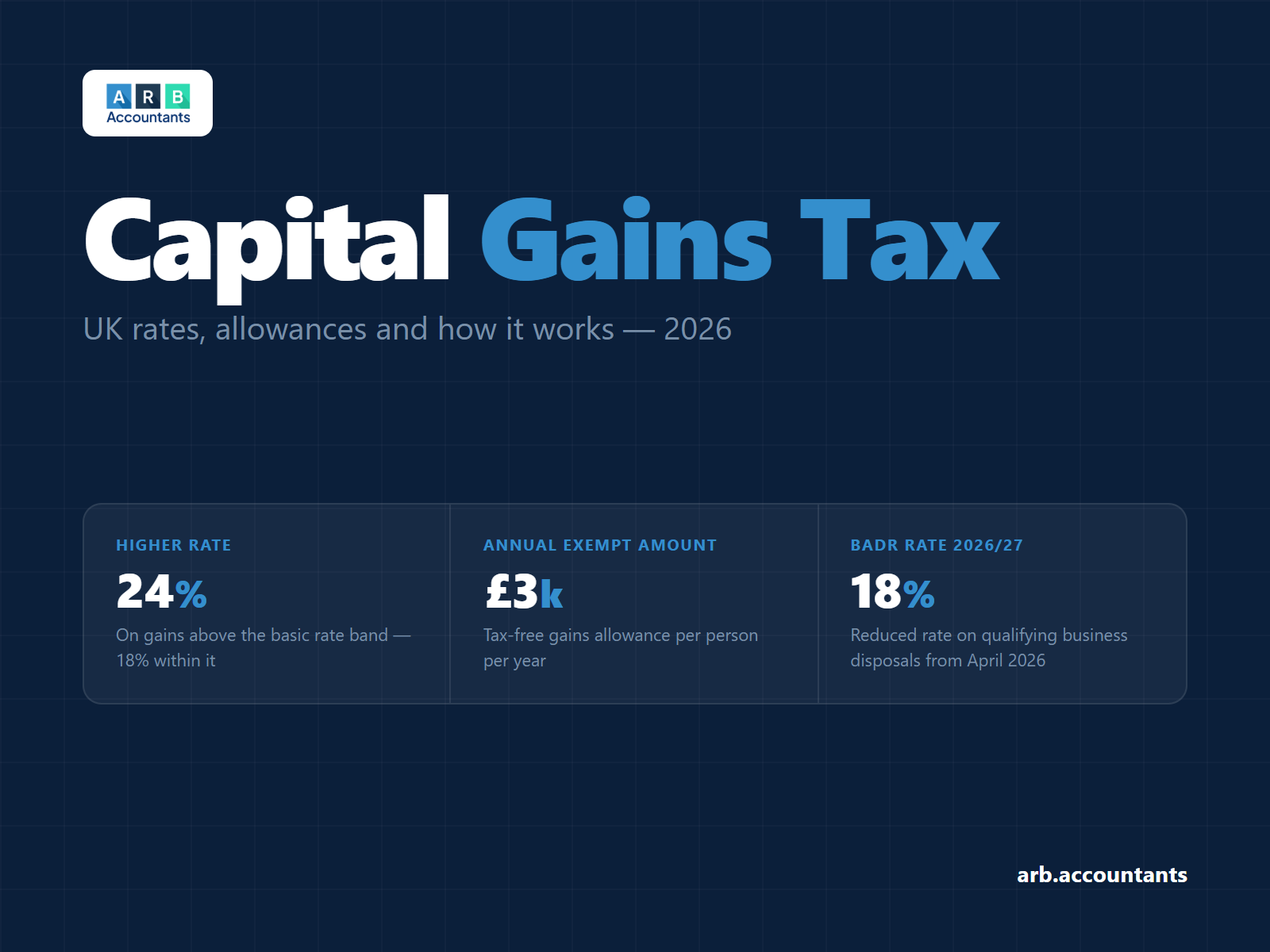
For 2026/27, UK capital gains tax is charged at 18% on gains within the basic rate band and 24% on gains above it. The annual exempt amount is £3,000 per person. Business Asset Disposal Relief applies a reduced rate of 18% on qualifying business disposals from 6 April 2026. These unified rates apply to all asset types including shares and investment property. The rates were raised from 10%/20% (non-property) with effect from 30 October 2024.
Capital Gains Tax UK at a Glance
- CGT is charged on the gain (profit), not the total amount you receive when you sell an asset.
- The main rates for 2025/26 and 2026/27 are 18% (basic rate) and 24% (higher rate) for all chargeable assets.
- Every individual gets a £3,000 annual exempt amount. Gains below this are tax-free.
- Gains are added on top of your taxable income, so your Income Tax position determines which rate applies to each part of the gain.
- Your main home is usually exempt. Shares in an ISA are exempt. UK government gilts and Premium Bonds are exempt.
- UK residential property disposals must be reported and any tax paid within 60 days of completion.
- The October 2024 Budget unified CGT rates across asset types, raising non-property rates from 10%/20% and reducing property rates from 18%/28%.
What is Capital Gains Tax?
Capital gains tax is the tax you pay on the profit you make when you sell or give away an asset that has increased in value. HMRC charges CGT on the gain, not on the total amount you receive. If you bought shares for £10,000 and sold them for £18,000, your gain is £8,000. That is what CGT is calculated on.
A disposal does not have to be a sale. Giving an asset away, transferring it to someone other than your spouse or civil partner, exchanging it for something else, or receiving compensation for its loss or destruction can all count as a disposal for CGT purposes.
CGT applies to individuals, trustees and personal representatives of estates. Companies do not pay CGT; they pay corporation tax on chargeable gains instead.
What Assets Are Subject to Capital Gains Tax?
The most common chargeable assets are:
- Shares that are not held in an ISA or PEP
- Investment property, including buy-to-let and second homes
- Business assets such as goodwill, land, plant and machinery used in a business
- Personal possessions worth more than £6,000, with the exception of your car
- Cryptoassets such as Bitcoin and other digital tokens
- Your main home if you have let it out, used part of it exclusively for business, or the grounds exceed half a hectare
If you own an asset jointly, CGT applies to your share of the gain.
What is Exempt from Capital Gains Tax?
A number of assets and disposals are outside the scope of CGT:
- ISAs and PEPs: gains on assets held within an Individual Savings Account are always exempt, regardless of the size of the gain
- Your main home: Principal Private Residence Relief (PPR) generally exempts the gain on a property that has been your main residence
- UK government gilts and Premium Bonds: exempt from CGT
- Your car: vehicles for personal use are exempt even if they increase in value
- Betting, lottery and pools winnings: exempt
- Gifts to your spouse or civil partner: transfers between married couples and civil partners do not trigger a CGT charge at the time of transfer
- Gifts to charity: donations of qualifying assets to registered charities are exempt
Capital Gains Tax Rates 2025/26 and 2026/27
Since 30 October 2024, a unified set of rates applies to all types of chargeable asset, including property and shares. There is no longer a separate higher rate for residential property.
| Tax year | Basic rate taxpayer | Higher or additional rate taxpayer |
|---|---|---|
| 2025/26 | 18% | 24% |
| 2026/27 | 18% | 24% |
Before 30 October 2024 (for context): non-property gains were taxed at 10% (basic) and 20% (higher). Residential property gains were taxed at 18% (basic) and 28% (higher). The Budget aligned all rates to 18%/24%.
Business Asset Disposal Relief (BADR) qualifies for a reduced rate on the first tranche of gains from business disposals:
| Period | BADR rate |
|---|---|
| Up to 5 April 2025 | 10% |
| 6 April 2025 to 5 April 2026 | 14% |
| From 6 April 2026 | 18% |
Trustees pay CGT at a flat 24% with an annual exempt amount of £1,500.
The Annual Exempt Amount
Every individual is entitled to an annual exempt amount (AEA) of £3,000 for 2025/26 and 2026/27. This means the first £3,000 of your net gains in a tax year is completely tax-free.
You apply the AEA after deducting any capital losses for the year. If your total gains after losses are £3,000 or less, you owe no CGT at all.
The AEA is a use-it-or-lose-it allowance. It resets on 6 April each year and cannot be carried forward if unused. Couples who are married or in a civil partnership each have their own £3,000 AEA, so between them they can shelter £6,000 of gains before paying any CGT.
How the AEA has changed in recent years:
| Tax year | Individual AEA |
|---|---|
| 2022/23 | £12,300 |
| 2023/24 | £6,000 |
| 2024/25 | £3,000 |
| 2025/26 | £3,000 |
| 2026/27 | £3,000 |
The sharp reduction from £12,300 means many more people now have a CGT liability on the same level of gain than they did a few years ago.
How Gains Are Stacked on Top of Income
CGT is not calculated in isolation from your Income Tax position. HMRC stacks your capital gains on top of your taxable income to work out which rate applies.
The process for 2026/27:
- Calculate your taxable income (all income minus the Personal Allowance of £12,570 and any other reliefs)
- Total your capital gains for the year
- Deduct any capital losses and the £3,000 annual exempt amount
- Add the remaining gain to your taxable income
- The portion of the total that falls within the basic rate band (up to £37,700 above the Personal Allowance) is taxed at 18%
- The portion above the basic rate band is taxed at 24%
Example A: basic rate taxpayer with modest gains
Taxable income: £20,000 Capital gain after AEA: £9,600 Total: £29,600 (within the £37,700 basic rate band) CGT due: 18% x £9,600 = £1,728
Example B: basic rate taxpayer with larger gains
Taxable income: £20,000 Capital gain after AEA: £49,600 Remaining basic rate band: £37,700 minus £20,000 = £17,700 Gains within basic band: 18% x £17,700 = £3,186 Gains above basic band: 24% x £31,900 = £7,656 CGT due: £10,842
Example C: higher rate taxpayer
Taxable income: £60,000 (already above the basic rate band) Capital gain after AEA: £15,000 CGT due: 24% x £15,000 = £3,600
How to Calculate Your Capital Gain
Your gain on any disposal is calculated as:
Sale proceeds minus original cost minus improvement costs minus allowable costs of disposal
- Sale proceeds: what you received, or the market value if you gave the asset away
- Original cost: what you paid for the asset, including acquisition costs such as stamp duty and legal fees when you bought it
- Improvement costs: the cost of enhancements that added value (redecoration and maintenance do not count)
- Disposal costs: legal fees, estate agent commission, and other costs directly related to the sale
You can use your AEA against the gains that would otherwise be taxed at the highest rate first. So if you have gains at both 18% and 24%, HMRC allows you to allocate the AEA against the 24% gains first.
Business Asset Disposal Relief
Business Asset Disposal Relief (BADR), formerly known as Entrepreneurs’ Relief, reduces the CGT rate on qualifying gains from business disposals. It is one of the most significant CGT reliefs available to business owners and company directors.
BADR rates:
- Up to 5 April 2025: 10%
- 6 April 2025 to 5 April 2026: 14%
- From 6 April 2026: 18%
BADR is subject to a lifetime limit on qualifying gains. Gains beyond the lifetime limit are taxed at the standard rates.
To qualify for BADR on company shares, you must:
- Be an employee or office holder of the company
- Have held the shares for at least two years before disposal
- Own at least 5% of the company’s ordinary shares and 5% of voting rights
- Be entitled to at least 5% of the company’s distributable profits or 5% of assets on a winding-up
- The company must be a trading company (or the holding company of a trading group)
To qualify for BADR on a business or partnership interest, you must:
- Have owned and run the business for at least two years before disposal (or closure)
- If closing the business, dispose of the assets within three years
Residential Property and the 60-Day Rule
UK residential property is now taxed at the same CGT rates as other assets (18%/24%), but it has a different reporting and payment deadline. For reliefs, allowable costs and worked examples, see our full guide to Capital Gains Tax on property, or estimate your bill with the Capital Gains Tax calculator.
If you sell a UK residential property with a completion date on or after 27 October 2021, you must:
- Report the disposal using HMRC’s Capital Gains Tax on UK property online account
- Pay the estimated CGT due
- Complete both steps within 60 days of the completion date
This applies even if you are already registered for Self Assessment. You cannot simply wait for your annual return. Missing the 60-day deadline triggers an automatic penalty and interest on unpaid tax.
Your main home is usually exempt under Principal Private Residence Relief. The 60-day rule still applies where there is a chargeable gain, for example because part of the property was let or used for business.
Legal Ways to Reduce Your Capital Gains Tax Bill
Use your annual exempt amount in full. The £3,000 AEA resets every 6 April. If you have assets sitting on gains, consider disposing of enough in each tax year to use the allowance rather than triggering a large gain in a single year.
Use an ISA. Gains on assets held within an ISA are permanently exempt. Moving investments into an ISA before they grow significantly is one of the most straightforward long-term CGT planning strategies.
Transfer assets to your spouse or civil partner. Transfers between married couples and civil partners happen at no gain and no loss for CGT purposes. This means you can redistribute assets before sale so both partners use their own £3,000 AEA and potentially pay tax at their own (lower) rate.
Spread disposals across two tax years. If you plan to sell a large holding, consider selling part before 5 April and the remainder after 6 April. Each tax year gives a fresh £3,000 AEA, potentially saving up to £540 (18% of £3,000) or £720 (24% of £3,000) in CGT.
Claim Business Asset Disposal Relief. If you are selling a qualifying business or company shares, check whether BADR applies. Even at the 18% rate from April 2026, it can save significant amounts on a large business sale.
Offset losses against gains. If you have made losses on other disposals in the same tax year, those losses reduce your total gain. Losses made in previous years can also be carried forward and used in a future year, but only to reduce gains down to the AEA level.
Maximise allowable costs. Every cost directly related to buying or improving an asset, plus the costs of selling it, reduces your gain. Keep good records of legal fees, surveys, improvement invoices, and transaction costs.
When and How to Report Capital Gains
| Disposal type | Deadline | How to report |
|---|---|---|
| UK residential property | Within 60 days of completion | HMRC’s CGT on UK property account |
| All other assets | 31 January after the tax year ends | Self Assessment return |
If your total disposal proceeds in the tax year exceeded £50,000, you must report to HMRC even if no tax is owed. If you are not registered for Self Assessment, you can report gains using HMRC’s real-time CGT service for non-property assets.
Frequently Asked Questions
What is capital gains tax in the UK?
Capital gains tax (CGT) is a tax on the profit you make when you sell or dispose of an asset that has gone up in value. You pay tax on the gain, not on the full amount you receive. CGT applies to assets such as shares not held in an ISA, investment property, business assets, and personal possessions worth more than £6,000 (other than your car). Your main home is usually exempt.
What are the capital gains tax rates for 2026/27?
For 2026/27, the main CGT rates are 18% for gains within the basic rate band and 24% for gains above it. Business Asset Disposal Relief applies a reduced rate of 18% from 6 April 2026 on qualifying business disposals. These rates apply to all chargeable assets including property and shares.
How much capital gains tax will I pay?
Deduct the £3,000 annual exempt amount from your net gains, then add the remainder to your taxable income. Any part of the total within the basic rate band (up to £37,700 above the Personal Allowance for 2026/27) is taxed at 18%. Any part above that is taxed at 24%.
What is the capital gains tax annual allowance?
The annual exempt amount for 2025/26 and 2026/27 is £3,000 per person. The first £3,000 of your net gains each tax year is tax-free. The allowance cannot be carried forward if unused and resets on 6 April.
Do I pay capital gains tax on my home?
Usually not. Principal Private Residence Relief exempts the gain on your main home when you sell it, covering the period you lived there plus the final nine months of ownership. CGT can apply if you let the property out, used part of it exclusively for business, or the grounds are very large.
Do I pay capital gains tax on shares?
You pay CGT on gains from shares held outside an ISA. The gain is the sale price minus the original cost and dealing costs. Shares in an ISA are always exempt. UK government gilts and Premium Bonds are also exempt.
What is Business Asset Disposal Relief?
BADR (formerly Entrepreneurs’ Relief) reduces the CGT rate on qualifying business and share disposals. The rate is 14% for 2025/26 and 18% from 6 April 2026, subject to a lifetime limit. You must meet qualifying conditions around ownership period, shareholding percentage, and trading status.
When did CGT rates change?
The main CGT rates changed on 30 October 2024 (Autumn Budget). Before that date, non-property gains were taxed at 10%/20% and residential property at 18%/28%. From 30 October 2024, all assets unified to 18%/24%. The BADR rate increased from 10% to 14% from April 2025 and rises to 18% from April 2026.
How do I report capital gains to HMRC?
For UK residential property, report and pay within 60 days of completion using HMRC’s online Capital Gains Tax on UK property account. For other assets, report on your Self Assessment return by 31 January following the end of the tax year.
How can I reduce my capital gains tax bill?
Use your £3,000 annual exempt amount in full each year. Hold investments inside an ISA. Transfer assets to a spouse or civil partner before sale. Spread large disposals across two tax years. Claim BADR on qualifying business sales. Offset losses against gains. Keep full records of all acquisition and disposal costs.
Planning a disposal or concerned about a CGT liability?
ARB Accountants advises on capital gains tax planning for individuals, company directors and landlords across Essex and beyond. We calculate your exposure, identify every available relief, and report to HMRC accurately and on time.
Talk to our tax teamFrequently Asked Questions
What is capital gains tax in the UK?
Capital gains tax (CGT) is a tax on the profit you make when you sell or dispose of an asset that has gone up in value. You pay tax on the gain, not on the full amount you receive. CGT applies to assets such as shares not held in an ISA, investment property, business assets, and personal possessions worth more than £6,000 (other than your car). Your main home is usually exempt.
What are the capital gains tax rates for 2026/27?
For 2026/27, the main CGT rates are 18% for gains within the basic rate band and 24% for gains above it. Business Asset Disposal Relief (BADR) applies a reduced rate of 18% from 6 April 2026 on qualifying business disposals, up to the lifetime limit. These rates apply to all chargeable assets including property and shares. There is no longer a separate residential property rate.
How much capital gains tax will I pay?
You first deduct the £3,000 annual exempt amount from your total gains. The remaining gain is added to your taxable income for the year. Any part of the gain that falls within your unused basic rate band is taxed at 18%. Any part above the basic rate band (income plus gains exceeding £37,700 for 2026/27) is taxed at 24%. For example: taxable income of £20,000 and a net gain of £9,600 after the AEA. £9,600 added to £20,000 gives £29,600, which is within the £37,700 basic rate band. CGT due: 18% of £9,600 = £1,728.
What is the capital gains tax annual allowance?
The annual exempt amount for 2025/26 and 2026/27 is £3,000 per person. This means the first £3,000 of your net gains each tax year is tax-free. The annual exempt amount cannot be carried forward if unused, so it resets on 6 April each year. Trustees pay CGT using an annual exempt amount of £1,500.
Do I pay capital gains tax on my home?
Usually not. When you sell your main home, you are entitled to Principal Private Residence Relief, which exempts the gain from CGT. The relief covers the period you lived in the property as your main home plus the final nine months of ownership. CGT can apply to your home if you let it out, used part of it exclusively for business, or if the grounds exceed half a hectare and the excess is not needed for the enjoyment of the home.
What is Business Asset Disposal Relief?
Business Asset Disposal Relief (BADR), formerly Entrepreneurs' Relief, reduces the CGT rate on qualifying business disposals. For 2025/26 the rate is 14%; from 6 April 2026 it rises to 18%. To qualify for shares, you must be an employee or officer of the company for at least two years, hold at least 5% of shares and voting rights, and the company must be a trading company. For business sales, you must have owned and run the business for at least two years. BADR is subject to a lifetime limit on qualifying gains.
When did UK capital gains tax rates change?
The main CGT rates changed from 30 October 2024 (the Autumn Budget). Before that date, gains on most assets were taxed at 10% (basic rate) and 20% (higher rate). From 30 October 2024, the rates unified to 18% and 24% for all asset types. Residential property had previously been taxed at 18%/28%, and those rates were also reduced to 18%/24% from the same date.
How do I report capital gains to HMRC?
For UK residential property disposals, you must report the gain and pay any tax due within 60 days of completion using HMRC's online Capital Gains Tax on UK property account. For all other assets, you report gains on your Self Assessment return by 31 January following the end of the tax year and pay any tax owed by the same date. If your total disposal proceeds in the tax year exceeded £50,000, you must report even if no tax is owed.
How can I reduce my capital gains tax bill?
Legal ways to reduce CGT include: using your £3,000 annual exempt amount in full each year; holding assets in an ISA where gains are exempt; transferring assets to a spouse or civil partner before sale to use their annual exempt amount or a lower tax rate; timing disposals across two tax years to use two annual exempt amounts; claiming Business Asset Disposal Relief on qualifying business sales; deducting allowable losses from the same or previous years; and maximising allowable costs of acquisition and disposal.
About The Author

Saurabh Bedi | Director
Saurabh is a tax advisor at ARB Accountants, specialising in Self-Assessment and small business tax. He's dedicated to making tax simple and stress-free, helping clients stay compliant and confident with HMRC.
Qualifications & Experience
- Fellow of Chartered Certified Accountants (ACCA)
- MSc Chartered Certified Accountancy 2008
- Working in accountancy since 2008