Business Asset Disposal Relief: 18% and a £1m Lifetime Limit
What is Business Asset Disposal Relief?
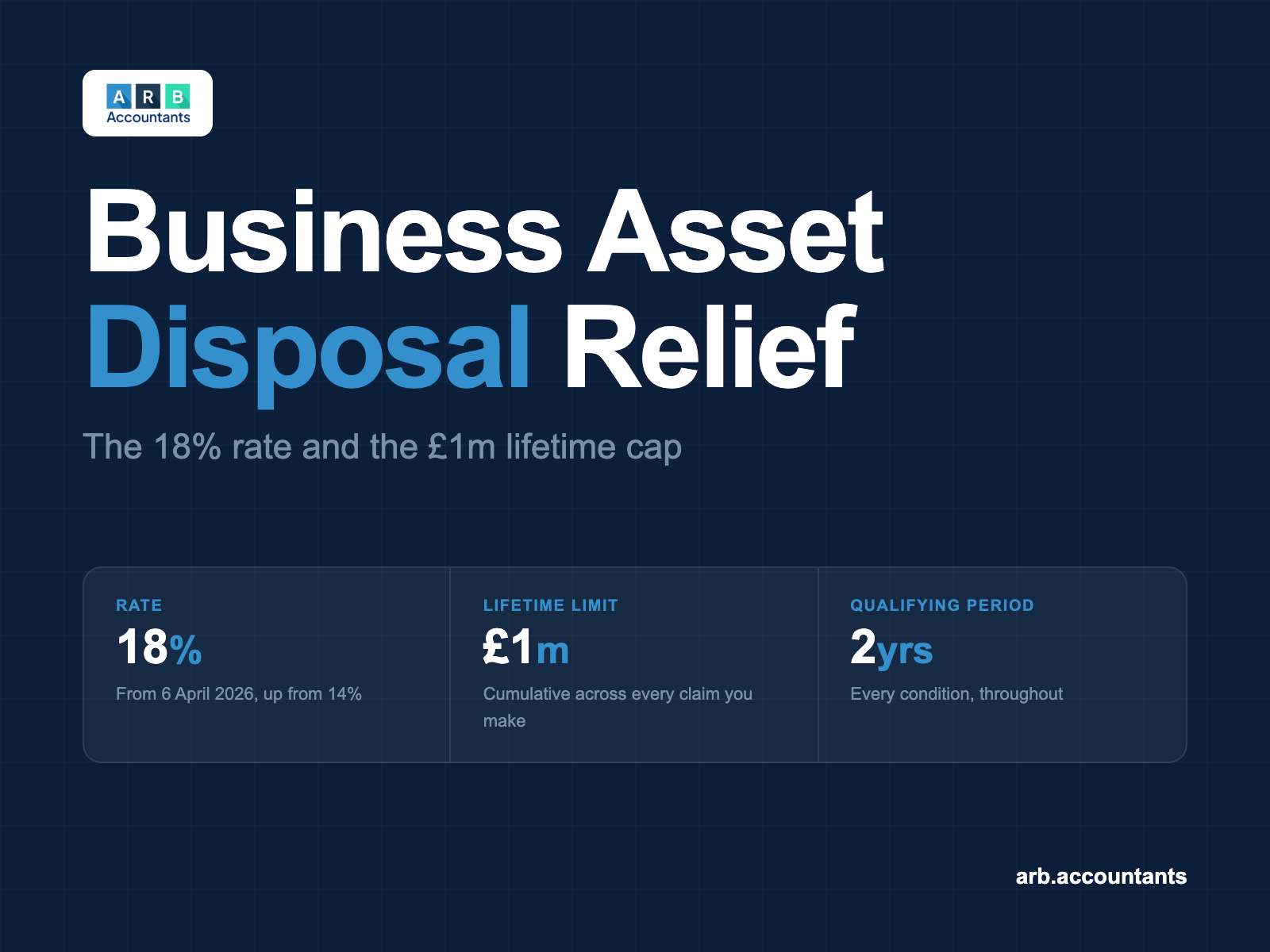
BADR reduces capital gains tax to 18% on qualifying business disposals, capped at a £1 million lifetime limit. Against the standard 24% rate, that's a saving of six percentage points, or up to £60,000 on a full £1m of gains. The rate has risen twice in quick succession: 10% until April 2025, 14% for 2025/26, and 18% from 6 April 2026. The conditions catch more people out than the rate does, and almost all of them turn on a two-year qualifying period you cannot fix retrospectively.
BADR at a glance
- Rate: 18% from 6 April 2026 (was 14%, and 10% before April 2025).
- Lifetime limit: £1 million of gains, cumulative across every claim you have ever made.
- Maximum saving: £60,000, against the 24% standard rate.
- Every condition must be met for two years ending with the disposal.
- Claim deadline: first anniversary of the 31 January after the tax year of disposal.
Table Of Contents
- What BADR Is Worth Now
- The Rate Rises: 10% to 14% to 18%
- Do You Qualify?
- The 5% Test for Shareholders
- The Trading Company Requirement
- The £1m Lifetime Limit
- EMI Shares: The Easier Route
- Property Used by the Business
- Where Claims Go Wrong
- How to Claim
- Get Help Before You Sell
What BADR Is Worth Now
Qualifying gains are taxed at 18% instead of the standard 24%. That's a saving of six percentage points, worth a maximum of £60,000 on a full £1 million of gains.
| Gain | With BADR (18%) | Without (24%) | Saving |
|---|---|---|---|
| £250,000 | £45,000 | £60,000 | £15,000 |
| £500,000 | £90,000 | £120,000 | £30,000 |
| £1,000,000 | £180,000 | £240,000 | £60,000 |
| £2,000,000 | £420,000 | £480,000 | £60,000 (capped) |
Worth having, and worth being honest about: this is a materially smaller relief than it was. On a £1m gain in 2024/25 the saving was £140,000. The relief still justifies planning, but it no longer justifies distorting a commercial decision.
The Rate Rises: 10% to 14% to 18%
The rate that applies depends on the date of disposal, not when you file or when the money arrives. Contracts exchanged before a rate change generally fix the date at exchange rather than completion, which matters for deals straddling 5 April.
| Disposal date | Rate |
|---|---|
| On or before 5 April 2025 | 10% |
| 6 April 2025 to 5 April 2026 | 14% |
| From 6 April 2026 | 18% |
Two rises in two years, and the gap against the standard 24% rate has narrowed from 14 points to 6. It’s reasonable to read a direction of travel here, though nobody should assume 18% is a ceiling.
If a sale is already planned, the date is worth a conversation. If it isn’t, accelerating a sale to chase a rate is how people sell badly. The tax difference between rates is six points; the difference between a well-run sale process and a rushed one is routinely twenty per cent of the price.
Do You Qualify?
The conditions differ by what you’re selling, and every one must have been met throughout the two years ending with the disposal.
Selling a sole trader business or partnership share
- You’ve been a sole trader or business partner for at least two years, and
- You’ve owned the business for at least two years.
You can sell all or part of the business. Selling individual assets out of a continuing business doesn’t qualify, which is a distinction people get wrong: the relief is for disposing of a business or part of one, not for selling off equipment.
Selling shares in your company
- You hold at least 5% of ordinary share capital and voting rights, and
- You’re entitled to at least 5% of profits available for distribution and of assets on a winding up, and
- You’re an employee or office holder of the company or a group company, and
- The company is a trading company or the holding company of a trading group.
If the business has closed
You can still claim if you dispose of the business assets within three years of the business ceasing, provided the two-year conditions were met up to cessation. The same three-year window applies to selling shares in a company that has stopped trading.
The 5% Test for Shareholders
The 5% test is the most common reason a claim fails. It isn't one test but four: 5% of ordinary share capital, 5% of voting rights, 5% of profits available for distribution, and 5% of assets on a winding up. All four, throughout the two years.
The economic tests (profits and assets) were added in 2019 specifically to stop arrangements where someone held 5% of the shares but had no real economic stake. They catch structures that look fine on a shareholders’ register:
- Alphabet shares with different dividend rights. If your class isn’t entitled to 5% of distributable profits, you fail, even holding 5% of the capital.
- Preference shares ranking ahead of you on a winding up, which can push your entitlement to assets below 5%.
- Dilution by a funding round during the two years. Falling below 5% at any point breaks the qualifying period, though there’s a separate election available where dilution is caused by a commercial share issue.
- Growth or hurdle shares which may carry no entitlement until a threshold is met.
This is the single most valuable thing to check early. A structure that fails the test can often be fixed, but the two-year clock restarts from the fix, so discovering it three months before a sale is discovering it too late.
The Trading Company Requirement
The company must be a trading company, meaning its activities don’t include substantial non-trading activities. Substantial is generally taken as more than 20%, measured across income, asset values, expenses and management time.
What puts this at risk in an otherwise ordinary company:
- Surplus cash built up over years. Large cash balances beyond working capital needs can be argued to be an investment activity, though HMRC’s position is that cash held for genuine trading purposes is fine.
- Investment property held alongside the trade, particularly where it’s let to third parties.
- A portfolio of shares or funds bought with retained profits.
A profitable company that banked its profits for a decade rather than distributing them can find itself argued out of trading status at exactly the point the shareholder wants to sell. This is worth looking at years ahead, because unwinding it close to a sale is both expensive and conspicuous.
The £1m Lifetime Limit
The £1 million limit is cumulative across your lifetime, not per disposal and not per business. It counts every qualifying claim you have ever made, including claims under Entrepreneurs' Relief before the 2020 reduction, when the limit was £10 million.
That last point catches serial business owners. Someone who claimed £3m of Entrepreneurs’ Relief on a sale in 2018, entirely legitimately under the then £10m limit, has no lifetime limit left at all. The 2020 change reduced the cap without wiping the slate.
Two practical consequences:
- Check your history before assuming you have £1m available. Prior claims are on your earlier returns.
- Spouses have their own limit. Where shares are genuinely held by both, two lifetime limits are available. Transfers between spouses are on a no gain no loss basis, but the recipient must independently meet every condition, including the two-year period and the employment requirement, so this isn’t something to arrange shortly before a sale.
EMI Shares: The Easier Route
Shares acquired under a qualifying Enterprise Management Incentive option get materially easier treatment. The 5% personal company test doesn't apply at all, and the two year period runs from the date the option was granted rather than when the shares were acquired.
That combination makes EMI the standard route for key employees to qualify for BADR on an exit. A manager holding 1% of the company through EMI options granted three years ago can claim; the same manager holding 1% of ordinary shares bought directly cannot.
For an owner planning an exit, this matters when structuring the team’s participation. EMI is worth considering well before a sale process starts, both because of the two-year clock and because valuation agreements with HMRC take time.
Property Used by the Business
Where you personally own property that your company or partnership uses, selling it as part of your withdrawal from the business can qualify as an associated disposal.
The relief is restricted, and the restriction is where it usually unravels: rent you charged reduces the relief proportionately. Charge a full market rent and the relief can be removed entirely. Charge nothing and it’s generally preserved.
This creates a genuine tension. Charging rent extracts profit from the company tax-efficiently during the trading years. Not charging it preserves BADR on an eventual sale. Which is better depends on how long until the exit and how much the property has appreciated, and it’s a calculation worth doing explicitly rather than drifting into.
Where Claims Go Wrong
From cases we see, in rough order of frequency:
- The two-year period isn’t met. Shares issued eighteen months before a sale. A director appointed too late. The clock cannot be restarted.
- The 5% economic tests fail even though the shareholding is 5%, because of alphabet shares or preference rights.
- Employment ceased before the sale. Stepping back from the business and resigning your directorship before completion breaks the condition at exactly the wrong moment.
- The company isn’t trading enough, usually because of accumulated cash or investment property.
- The lifetime limit was already used by a claim years earlier under Entrepreneurs’ Relief.
- The three-year post-cessation window was missed on a business that closed.
Every one of these is preventable with notice, and almost none is fixable at the point of sale.
How to Claim
Claim through the Capital Gains summary pages of your Self Assessment return, or by writing to HMRC if you don’t file returns.
The deadline is the first anniversary of the 31 January following the tax year of disposal. For a disposal in 2026/27, that’s 31 January 2029. Generous, but not a reason to leave it: the claim is far easier to support while the paperwork is fresh.
You’ll want to keep the share purchase or subscription documents, the articles showing rights attaching to your class of share, evidence of employment or office throughout the period, and the sale agreement.
Get Help Before You Sell
The pattern with BADR is consistent. The relief itself is straightforward. The conditions are not, they are checked retrospectively across a two-year window, and nothing can be fixed after the event.
ARB Accountants works with owners ahead of a sale: reviewing share structures and articles against the conditions, checking the trading status test, confirming what’s left of the lifetime limit, and modelling the tax on different deal structures before terms are agreed.
Planning an exit in the next few years?
Free 60-minute consultation. We'll check whether you currently qualify, what would break it, and what needs fixing while the two year clock still allows it. ACCA-chartered. Fixed fees.
Read next
- Employee Ownership Trusts: the alternative exit, and what changed in November 2025
- How to value a business: what the gain is likely to be
- How to close a limited company: the three year post-cessation window
- Salary vs dividends: extracting value before an exit
Frequently Asked Questions
What is Business Asset Disposal Relief?
BADR is a capital gains tax relief that reduces the rate on qualifying business disposals to 18%, subject to a £1 million lifetime limit. It was called Entrepreneurs' Relief until 2020, when the lifetime limit was cut from £10 million to £1 million and it was renamed.
What is the Business Asset Disposal Relief rate for 2026/27?
18% on qualifying gains from disposals made on or after 6 April 2026. The rate was 14% for disposals between 6 April 2025 and 5 April 2026, and 10% on or before 5 April 2025. The rate that applies depends on the date of disposal, not the date you file.
What is the BADR lifetime limit?
£1 million of qualifying gains across your lifetime. It is cumulative across every claim you have ever made, including claims made under Entrepreneurs' Relief before 2020 when the limit was £10 million. Gains above the limit are taxed at the standard 24% rate.
How much does BADR actually save now?
Six percentage points. Qualifying gains are taxed at 18% instead of the standard 24%, so the maximum saving on a full £1 million of gains is £60,000. When the rate was 10% the saving was 14 points and worth £140,000, so the relief is now worth well under half what it was two years ago.
Who qualifies for Business Asset Disposal Relief?
Broadly, sole traders and partners selling all or part of a business they have owned for at least two years, and shareholders selling shares in a trading company where they hold at least 5% of the shares and voting rights and are an employee or office holder. Every condition must have been met for the two years ending with the disposal.
What is the 5% rule for BADR?
To claim on a share sale you must hold at least 5% of the ordinary share capital and voting rights, and be entitled to at least 5% of the profits available for distribution and 5% of the assets on a winding up. All of those tests must be met throughout the two year qualifying period, not just at the date of sale.
Do I have to be a director to claim BADR?
No, but you must be an employee or office holder of the company or a group company. A non-executive directorship counts as an office. A shareholder with no role in the business at all does not qualify, however long they have held the shares.
Can I claim BADR if I have already closed the business?
Yes, within limits. If the business has ceased, you must dispose of the assets within three years of cessation. The same three year window applies to selling shares in a company that has stopped trading, and the two year qualifying conditions must have been met up to the date trading ceased.
Can I claim BADR on property I own that the business uses?
Sometimes, as an associated disposal, where the property is sold as part of your withdrawal from the business. The relief is restricted, and any rent you charged the company for using the property reduces the relief proportionately. Charging a full market rent can remove it entirely.
How do I claim Business Asset Disposal Relief?
Through the Capital Gains summary pages of your Self Assessment return, or by writing to HMRC if you do not file returns. The deadline is the first anniversary of the 31 January following the tax year of disposal, so for a 2026/27 disposal you have until 31 January 2029.
Should I sell now before the rate rises again?
Selling a business for tax reasons alone is rarely sound, and the rate has now risen twice in two years so there is no guarantee 18% is the ceiling. That said, if a sale was already planned for the next year or two, the direction of travel is a legitimate factor in the timing conversation.
What happens to gains above the £1m limit?
They are taxed at the standard capital gains rate, currently 24% for higher rate taxpayers. There is no tapering: once the cumulative £1 million is used, every further pound of gain is taxed at the full rate.
About The Author

Saurabh Bedi | Director
Saurabh is a tax advisor at ARB Accountants, specialising in Self-Assessment and small business tax. He's dedicated to making tax simple and stress-free, helping clients stay compliant and confident with HMRC.
Qualifications & Experience
- Fellow of Chartered Certified Accountants (ACCA)
- MSc Chartered Certified Accountancy 2008
- Working in accountancy since 2008