Off-Payroll Working Rules Explained: What Contractors and Businesses Need to Know
What is off-payroll working?
Off-payroll working describes an arrangement where an individual provides services to a client through their own limited company — usually called a personal service company — rather than as a direct employee. The individual controls the company, invoices the client through it, and takes income as a combination of salary and dividends.
These arrangements became common from the 1990s onwards because operating through a limited company is tax efficient compared with direct employment. Contractors pay Corporation Tax on company profits and draw dividends taxed at lower rates than employment income. Clients benefit because they avoid employer National Insurance and employment rights obligations.
HMRC’s concern is that many such arrangements are economically indistinguishable from employment. The contractor does the same work, in the same way, under the same direction, as an employee would. The intermediary company changes the tax treatment without changing the substance of the relationship.
The off-payroll working rules address this by requiring that where the substance of the arrangement is employment, it is taxed as employment — regardless of what the company structure says on paper.
The legislation: Chapter 8 and Chapter 10 ITEPA 2003
The UK rules on taxing contractors through intermediaries sit in two chapters of the Income Tax (Earnings and Pensions) Act 2003.
Chapter 8 contains the original IR35 rules introduced in April 2000. Under Chapter 8, it is the contractor’s own company that must determine whether the engagement is inside IR35 and, if it is, operate a deemed employment payment. Chapter 8 still governs small company engagements today.
Chapter 10 contains the off-payroll working rules introduced from April 2017 (public sector) and April 2021 (medium and large private sector). Under Chapter 10, it is the end client — not the contractor — that must make the employment status determination and issue a Status Determination Statement. The fee-payer in the supply chain then operates PAYE and National Insurance where the determination is inside.
The two chapters exist simultaneously. When a client is small, Chapter 8 applies and the contractor self-assesses. When a client is medium or large, Chapter 10 applies and the client determines status. Understanding which chapter applies to a given engagement is the first step in compliance for both contractors and businesses.
Who the off-payroll working rules apply to
The off-payroll working rules under Chapter 10 apply where all four conditions are met:
- The worker provides services to a client in the UK
- Through an intermediary — a limited company, partnership or other vehicle the worker controls
- The client is medium or large — not qualifying as a small company under the Companies Act size criteria
- The engagement would be employment if the intermediary were removed — applying the three employment status tests
Where any of these conditions is absent, Chapter 10 does not apply. If the client is small, Chapter 8 applies instead.
The small company exemption. A company or individual is small if they meet two of the following three criteria in their most recent financial year:
- Annual turnover of £15m or less (updated from £10.2m in April 2025)
- Balance sheet total of £7.5m or less (updated from £5.1m in April 2025)
- 50 or fewer employees
For newly incorporated companies and individuals who are not companies, there are modified tests. Public sector bodies — government departments, NHS trusts, local authorities — are never small for these purposes and have been subject to Chapter 10 since April 2017.
How the off-payroll working rules work in practice
When a medium or large client engages a contractor through a personal service company, the process under the off-payroll working rules is:
Step 1: Employment status assessment. Before or at the start of the engagement, the client assesses whether the working arrangement, if stripped of the intermediary, would be one of employment. The three main tests are personal service, control and mutuality of obligation.
Step 2: Status Determination Statement. The client issues a written SDS to the contractor and to the fee-payer in the supply chain. The SDS must state the determination (inside or outside) and give reasons.
Step 3: Disagreement process. The contractor has the right to challenge the determination through the client’s formal disagreement process. The client must respond within 45 days.
Step 4: Operating PAYE on inside engagements. Where the engagement is inside, the fee-payer deducts Income Tax and employee National Insurance from payments to the contractor’s company, pays employer National Insurance on top, and accounts for these through Real Time Information (RTI) payroll submissions.
Step 5: Passing the SDS down the chain. In engagements involving agencies, the SDS must be passed down the supply chain to every party between the client and the fee-payer. Each party must pass it on within 31 days of receiving it.
Inside off-payroll working engagements — what they mean for contractors
When a client determines that an engagement is inside the off-payroll working rules, the contractor’s company receives payments with PAYE and National Insurance already deducted. The practical consequences are significant.
Tax treatment. The fee-payer treats payments to the contractor’s company as deemed employment payments. They deduct Income Tax at the contractor’s marginal rate (20%, 40% or 45%) and employee National Insurance (8% up to the Upper Earnings Limit, 2% above). They also pay employer National Insurance at 13.8% on top of the gross payment — this comes from the engagement rate itself, reducing the net amount the contractor’s company receives.
No salary and dividend planning. Payments received by the contractor’s company under inside off-payroll working rules are already taxed as employment income. Drawing dividends from the company on those amounts is not possible as normal tax planning — the money has already been taxed at employment rates.
The financial impact. A contractor on a £100,000 contract inside the off-payroll working rules typically takes home between £55,000 and £60,000. An equivalent outside engagement using a salary and dividend structure typically delivers £70,000 to £75,000. The gap of £10,000 to £20,000 represents the real cost of an inside determination.
IR35 insurance. Some contractors take out tax liability insurance that covers the cost of an HMRC investigation and any tax liability arising from a dispute about status. This does not change the determination — it covers the financial risk if a determination is later found to be wrong.
Outside off-payroll working engagements — protecting your position
An outside determination means the client has concluded that the contractor would not be an employee if the intermediary were removed. Payments are made gross to the contractor’s company. The contractor pays Corporation Tax and can use a salary and dividend structure to manage their personal tax position.
Maintaining an outside status requires the working practices to genuinely match the written contract. HMRC and tribunals look at what actually happens, not what the paperwork says. Key indicators of genuine outside status:
Genuine substitution right. The contractor can send a qualified substitute to do the work. The substitution clause must be genuine and, ideally, exercised at least once. A clause that exists only on paper carries very little evidential weight.
Low control. The contractor sets their own hours, chooses how to complete the work, and is not subject to day-to-day direction by the client. Working alongside permanent employees under the same management structure undermines an outside position.
No mutuality of obligation. There is no expectation of ongoing work when the project ends. The client does not guarantee further engagements and the contractor is not obliged to accept them.
Project-based delivery. The engagement has a defined deliverable or outcome. The contractor is paid for completing a piece of work, not for being available.
Business-like conduct. The contractor has multiple clients, markets their services, carries professional indemnity insurance, and operates in a commercially independent way. These factors are not determinative on their own but contribute to the overall picture.
The Status Determination Statement in detail
The SDS is the document at the centre of the off-payroll working rules. Getting it right matters for both clients (who face liability if the SDS is invalid) and contractors (who need a clear statement to challenge or accept).
What a valid SDS must contain:
- A clear conclusion: inside or outside the off-payroll working rules
- The reasons for that conclusion, referencing the specific factors considered
- The name of the worker and the engagement it relates to
- The date of the determination
An SDS that gives a conclusion without reasons is not valid. If a client issues a blank or generic SDS, it is treated as if no SDS has been issued, and liability remains with the client.
The 45-day rule. If a contractor or agency disputes the SDS, the client must respond in writing within 45 days. The response must either confirm the original determination with additional reasons or issue a revised SDS. If the client fails to respond within 45 days, the liability for any PAYE and NI transfers to them — not the agency or contractor.
Passing the SDS down the supply chain. In engagements involving one or more agencies, the client must pass the SDS to the agency it contracts with. That agency must pass it to the next party within 31 days. This continues until it reaches the fee-payer. Each party in the chain must keep a copy.
Supply chain liability — who is responsible
One of the more complex aspects of the off-payroll working rules is how liability is allocated across supply chains involving multiple parties.
Default position: The fee-payer — the entity that pays the contractor’s company — is responsible for operating PAYE and National Insurance on inside engagements.
Liability transfers to the client when:
- The client fails to issue a valid SDS
- The client fails to respond to a disagreement within 45 days
- The client provides fraudulent information to the agency that causes the agency to misclassify the engagement
Liability transfers up the chain when:
- An agency in the supply chain fails to pass on the SDS within 31 days
- An agency provides false information that causes a misclassification
HMRC can pursue any party in the supply chain for unpaid PAYE and National Insurance in certain circumstances, but the default enforcement target is the fee-payer. The liability transfer provisions exist to ensure there is always an identifiable responsible party even in complex multi-tier supply chains.
What businesses need to do to comply
Review your contractor population. Identify every worker providing services through an intermediary. Assess each engagement before the next contract renewal or immediately if no assessment has been made.
Create or update your SDS process. Put in place a documented process for making employment status assessments, issuing SDSs and handling contractor challenges. The process must include a 45-day response commitment.
Update your payroll for inside engagements. Configure your payroll software to handle deemed employer payments — deducting Income Tax and employee National Insurance and paying employer National Insurance on payments to inside contractors’ companies.
Check your supply chain. If you use agencies, confirm they have received your SDSs and are operating PAYE correctly on inside engagements. You cannot fully delegate the compliance risk — fraudulent information from an agency does not always transfer liability away from the client.
Review the small company position annually. If your business is near the small company thresholds, review your accounts each year. A business that grows above the thresholds mid-year may need to start operating Chapter 10 from the following April.
What contractors need to do
Confirm your client’s size. Before starting an engagement, ask whether your client qualifies as small. If they do, you self-assess under Chapter 8. If they do not, they must issue an SDS.
Request an SDS before starting work. Medium and large clients must issue one. If no SDS has been provided, ask for it in writing. Starting work without one does not mean you have no risk — the absence of an SDS transfers liability to the client, not away from the situation altogether.
Review your contract against your working practices. The SDS reflects how the engagement is expected to work. Your contract and your actual day-to-day practices both need to support the outside determination. If the client has determined inside, review whether the working arrangements could be restructured.
Understand the financial impact before accepting an inside engagement. An inside determination is not automatically a reason to walk away — the gross rate may reflect the additional tax cost. But make sure you have calculated the net position before agreeing terms.
Keep records. Document your working practices, substitution arrangements, how you invoice and market your services, and any evidence of genuine business independence. If HMRC investigates, records made at the time carry more weight than reconstructed accounts.
Frequently Asked Questions
What is off-payroll working?
Off-payroll working is when a worker provides services to a client through their own limited company rather than as a direct employee. The off-payroll working rules require medium and large clients to determine whether such arrangements are effectively employment and, if so, to apply PAYE and National Insurance to the payments.
What are the off-payroll working rules?
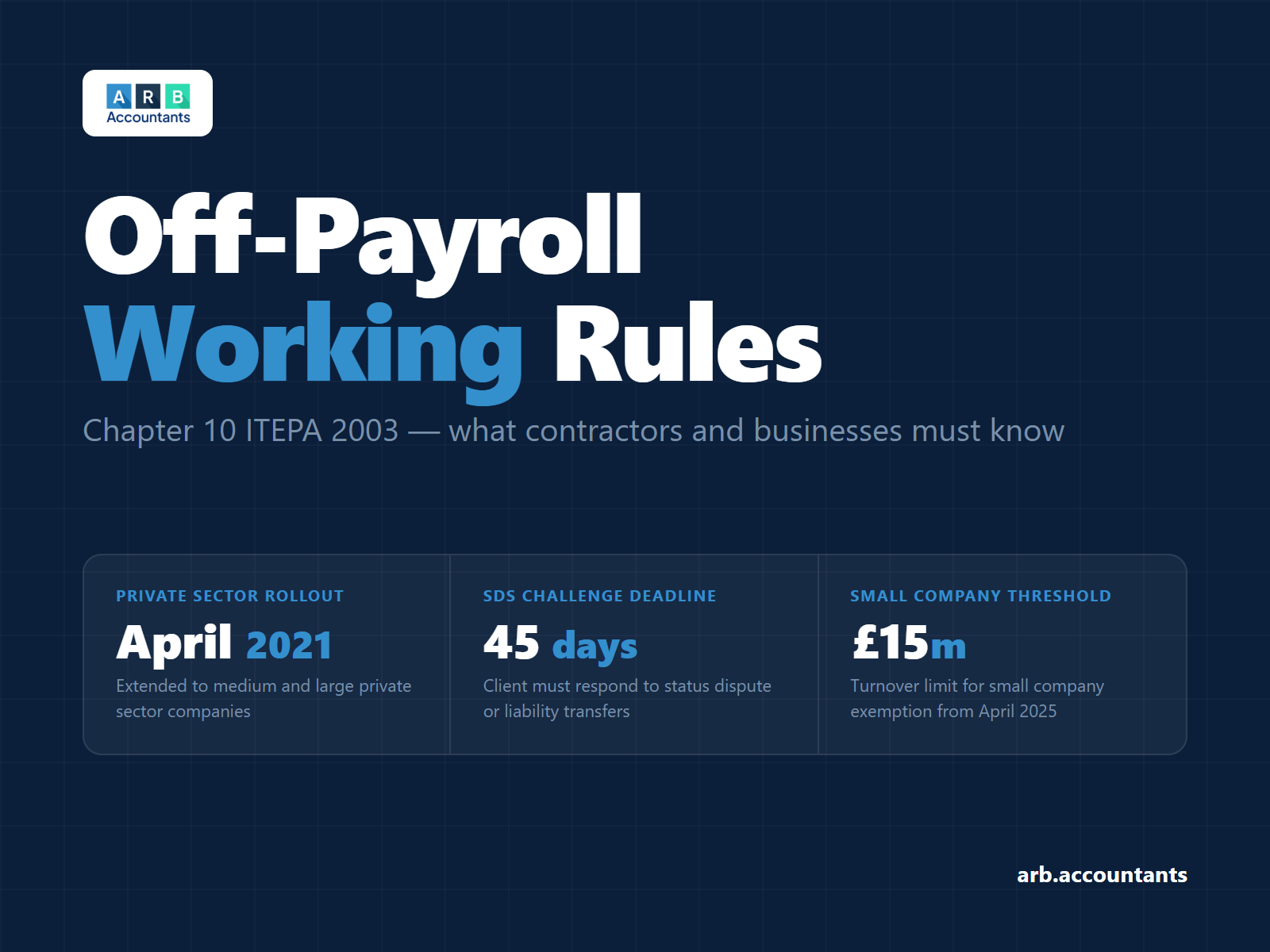
Rules in Chapter 10 of ITEPA 2003 requiring medium and large clients to assess contractor employment status, issue a Status Determination Statement, and ensure PAYE and National Insurance is operated on inside engagements. Introduced for public sector in April 2017 and extended to medium and large private sector companies in April 2021.
What is an inside off-payroll working engagement?
An engagement where the client has determined the contractor would be an employee if their intermediary company were removed. The fee-payer deducts Income Tax and National Insurance from payments to the contractor’s company. The contractor’s take-home pay is significantly lower than on an equivalent outside engagement.
Who is exempt from the off-payroll working rules?
Small companies meeting two of: turnover £15m or less, balance sheet £7.5m or less, 50 or fewer employees. Small clients do not need to issue SDS forms and the contractor assesses their own status under Chapter 8 IR35 rules.
What must a Status Determination Statement contain?
A clear inside or outside conclusion, the reasons for that conclusion referencing specific factors assessed, the worker’s name, and the date. An SDS without reasons is invalid and leaves liability with the client.
What happens if a client does not issue an SDS?
Liability for PAYE and National Insurance transfers to the client. The same applies if the client fails to respond to a contractor’s challenge within 45 days.
Can I challenge an inside off-payroll working determination?
Yes. Every medium and large client must have a formal disagreement process. Submit your challenge in writing and the client must respond within 45 days. If they do not respond, liability transfers to them.
What is the difference between IR35 and off-payroll working?
IR35 is the informal name for the original 2000 intermediaries legislation in Chapter 8 ITEPA 2003, where contractors self-assessed. Off-payroll working rules (Chapter 10) are the 2017 and 2021 reforms that shifted the assessment responsibility to the end client for medium and large engagements. Both target the same underlying issue: disguised employment through a personal service company.
Get Help With Off-Payroll Working Compliance
Whether you are a contractor reviewing your status, a business assessing your contractor population, or an agency navigating supply chain liability, ARB Accountants can help you get the off-payroll working rules right.
ACCA-chartered. Fixed fees. Free 60-minute consultation.
Book a free consultation or call 01702 345 207.
Frequently Asked Questions
What is off-payroll working?
Off-payroll working describes an arrangement where a worker provides services to a client through their own limited company or other intermediary rather than as a direct employee. The off-payroll working rules — introduced for the public sector in April 2017 and extended to the private sector in April 2021 — require medium and large clients to determine whether such arrangements are effectively employment and, if so, to apply PAYE and National Insurance to the payments made.
What are the off-payroll working rules?
The off-payroll working rules are contained in Chapter 10 of the Income Tax (Earnings and Pensions) Act 2003. They require medium and large clients to assess whether each contractor working through a personal service company would be an employee if the intermediary company were removed. Where the answer is yes, the engagement is inside the off-payroll working rules, the client issues a Status Determination Statement and the fee-payer operates PAYE and National Insurance on the contractor's payments.
Who do the off-payroll working rules apply to?
The rules apply to contractors who provide services through a personal service company or other intermediary to a medium or large client in the UK. They apply to public sector bodies, large companies (annual turnover over £15m, balance sheet over £7.5m, or more than 50 employees, meeting at least two of three criteria) and medium-sized companies. Small companies are exempt — if your client qualifies as small, you assess your own IR35 status as the contractor.
What is an inside off-payroll working engagement?
An inside off-payroll working engagement is one where the client has determined that the contractor, if working directly without a personal service company, would be an employee. In this case, the fee-payer deducts Income Tax and employee National Insurance from payments to the contractor's company and pays employer National Insurance on top. The contractor's company receives net payments after PAYE deductions and cannot use salary and dividend planning to reduce the tax on that income.
What is a Status Determination Statement?
A Status Determination Statement (SDS) is a written notice that medium and large clients must issue to the contractor and the fee-payer before or at the start of an engagement. It must state clearly whether the engagement is inside or outside the off-payroll working rules and explain the reasons for that conclusion. The client must also have a process for contractors to disagree with the determination and must respond to any challenge within 45 days.
What happens if a client fails to issue a Status Determination Statement?
If a client fails to issue a valid SDS, the tax and National Insurance liability for the engagement transfers to the client themselves — not the agency or fee-payer further down the supply chain. The same transfer of liability occurs if the client does not respond to a contractor's challenge within 45 days. Issuing an SDS that does not give reasons is also treated as no SDS for these purposes.
Are small companies exempt from the off-payroll working rules?
Yes. Small companies are exempt from the off-payroll working rules. A company qualifies as small if it meets two of: annual turnover of £15m or less (updated from £10.2m in April 2025), balance sheet total of £7.5m or less (updated from £5.1m), and 50 or fewer employees. Where a client is small, the contractor's own company determines employment status under the original IR35 rules in Chapter 8 ITEPA 2003.
What is the CEST tool and should I use it?
CEST (Check Employment Status for Tax) is HMRC's online tool for assessing whether a particular engagement falls inside or outside the off-payroll working rules. HMRC will stand behind results produced by CEST where the information entered is accurate and complete. Using CEST and keeping a copy of the result is not mandatory, but it provides a documented audit trail that supports reasonable care if a determination is later challenged.
Can a contractor challenge an inside determination?
Yes. Every medium and large client must have a formal disagreement process. If a contractor disagrees with an SDS, they submit their reasons to the client in writing. The client must review the determination and respond within 45 days, either confirming the original determination with reasons or issuing a revised SDS. If they fail to respond within 45 days, liability transfers to the client.
What is the difference between off-payroll working rules and IR35?
IR35 is the informal name for the UK intermediaries legislation originally introduced in April 2000, governed by Chapter 8 ITEPA 2003. The off-payroll working rules are a later addition — Chapter 10 ITEPA 2003 — introduced in 2017 and 2021 that shifted responsibility for determining status from the contractor to the client. Both sets of rules aim to prevent the same thing: workers who are effectively employees using a limited company to pay less tax. The difference is who is responsible for making the determination and operating PAYE.
About The Author

Saurabh Bedi | Director
Saurabh is a tax advisor at ARB Accountants, specialising in Self-Assessment and small business tax. He's dedicated to making tax simple and stress-free, helping clients stay compliant and confident with HMRC.
Qualifications & Experience
- Fellow of Chartered Certified Accountants (ACCA)
- MSc Chartered Certified Accountancy 2008
- Working in accountancy since 2008