Small Business Tax Tips: How to Legally Reduce Your Tax Bill
1. Claim every allowable expense — including the ones you’re missing
The single biggest tax leak for small businesses is not claiming costs they are entitled to. HMRC allows any cost that is wholly and exclusively incurred for business purposes to be deducted before calculating taxable profit. At 19% Corporation Tax or 40% Income Tax, every £1,000 you miss costs you £190 to £400 in tax you did not need to pay.
The most commonly missed deductions for small businesses:
Professional subscriptions and memberships. Industry body memberships, trade association fees, professional journals and technical reference materials are all allowable if directly relevant to your business. Many business owners pay these personally and forget to log them.
Software and digital tools. Accounting software, project management tools, cloud storage, design platforms, email marketing tools and any subscription used in the business is fully deductible. Track recurring subscriptions — these often go unnoticed through the year.
Training and professional development. Courses, seminars, online learning platforms and books that maintain or update skills relevant to your current trade are allowable. Training to develop an entirely new skill or trade is not, but existing-trade development is.
Business travel and subsistence. Mileage at HMRC’s approved rates (55p per mile for the first 10,000 miles from 6 April 2026, up from 45p, then 25p beyond), train and bus fares for business journeys, parking and subsistence costs when travelling on business away from your normal workplace are all claimable. Commuting to a regular fixed workplace is not.
Phone and broadband. The business-use proportion of your phone bill and home broadband is deductible. If your phone is used 70% for business, claim 70% of the cost.
Bank charges and interest. Business bank account fees and interest on business loans and credit facilities are allowable expenses, including the interest element of hire purchase agreements on business assets.
2. Get your business structure right for your profit level
The choice between operating as a sole trader and running a limited company is the single biggest structural tax decision a small business owner makes, and many owners never revisit it after first starting out.
As a sole trader, all profit is taxed as your personal income. At the 40% higher rate, a sole trader earning £70,000 in profit pays Income Tax at 40% on everything above £50,270, plus Class 4 National Insurance. The combined marginal rate above £50,270 is 42%.
As a limited company director drawing a low salary and dividends, the same £70,000 of profit is first subject to Corporation Tax at 19% (on profits up to £50,000), and the remainder extracted as dividends taxed at 8.75% (basic rate) or 33.75% (higher rate). The overall effective rate is materially lower.
The crossover point where a limited company starts saving meaningful money is broadly £30,000 to £40,000 of annual profit, once accountancy costs are factored in. Below that threshold, the additional compliance cost often erodes the saving. Above it, the difference compounds each year.
3. Use the salary and dividend structure if you have a limited company
If you already operate through a limited company, the salary and dividend strategy is the most consistently effective tax tip available to you.
The optimal salary level for 2025/26 depends on your circumstances:
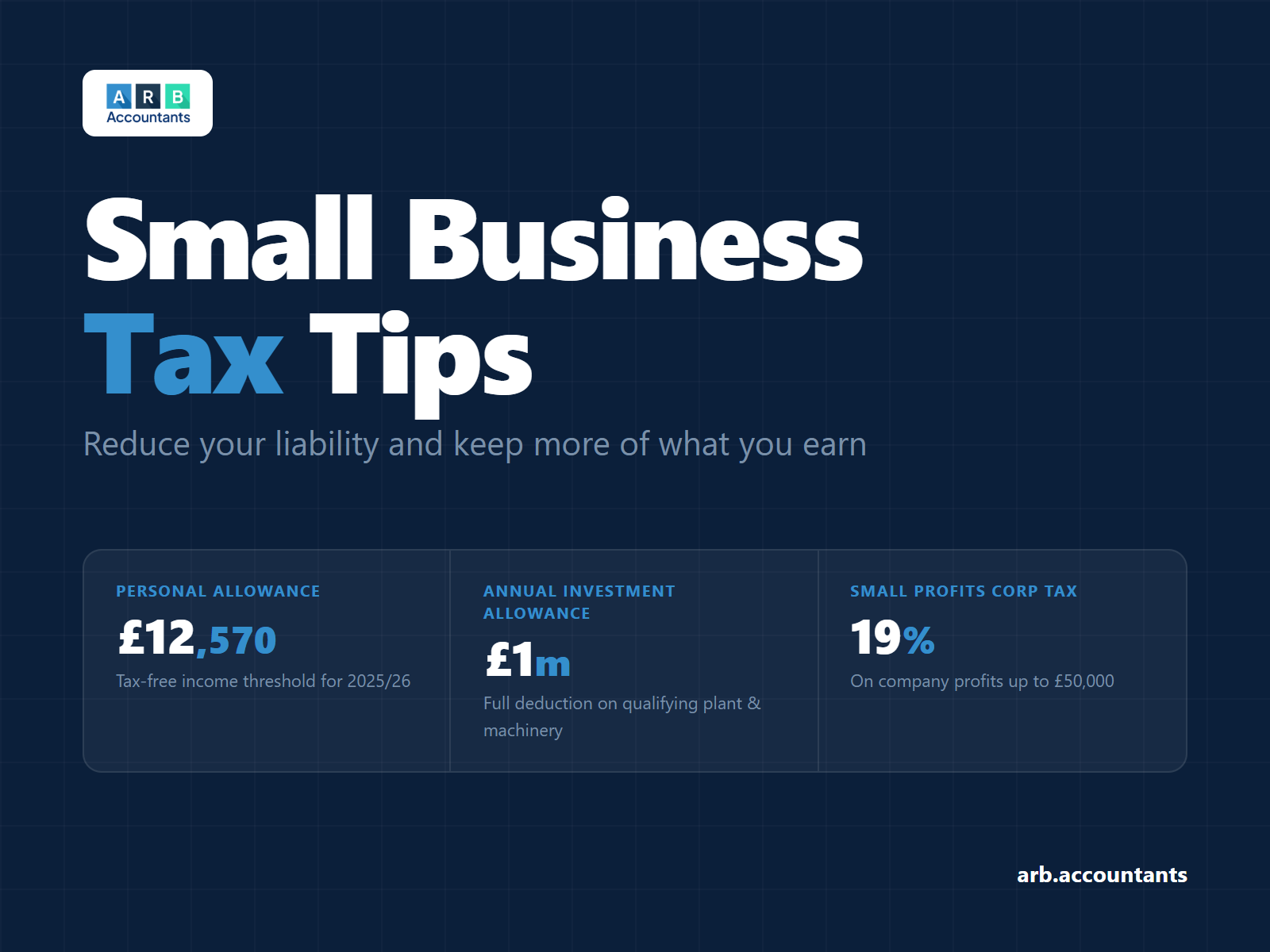
- £12,570 (Personal Allowance): no Income Tax on the salary; the salary is deductible against Corporation Tax. You pay no employee NI below £12,570 but the employer NI secondary threshold is £5,000, so employer NI applies on salary above £5,000 unless you use the Employment Allowance.
- £5,000 (Secondary NI threshold): no employer National Insurance. Suitable if you are not eligible for the Employment Allowance (sole director with no other employees).
Profits above the salary level are drawn as dividends. Dividends are taxed at 8.75% (basic rate), 33.75% (higher rate) and 39.35% (additional rate) — no National Insurance. The dividend allowance for 2025/26 is £500, meaning the first £500 of dividends is tax-free.
A director drawing £12,570 salary and £67,430 in dividends from a company with £80,000 profit pays substantially less combined tax than an employee on a £80,000 PAYE salary.
4. Make pension contributions before your year end
Employer pension contributions are one of the most tax-efficient tools available to limited company directors, and one of the most underused.
Every pound the company contributes to a director’s pension:
- Reduces taxable profits, saving Corporation Tax at 19% or 25%
- Attracts no employer National Insurance (unlike salary)
- Does not count as a benefit in kind for Income Tax purposes
For a company paying the 25% marginal Corporation Tax rate, a £10,000 employer pension contribution costs the company effectively £7,500 after tax relief. That £10,000 sits in your pension growing free of Income Tax and Capital Gains Tax.
The annual pension allowance for 2025/26 is £60,000 (combined employer and employee contributions). If you have unused allowance from the previous three tax years, you can carry it forward and make a larger contribution.
Timing matters. Contributions must be paid before the company’s financial year end to be deductible in that year’s Corporation Tax calculation.
5. Use the Annual Investment Allowance in full
The Annual Investment Allowance (AIA) allows businesses to deduct the full cost of qualifying plant and machinery from taxable profits in the year of purchase — up to £1 million per year. For most small businesses, the £1 million cap is more than sufficient to cover all capital spending in a year.
Qualifying assets include computers and IT equipment, office furniture, machinery, tools, commercial vehicles and some building fixtures. Cars have their own rules and generally do not qualify for AIA, though electric cars and vans qualify for a 100% First Year Allowance.
Why timing matters. If your financial year ends on 31 March and you are planning a £30,000 equipment purchase, buying it in March rather than April brings the tax relief forward by a full year. At 19% Corporation Tax, that is £5,700 of tax relief arriving twelve months earlier — a real cash flow benefit.
If you have already spent over the AIA limit in a year, any additional qualifying assets can be claimed at the 18% writing-down allowance rate — so larger spenders still get ongoing relief, just spread over time.
6. Time income and expenditure around your accounting period
Cash basis accounting and the timing of invoices and payments gives businesses flexibility in when income and costs are recognised for tax purposes.
Invoicing. If your profits are unusually high in one year (perhaps due to a large one-off project), consider whether any invoices for work done near your year end can be raised early in the following year instead. Shifting £20,000 of income across a year boundary moves the tax bill back by a year.
Expenditure. Conversely, accelerating planned expenditure into the current year — renewing insurance, prepaying subscriptions, stocking up on consumables — can reduce this year’s taxable profit when that is advantageous.
Note on accruals accounting. Limited companies using accruals accounting must recognise income when earned and expenses when incurred, not when cash changes hands. Cash flow timing has less scope in this structure, though invoice timing and genuine pre-year-end spending still apply.
7. Review your VAT scheme — you may be on the wrong one
Most VAT-registered small businesses default to the standard VAT accounting scheme and never reconsider it. For some businesses, a different scheme saves meaningful money every year.
Flat Rate Scheme. You charge customers VAT at 20% but pay HMRC at a lower flat rate specific to your sector (for example, 14.5% for management consultancies, 12% for accountancy firms). The difference is yours. With annual turnover up to £150,000 (excluding VAT), the calculation is simple and the potential saving can reach several thousand pounds per year for service businesses with low VAT costs. A new business gets an additional 1% discount in its first year.
Cash Accounting Scheme. You pay VAT to HMRC only when customers pay you (not when you invoice them) and reclaim input VAT only when you pay suppliers. This is valuable if you have slow-paying clients — it protects your cash flow and prevents you paying VAT on invoices that have not yet been settled.
Annual Accounting Scheme. You file one VAT return per year rather than quarterly, making nine interim payments throughout the year based on your previous year’s liability. This reduces paperwork and makes cash flow more predictable.
8. Check whether you qualify for R&D tax credits
Research and Development (R&D) tax credits are significantly under-claimed by small businesses, often because owners assume they do not qualify. HMRC’s definition of qualifying R&D is much broader than most people expect.
You do not need to be a tech company or have a dedicated research department. R&D for HMRC purposes includes any project that seeks to achieve a scientific or technological advance and involves resolving genuine uncertainty that a competent professional could not easily resolve. This includes:
- Developing bespoke software for your own use or for clients
- Creating new or improved manufacturing processes
- Solving engineering problems with no established solution
- Developing new products with technical functionality that goes beyond existing knowledge
Since April 2024, the SME and RDEC schemes have been merged into a single R&D Expenditure Credit (RDEC) scheme, with a merged rate of 20% for most companies. Loss-making companies can still receive cash payments in some circumstances.
If your business involves any technical problem-solving, it is worth asking a specialist to review whether an R&D claim is appropriate. Retrospective claims can go back two accounting periods.
9. Claim home office costs correctly
Working from home is now standard for many small business owners, but the home office deduction is frequently under-claimed or miscalculated.
Sole traders can claim using HMRC’s flat rate (£10 per month for 25 to 50 hours worked at home, £18 for 51 to 100 hours, £26 for over 100 hours) or calculate the actual proportion of home costs used for business based on floor area and time. If the actual proportion exceeds the flat rate, the calculation is usually worthwhile.
Limited company directors have two main options. The company can pay the director a use-of-home charge, typically £6 per week under HMRC’s simplified rules (or a higher calculated amount if supported). Alternatively, if a room is used exclusively for business and the company pays rent for it, this creates a licence arrangement — more complex but potentially larger deduction.
What you cannot do as a limited company director is claim home office costs personally as an employee expense unless you have a formal homeworking arrangement with the company and the expenses meet strict criteria.
10. Keep records properly and use an accountant who looks ahead
The most consistent tax tip across all structures and profit levels is this: good record-keeping and an accountant who plans rather than just files.
Reactive accountancy — handing over receipts in January and having a return filed — misses all the year-end opportunities above. Proactive tax planning, reviewed at least once before your financial year end, consistently finds savings that reactive filing misses.
The measurable return on a good accountant is straightforward. A specialist accountant who identifies £5,000 of missed deductions, optimises your salary level, times a pension contribution correctly and recommends a VAT scheme review can easily save £2,000 to £5,000 in tax in a single year — frequently more than their fee.
Frequently Asked Questions
What are the best tax tips for small businesses?
Claim every allowable expense including commonly missed ones (software, training, home office), use the Annual Investment Allowance for equipment, use a salary and dividend structure if you trade through a limited company, make employer pension contributions before your year end, review whether a VAT scheme saves money, and plan the timing of income and expenditure around your accounting period.
How can a small business reduce its tax bill legally?
By using reliefs and allowances HMRC builds into the tax system: deducting all allowable expenses, using the Annual Investment Allowance, claiming R&D tax credits where eligible, making pension contributions, and structuring income efficiently. These are not avoidance — they are reliefs designed for businesses to use.
How much tax does a small business pay in the UK?
Sole traders pay Income Tax at 20%, 40% or 45% on profits above the Personal Allowance (£12,570 for 2025/26) plus Class 4 National Insurance. Limited companies pay Corporation Tax at 19% on profits up to £50,000 or 25% on profits above £250,000, with directors paying additional Income Tax and National Insurance on salary.
What expenses can a small business claim?
Staff wages, office rent, utilities, professional fees, marketing, software, business travel (at HMRC approved mileage rates), training, insurance, and the business-use proportion of home costs. Capital items like equipment are claimed through the Annual Investment Allowance rather than as revenue expenses.
Are pension contributions tax-deductible for small businesses?
Yes. Employer pension contributions are fully deductible against Corporation Tax and attract no employer National Insurance, making them one of the most efficient ways to reduce a limited company’s tax bill. The annual pension allowance is £60,000 for 2025/26.
What is the Annual Investment Allowance?
The AIA lets businesses deduct the full cost of qualifying plant and machinery — up to £1 million per year — from taxable profits in the year of purchase. For a small business buying £20,000 of equipment, AIA gives immediate full tax relief rather than spreading small deductions over years through writing-down allowances.
Should my small business be a sole trader or limited company?
At profits below roughly £30,000 to £40,000 per year, sole trader status is often simpler and comparably tax-efficient. Above that level, a limited company with a salary and dividend structure typically saves meaningful tax because dividends are taxed at lower rates than employment income and Corporation Tax at 19% is lower than higher-rate Income Tax at 40%.
Can I claim home office expenses as a small business owner?
Yes. Sole traders can use HMRC’s flat rate (£10 to £26 per month depending on hours) or calculate the actual proportion of home costs used for business. Limited company directors can charge a use-of-home fee to the company. The rules differ by structure, so it is worth understanding which approach applies to you.
Talk to ARB About Your Business Tax Position
ARB Accountants works with sole traders, limited company directors, landlords and contractors across the UK. Whether you want a one-off tax review, year-round planning support, or help identifying missed deductions, we look at your full picture — not just what needs filing.
ACCA-chartered. Fixed fees. Free 60-minute consultation.
Book a free consultation or call 01702 345 207.
Frequently Asked Questions
What are the best tax tips for small businesses?
The most effective small business tax tips are: claim every allowable expense (especially the commonly missed ones like home office, software and training), use the Annual Investment Allowance for equipment purchases, use a salary and dividend structure if you trade through a limited company, make employer pension contributions before your year end, review your VAT scheme, and plan the timing of income and major expenditure around your accounting period.
How can a small business reduce its tax bill legally?
Legal tax reduction works by using reliefs and allowances HMRC builds into the tax system: deducting all allowable expenses, using the Annual Investment Allowance, claiming R&D tax credits if you innovate, making pension contributions, and structuring income efficiently. None of this is avoidance. These are reliefs designed for businesses to use.
How much tax does a small business pay in the UK?
Sole traders pay Income Tax at 20%, 40% or 45% on profits above £12,570, plus Class 4 National Insurance at 6% up to £50,270 and 2% above. Limited companies pay Corporation Tax at 19% on profits up to £50,000 or 25% on profits above £250,000, and directors pay Income Tax and National Insurance on any salary drawn.
What expenses can a small business claim against tax?
Allowable expenses include: staff wages and salaries, office rent and rates, utilities, professional fees (accountancy, legal), marketing, software subscriptions, business travel and vehicle costs, professional development and training, insurance, and the business-use proportion of home running costs. Capital items like equipment are claimed through the Annual Investment Allowance rather than as revenue expenses.
Should I be a sole trader or limited company to save tax?
At profits under roughly £30,000 to £40,000 per year, sole trader status is often simpler and equally tax-efficient. Above that level, a limited company with a salary and dividend structure typically saves meaningful tax because dividends are taxed at lower rates than employment income (8.75% basic rate versus 20%) and Corporation Tax at 19% is lower than higher-rate Income Tax at 40%.
How does the salary and dividend strategy work?
Limited company directors take a salary at or near the Personal Allowance (£12,570) or Secondary NI threshold (£5,000 for 2025/26) to keep PAYE costs minimal while making the salary deductible against Corporation Tax. Additional profits are drawn as dividends, taxed at 8.75% (basic), 33.75% (higher) or 39.35% (additional rate) — substantially lower than equivalent employment income tax rates.
Are pension contributions tax-deductible for small businesses?
Yes. Employer pension contributions are fully deductible against Corporation Tax and attract no employer National Insurance — making them one of the most tax-efficient ways to extract value from a limited company. The annual pension allowance is £60,000 for 2025/26, including both employer and employee contributions.
What is the Annual Investment Allowance and how much can I claim?
The Annual Investment Allowance lets you deduct the full cost of qualifying plant and machinery — up to £1 million per year — from your taxable profits immediately. For a small business buying £20,000 of equipment, AIA gives full tax relief in year one rather than spreading it over years. At 19% Corporation Tax, that is a £3,800 saving upfront.
Can a small business claim home office expenses?
Yes. Sole traders can claim a proportion of home running costs (broadband, heat, light, council tax) based on rooms used for work and hours worked, or use HMRC's flat rate (£10 to £26 per month). Limited company directors can charge the company a use-of-home fee or the company can pay for dedicated home office expenses. The rules differ by structure.
What is Making Tax Digital and does it apply to my small business?
Making Tax Digital requires digital record-keeping and software-based filing. MTD for VAT is already mandatory for all VAT-registered businesses. MTD for Income Tax Self Assessment applies from April 2026 for sole traders and landlords with income above £50,000. Getting compatible software in place now avoids last-minute compliance pressure.
About The Author

Saurabh Bedi | Director
Saurabh is a tax advisor at ARB Accountants, specialising in Self-Assessment and small business tax. He's dedicated to making tax simple and stress-free, helping clients stay compliant and confident with HMRC.
Qualifications & Experience
- Fellow of Chartered Certified Accountants (ACCA)
- MSc Chartered Certified Accountancy 2008
- Working in accountancy since 2008