Employee Ownership Trusts: What Changed in November 2025
What is an Employee Ownership Trust, and what changed?
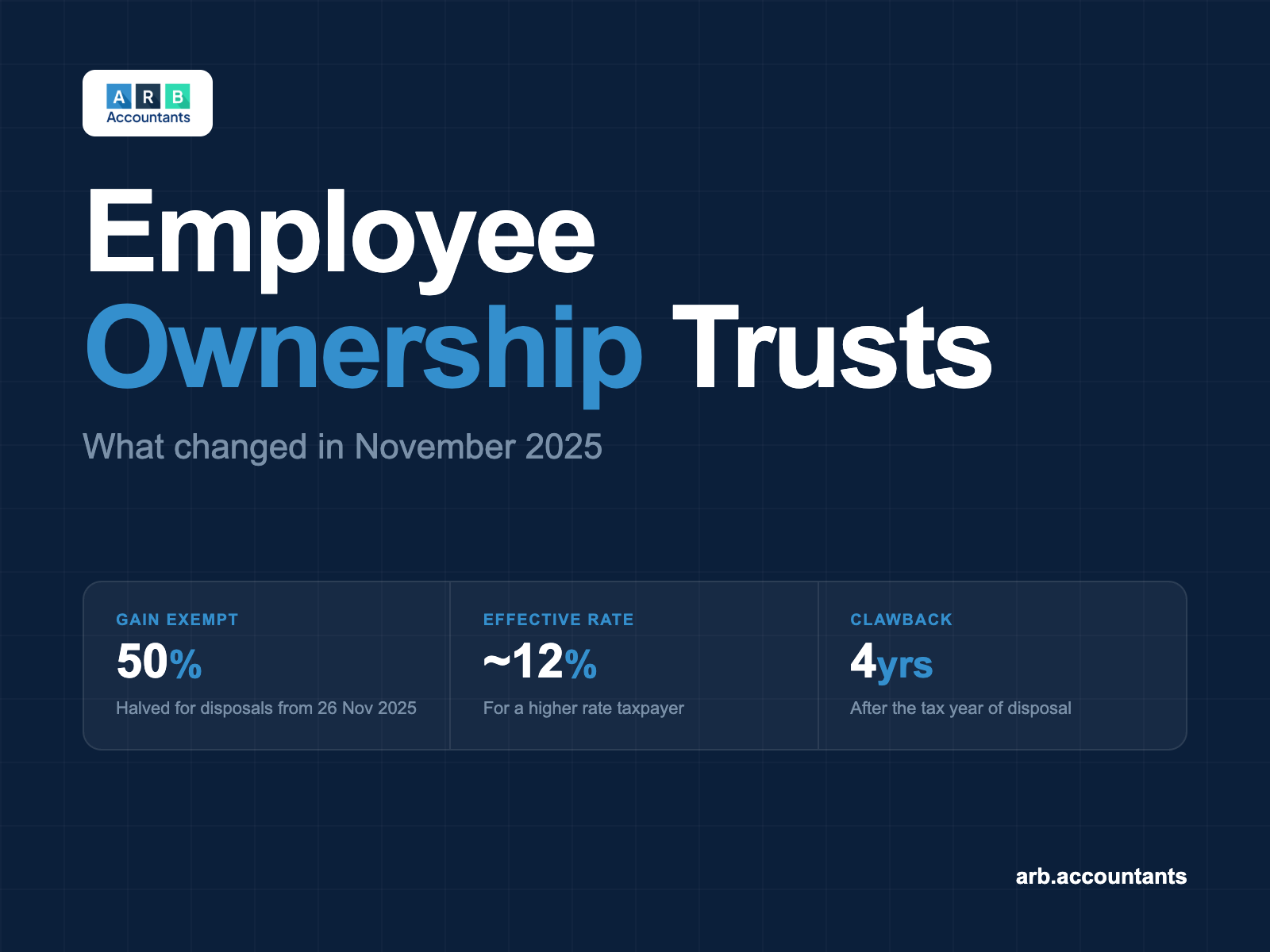
An EOT is a trust that buys a controlling interest in a company on behalf of all its employees, letting an owner exit without a trade sale. Until recently the whole gain was free of capital gains tax. For disposals on or after 26 November 2025, only 50% of the gain is exempt and the rest is taxed at the normal rate, giving an effective rate of about 12% for a higher rate taxpayer. BADR cannot be claimed on the taxable half. It's still usually the lowest-tax exit available, but the gap has narrowed sharply.
EOTs at a glance
- 50% of the gain exempt for disposals from 26 November 2025 (previously 100%).
- Effective rate around 12% for a higher rate taxpayer.
- No BADR on the taxable half, and no £1m cap on the relief either.
- Trustees must be UK resident, and former owners cannot control the board.
- Relief can be clawed back for four tax years after the year of disposal.
Table Of Contents
- What Is an Employee Ownership Trust?
- The November 2025 Change
- What an EOT Sale Costs in Tax Now
- EOT vs BADR vs Trade Sale
- The Qualifying Conditions
- How the Seller Actually Gets Paid
- The Four-Year Clawback
- Tax-Free Bonuses for Employees
- When an EOT Makes Sense
- Get Help Assessing an EOT
What Is an Employee Ownership Trust?
An EOT is a trust holding a controlling interest in a company for the benefit of all its employees. Introduced by the Finance Act 2014 and modelled loosely on the John Lewis structure, it allows an owner to sell to their workforce collectively rather than to a competitor, a private equity buyer or a management team.
The employees don’t own shares individually. The trust owns the shares on their behalf, which avoids the administrative problem of issuing and repurchasing shares as people join and leave. What employees get is a stake in the company’s future through the trust, plus the ability to receive income-tax-free bonuses.
For owners it solves a specific problem: what happens to the business and the people in it after you leave. A trade sale often means redundancies, relocation, or the business being absorbed. An EOT keeps it intact, which for many owner-managers matters as much as the price.
The trade-off is commercial rather than legal, and it’s significant: EOT sales usually pay less, and pay it later.
The November 2025 Change
At the Autumn Budget 2025, the capital gains relief on a qualifying EOT disposal was cut from 100% to 50%, with immediate effect for disposals on or after 26 November 2025. The government's stated reason was that the cost of the relief had grown significantly beyond what was expected when it was introduced in 2014.
What the change means:
- 50% of the gain is exempt. The other 50% is taxable at the normal rate, currently 24% for higher rate taxpayers.
- BADR and Investors’ Relief are blocked on the taxable half. The reliefs cannot be combined.
- Immediate effect. No transitional period, so deals in progress on 26 November 2025 were caught mid-flight.
This sits alongside a set of tightening measures from 30 October 2024: trustees must now be UK resident, former owners and connected persons cannot form a majority of the trustee board, trustees must take reasonable steps not to pay more than market value, and the clawback window was extended.
The practical consequence for anyone reading about EOTs is that a great deal of published material is now wrong. Guidance written before late 2025 describes a completely tax-free exit. That is no longer the position, and it’s the single most important thing to check the date on before relying on anything you read, including the modelling in an adviser’s pitch.
What an EOT Sale Costs in Tax Now
On a £3 million gain for a higher rate taxpayer:
| EOT (from 26 Nov 2025) | EOT (before) | BADR | No relief | |
|---|---|---|---|---|
| Exempt | £1,500,000 | £3,000,000 | £1,000,000 at 18% | £0 |
| Taxable | £1,500,000 at 24% | £0 | £2,000,000 at 24% | £3,000,000 at 24% |
| Tax | £360,000 | £0 | £660,000 | £720,000 |
| Effective rate | 12% | 0% | 22% | 24% |
The EOT remains the cheapest route, and the gap widens as the gain grows, because BADR is capped at £1m of lifetime gains while the 50% EOT exemption has no cap at all. On a £10m gain the EOT effective rate is still 12%, while BADR delivers an effective rate of about 23.4%.
What’s gone is the position where an EOT was simply free. A £3m gain now carries a £360,000 tax bill that didn’t exist in 2024, and that bill lands on a seller who is typically being paid in instalments over five years. The cash flow mismatch between paying tax at completion and receiving consideration over time is now a real planning issue rather than a theoretical one.
EOT vs BADR vs Trade Sale
Tax is one input. These usually matter more:
| EOT | Trade sale | |
|---|---|---|
| Price | Usually lower, based on an independent valuation | Usually higher, competitive tension |
| Payment | Deferred over several years from profits | Often substantially cash at completion |
| Certainty of payment | Depends on future trading | Cash is cash |
| Effective tax rate | ~12% | Up to 24%, or 18% on the first £1m with BADR |
| What happens to staff | Continuity | Buyer’s decision |
| Your involvement after | Often continues | Usually an earn-out then out |
| Process cost and time | Moderate, no competitive process | Higher, due diligence heavy |
The honest framing: an EOT trades price and payment certainty for tax efficiency, continuity and control over the outcome. Owners who choose it usually do so because they care what happens to the business, and the tax treatment makes that choice affordable rather than driving it.
If the answer to “what happens to my staff” is “not my problem”, an EOT is probably the wrong structure, because the deferred consideration depends entirely on the business continuing to perform without you.
The Qualifying Conditions
All of these must be satisfied:
Trading requirement. The company must be a trading company or the holding company of a trading group. Property investment and investment businesses don’t qualify.
Controlling interest. The trust must acquire more than 50% of the ordinary share capital, voting rights, and entitlement to profits and assets on a winding up, and must hold it by the end of the tax year of disposal.
All-employee benefit. The trust must benefit all eligible employees on the same terms. Amounts can be varied by remuneration, length of service and hours worked, but not by seniority or discretion.
Limited participation. Broadly, the ratio of continuing shareholders who are directors or employees to the total number of employees must not exceed two fifths. This stops a structure where the same small group effectively retains control.
UK resident trustees. Required for disposals from 30 October 2024.
No majority control by former owners. Former owners and persons connected with them cannot make up a majority of the trustee board.
Market value. Trustees must take reasonable steps to ensure they don’t pay more than market value, which makes an independent valuation effectively mandatory.
How the Seller Actually Gets Paid
This is the part that surprises owners. The trust has no money of its own. It buys your shares with consideration funded, in almost all cases, from the company's future profits contributed to the trust over a number of years.
Typical structures:
- Deferred consideration from profits. The company contributes cash to the trust annually, which pays the seller in instalments. Five to seven years is common.
- Bank funding for part of the consideration at completion, with the balance deferred.
- Vendor loan notes, sometimes carrying interest.
Three consequences worth being clear-eyed about:
- You remain exposed to the business. If trading deteriorates, the instalments may not be paid. You’ve sold the company but retained much of the risk.
- The tax may fall due before the cash arrives. The disposal happens at completion even if payment spreads over years, and the capital gains tax follows the disposal. On the old 100% relief this rarely mattered. With a 12% effective rate on a large gain, it very much does.
- The company must be able to afford it. Contributions to the trust come out of profits that would otherwise fund growth. Over-leveraging the deal is the most common way EOT transitions fail.
The Four-Year Clawback
Relief can be withdrawn if a disqualifying event happens by the end of the fourth tax year following the tax year of disposal. Disqualifying events include the trust ceasing to hold a controlling interest, the company ceasing to trade, or the all-employee benefit requirement being breached.
The liability falls on the seller, not the trustees. So an owner who has exited, been paid in instalments, and has no involvement in management can still face a tax charge because of decisions made by people now running the business.
Practically, sellers should take an interest in how the trust is governed after completion, and consider contractual protections. Walking away entirely on day one and assuming the tax position is settled is a mistake: it isn’t settled for four more years.
Tax-Free Bonuses for Employees
An employee-owned company can pay qualifying bonuses of up to £3,600 per employee per tax year free of income tax. National Insurance is still payable, by both employee and employer.
The conditions mirror the all-employee principle: bonuses must be available to all eligible employees on similar terms, and cannot be reserved for directors. Amounts can be varied by salary, length of service and hours worked.
For employees, £3,600 tax free is worth roughly £720 more than the same amount paid as ordinary salary to a basic rate taxpayer. It’s a genuine benefit of the structure and worth communicating properly when the transition happens, because staff often struggle to see what employee ownership means for them in concrete terms.
When an EOT Makes Sense
An EOT tends to fit where:
- You want the business to continue substantially as it is.
- There’s a management team capable of running it without you.
- The company is consistently profitable enough to fund deferred consideration.
- You’d accept a lower price for continuity and a cleaner conscience.
- The gain exceeds £1m, so BADR’s cap bites.
It tends not to fit where:
- You need cash at completion.
- The business depends on you personally, which makes deferred consideration a bad bet.
- Profits are volatile.
- There’s a trade buyer willing to pay a strategic premium that outweighs the tax difference.
That last point deserves emphasis after November 2025. The tax advantage over BADR is now roughly 10 percentage points on gains above £1m. A trade buyer paying 20% more than the independent valuation more than covers it.
Get Help Assessing an EOT
The EOT rules have changed twice in two years, both times tightening. Anything written before late 2025 describes a relief that no longer exists in that form, and a surprising amount of adviser material hasn’t been updated.
ARB Accountants works with owners weighing an exit: modelling the tax on EOT, trade sale and BADR routes against the current rules, checking the qualifying conditions, and being realistic about whether the company can actually fund deferred consideration.
Weighing up an EOT against a trade sale?
Free 60-minute consultation. We'll model both against the rules as they now stand, including the cash flow problem of paying tax at completion on consideration you receive over five years. ACCA-chartered.
Read next
- Business Asset Disposal Relief: the 18% route and its £1m cap
- How to value a business: what the trustees will be working from
- Management accounts: what a trust board needs to see monthly
- How to close a limited company: if neither sale route fits
Frequently Asked Questions
What is an Employee Ownership Trust?
An EOT is a trust that holds a controlling interest in a company for the benefit of all its employees. Introduced by the Finance Act 2014, it lets an owner sell the business to a trust on behalf of the workforce rather than to a third party, with partial capital gains tax relief on the sale.
What changed for EOTs in November 2025?
The capital gains tax relief was halved. For disposals on or after 26 November 2025, only 50% of the gain on a qualifying sale to an EOT is exempt, with the remaining 50% taxable at the normal rate. Previously the whole gain was exempt. The government reduced the relief because its cost had grown well beyond what was anticipated when it was introduced in 2014.
What is the effective tax rate on an EOT sale now?
Around 12% for a higher rate taxpayer. Half the gain is exempt and half is taxed at the standard 24% capital gains rate, giving an effective rate of about 12% across the whole gain. Business Asset Disposal Relief cannot be claimed on the taxable half.
Can I claim BADR on the taxable part of an EOT sale?
No. The rules specifically prevent Business Asset Disposal Relief or Investors' Relief being claimed on the 50% of the gain that remains taxable. The two reliefs cannot be stacked.
Is an EOT still worth it after the change?
For many sellers, yes. An effective rate of around 12% still compares favourably with 18% under BADR, and BADR is capped at £1 million of lifetime gains while EOT relief is not. On a large gain the EOT remains the lower-tax route, though the gap has narrowed considerably.
What are the qualifying conditions for an EOT?
The company must be a trading company or holding company of a trading group. The trust must acquire a controlling interest, meaning more than 50% of shares, votes, profits and assets. It must benefit all eligible employees on the same terms. Former owners and connected persons must not control the trustee board, and the trustees must be UK resident.
Do the trustees have to be UK resident?
Yes. Following changes from 30 October 2024, the trustees of an EOT must be UK resident. Previously it was possible to use non-UK trustees, and that is no longer available for qualifying disposals.
What is the clawback period for EOT relief?
Relief can be withdrawn if a disqualifying event occurs by the end of the fourth tax year following the tax year of disposal. That extended the previous window, and the liability falls on the seller rather than on the trustees, so sellers retain exposure well after completion.
Can employees get tax-free bonuses in an EOT company?
Yes. An employee-owned company can pay qualifying bonuses of up to £3,600 per employee per tax year free of income tax. National Insurance is still payable. The bonus must be available to all eligible employees on similar terms, and it cannot be paid only to directors.
How does the seller actually get paid?
Usually out of future profits. The trust rarely has cash of its own, so the consideration is typically paid over several years from company profits contributed to the trust, sometimes supported by bank or vendor financing. Sellers should expect deferred consideration rather than a cheque at completion, which is the main commercial risk of the route.
Can I stay involved in the business after selling to an EOT?
Yes, and many sellers do, continuing as a director or employee on commercial terms. There are limits: former owners and connected persons cannot make up a majority of the trustee board, and the limited participation requirement restricts the proportion of continuing shareholder-employees relative to the total workforce.
How does an EOT compare with a trade sale?
An EOT usually means a lower headline price, payment spread over years, and continuity for staff and culture. A trade sale usually means a higher price, cash at completion, and loss of control over what happens next. The tax difference is one input among several, and after November 2025 it is a smaller one than it was.
About The Author

Saurabh Bedi | Director
Saurabh is a tax advisor at ARB Accountants, specialising in Self-Assessment and small business tax. He's dedicated to making tax simple and stress-free, helping clients stay compliant and confident with HMRC.
Qualifications & Experience
- Fellow of Chartered Certified Accountants (ACCA)
- MSc Chartered Certified Accountancy 2008
- Working in accountancy since 2008