How to Value a Business in the UK
How do you value a UK business?
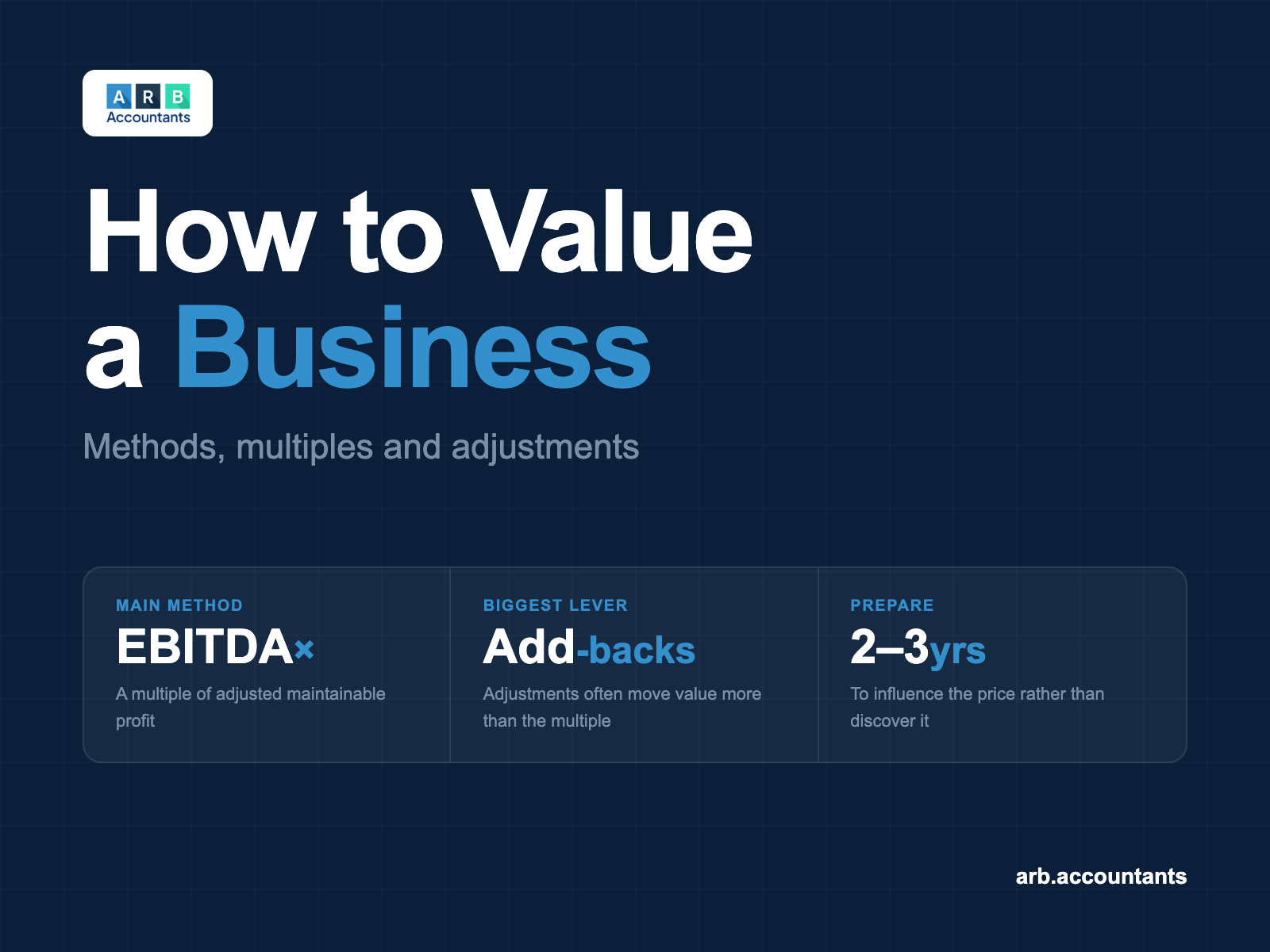
Most owner-managed businesses are valued on a multiple of adjusted profit, usually EBITDA. You normalise profit for things a new owner wouldn't pay (an above-market director salary, personal costs, one-offs), apply a multiple reflecting sector, size, growth and risk to get enterprise value, then add surplus cash and deduct debt to reach what shareholders actually receive. The adjustments usually move the number more than the multiple does, and the biggest single factor in the multiple is how much the business depends on you.
Business valuation at a glance
- Main method: multiple of adjusted EBITDA.
- Adjustments matter more than the multiple. Get them wrong and nothing else helps.
- Enterprise value is the business. Equity value is what you receive.
- Turnover multiples apply in few sectors and are usually a warning sign.
- Key-person risk is the largest discount on most owner-managed businesses.
Table Of Contents
- Why Valuation Is a Range, Not a Number
- The Three Main Methods
- Step One: Adjusted Profit
- Step Two: Choosing a Multiple
- Step Three: From Enterprise Value to What You Receive
- A Worked Example
- What Actually Moves the Price
- When You Need a Formal Valuation
- Preparing a Business for Sale
- Get Help Valuing Your Business
Why Valuation Is a Range, Not a Number
A valuation is an opinion supported by method, not a fact. Two competent advisers looking at the same accounts will produce different figures, because the judgements involved (which profits are maintainable, what risk the buyer is taking, what the owner does for free) are genuinely matters of opinion.
What a valuation gives you is a defensible range and, more usefully, an understanding of what drives the number. The actual price is set by negotiation, by how many buyers want the business, and by what a specific buyer can do with it that you can’t.
That last point explains why “what’s my business worth?” has no single answer. A competitor who can strip out duplicated overheads, or a buyer acquiring your customer list to sell something else into it, can rationally pay more than a financial buyer. The business is worth different amounts to different people, and a strategic premium can dwarf the difference between a 4x and a 5x multiple.
Be wary of anyone who gives you a figure quickly. Free online valuation tools apply a crude sector multiple to turnover or profit and ignore every adjustment that matters. They exist to generate enquiries, not valuations.
The Three Main Methods
1. Multiple of earnings. The default for profitable trading businesses. Take adjusted profit, apply a multiple. Covered in detail below.
2. Asset-based. Net assets, sometimes adjusted to market value. Appropriate for property companies, investment businesses, asset-heavy operations, and any business being wound down rather than sold as a going concern. For a profitable trading business it usually sets a floor rather than a valuation: nobody sells a business generating £300,000 a year for the value of its vans.
3. Discounted cash flow. Projects future cash flows and discounts them to present value. Theoretically the most rigorous method and the most sensitive to assumptions, which makes it unreliable for small businesses where forecasts beyond two years are speculative. Useful for businesses with long contracted revenue streams.
In practice most owner-managed sales use method one, sense-checked against method two. If the answers are wildly apart, that’s information: an earnings valuation well below net assets usually means the business isn’t earning an adequate return on the assets tied up in it.
Step One: Adjusted Profit
This is where most of the value is found or lost. The aim is maintainable profit: what a new owner could realistically expect to repeat, stripped of anything specific to you.
Start with operating profit over three years, weighted towards the most recent, then adjust.
Add back:
- Director salary and dividends above market rate. If you pay yourself £150,000 to run a business a manager would run for £70,000, £80,000 is really profit.
- Personal costs run through the business. A spouse on the payroll who doesn’t work there, personal vehicles, travel that isn’t business travel.
- One-off costs. A legal dispute, a failed project, relocation, exceptional bad debt.
- Non-recurring income, which comes off rather than being added back, for the same reason.
- Rent above or below market where you own the premises personally. Both directions need normalising.
Deduct:
- The cost of replacing what you do for free. If you’re the sales director and take no salary for it, the buyer must hire one. That’s a real cost against maintainable profit.
- Deferred investment. Equipment at the end of its life, software needing replacement, a website nobody has touched in six years. A buyer will spot it and price it in.
The adjustments frequently move the valuation more than the multiple does. On £400,000 of reported profit, £100,000 of legitimate add-backs at a 5x multiple is £500,000 of value. This is also why clean, timely management accounts matter at this point: adjustments you can evidence get accepted, and adjustments you assert get discounted.
Step Two: Choosing a Multiple
The multiple reflects risk and growth. Higher for predictable, diversified, growing businesses that run without the owner. Lower for volatile, concentrated, owner-dependent ones. Published sector averages are a starting reference, and small owner-managed businesses generally sit below them.
What pushes a multiple up:
- Recurring or contracted revenue rather than project-by-project work
- Customer spread, with no client above roughly 10% of revenue
- A management team that runs the business day to day
- Consistent or improving margins over several years
- Barriers to entry: IP, licences, accreditations, switching costs
- Growth that’s demonstrable rather than forecast
What pushes it down:
- Owner dependence, the big one
- Customer concentration. One client at 40% of revenue can knock a full turn off the multiple
- Volatile or declining profits
- Messy records, unfiled accounts, unresolved tax issues
- Legacy problems: employment disputes, dilapidations, an HMRC enquiry
- Sector headwinds or regulatory uncertainty
I’d treat any multiple quoted without reference to these factors as decoration. The honest answer to “what multiple will I get?” is that it depends on which of the above apply to you, and most of them are things you can change with two or three years’ notice.
Step Three: From Enterprise Value to What You Receive
Multiplying adjusted profit by a multiple gives enterprise value, the worth of the trading business. That is not what lands in your bank account. To get equity value you add surplus cash, deduct debt, and adjust for working capital.
| Adjusted EBITDA × multiple | Enterprise value |
| + Surplus cash | Cash beyond what the business needs to operate |
| − Debt | Loans, finance leases, overdraft, often director loans |
| +/− Working capital adjustment | Against an agreed normal level |
| = | Equity value |
Two of these are routinely fought over.
Surplus cash. Sellers argue all cash is surplus. Buyers argue the business needs a float to operate and only the excess belongs to the seller. Where the line sits is negotiated, and on a cash-rich company it can be worth more than a full turn of multiple.
Working capital. Deals are usually done on the basis that a normal level of working capital is delivered with the business. Collect your debtors aggressively and delay paying suppliers before completion, and the adjustment claws it straight back. It’s worth understanding this early, because the instinct to tidy the balance sheet before a sale can be actively counterproductive.
A Worked Example
A recruitment business, three-year record, owner active in the business.
| Reported operating profit | £320,000 |
| Add back: director salary above market (£140,000 paid, £75,000 market) | +£65,000 |
| Add back: spouse on payroll, not working in the business | +£28,000 |
| Add back: one-off tribunal costs | +£22,000 |
| Deduct: cost of replacing owner’s billing role | −£60,000 |
| Adjusted EBITDA | £375,000 |
| Multiple (agreed at 4.5x) | ×4.5 |
| Enterprise value | £1,687,500 |
| Add surplus cash | +£180,000 |
| Deduct bank loan | −£95,000 |
| Equity value | £1,772,500 |
Note what happened. The adjustments added £55,000 net to profit, which at 4.5x is £247,500 of value, most of it from normalising the owner’s own remuneration. That’s a larger swing than moving the multiple from 4.5x to 5x.
On a gain of this size, the tax treatment matters too. Business Asset Disposal Relief at 18% covers the first £1m of gains, with the balance at 24%.
What Actually Moves the Price
If you want a higher number, in order of impact:
- Reduce dependence on yourself. Promote or hire managers, move customer relationships to the team, take a genuine holiday and let the business run. This is worth more than everything below combined.
- Make revenue recurring. Retainers, contracts, service agreements. Predictable income is worth a materially higher multiple than the same money earned project by project.
- Fix customer concentration. One dominant client is a discount and, in a bad case, a deal-breaker.
- Clean up the numbers. Timely management accounts, consistent policies, a tidy balance sheet, no surprises in due diligence. Every unexplained item becomes a price chip.
- Resolve legacy issues before a buyer finds them. An open HMRC enquiry, an employment claim, a lease about to expire.
- Demonstrate growth over at least two years, rather than forecasting it.
The consistent finding is that buyers pay for certainty. Almost every item on that list reduces the buyer’s risk, which is the same thing as increasing your multiple.
When You Need a Formal Valuation
For a straightforward trade sale, price is negotiated and a formal valuation is often unnecessary. You need one where:
- Selling to an Employee Ownership Trust. Trustees must take reasonable steps not to pay more than market value, so an independent valuation is effectively mandatory. See our guide to Employee Ownership Trusts.
- Granting EMI options. The share value must be agreed, and HMRC’s Shares and Assets Valuation team can agree it in advance.
- Share transfers between connected parties, where market value substitutes for the actual price for tax purposes.
- Divorce, probate or shareholder disputes, where an independent figure is needed.
- Raising finance, where a lender or investor wants supporting analysis.
An arm’s length price between unconnected parties is normally accepted by HMRC as market value without challenge, which is why trade sales rarely need a separate exercise.
Preparing a Business for Sale
Start two to three years out if you want to influence the price rather than just discover it.
That window lets you build a management team and evidence it working, establish a track record of consistent adjusted profit, resolve legacy problems quietly, get the reporting to a standard that survives due diligence, and satisfy the two-year qualifying period for BADR.
Owners who start six months out are usually selling on the buyer’s terms. The information is incomplete, the adjustments are hard to evidence, and every gap becomes a negotiating point. The businesses that achieve good prices almost always prepared for it.
Get Help Valuing Your Business
Valuation is where commercial judgement and tax planning meet, and where getting the sequence right matters. There’s no point optimising a multiple if the share structure fails the BADR conditions, and no point modelling an EOT on rules that changed in November 2025.
ARB Accountants works with owners on the whole picture: establishing maintainable profit, sense-checking a realistic range, identifying what’s suppressing the number while there’s time to fix it, and modelling the tax on different exit routes before terms are agreed.
Thinking about what happens next?
Free 60-minute consultation. We'll talk through a realistic range for your business, what's holding it down, and what two years of preparation could be worth. ACCA-chartered. Fixed fees.
Read next
- Business Asset Disposal Relief: 18% on the first £1m of gains
- Employee Ownership Trusts: the alternative exit route
- Management accounts: the records that make adjustments defensible
- What makes a strong balance sheet: what a buyer looks at first
Frequently Asked Questions
How do you value a business in the UK?
The most common method for an owner-managed business is a multiple of adjusted profit, usually EBITDA. You normalise the profit for owner-specific items, apply a multiple reflecting sector, size, growth and risk to get enterprise value, then add surplus cash and deduct debt to reach the figure shareholders receive.
What multiple of profit is a business worth?
It varies enormously by sector, size and quality of earnings, and anyone quoting a single figure without asking about your business is guessing. Smaller owner-managed businesses generally sit below published sector averages because they carry higher key-person risk and have less diversified customer bases.
What is the difference between EBITDA and adjusted EBITDA?
EBITDA is earnings before interest, tax, depreciation and amortisation. Adjusted EBITDA normalises that figure for things a new owner would not incur, such as an above-market director salary, personal costs run through the business, or one-off legal fees. The adjustments frequently move the valuation more than the choice of multiple does.
Is my business worth a multiple of turnover?
Rarely, and turnover multiples are usually a warning sign. They are used in a few sectors with predictable recurring revenue, such as software or some agency and accountancy practices, but for most businesses profit is what a buyer is acquiring. A high-turnover, low-margin business is not worth more than a smaller, more profitable one.
What makes a business worth more?
Recurring or contracted revenue, a spread of customers with no single dependency, a management team that runs the business without the owner, consistent or growing margins, clean and timely financial records, and no unresolved legal, tax or employment issues. Reducing dependence on the owner is usually the single highest-value change.
Why do buyers pay less for owner-managed businesses?
Key-person risk. If the customer relationships, technical expertise or day-to-day decisions sit with one person who is leaving, the buyer is acquiring something that may not survive the transition. Businesses where the owner has genuinely stepped back attract noticeably better terms than those where they are still central.
How does cash in the company affect the valuation?
Surplus cash is normally added to enterprise value, so the seller receives it, but only cash genuinely surplus to the working capital the business needs to operate. Negotiating what counts as surplus and what is required working capital is one of the most contested parts of a deal.
Do I need a formal valuation to sell my business?
Not always for a trade sale, where the price is set by negotiation. You do need one for a sale to an Employee Ownership Trust, where trustees must not pay more than market value, and for share transactions requiring agreement with HMRC's Shares and Assets Valuation team, such as EMI option grants.
How long before a sale should I start preparing?
Two to three years if you want to influence the price. That is long enough to build a management team, tidy up the numbers, resolve legacy issues and establish a track record of the business performing without you. It also aligns with the two-year qualifying period for Business Asset Disposal Relief.
What is an earn-out?
Part of the price made conditional on the business hitting agreed targets after completion. Buyers use them to bridge a valuation gap and to keep the seller engaged. From a seller's point of view it means carrying risk after losing control, so the targets and the definitions behind them deserve very close attention.
Will HMRC accept my valuation?
For transactions where valuation determines a tax charge, such as EMI option grants or share transfers between connected parties, HMRC's Shares and Assets Valuation team can agree a value in advance in some cases. An arm's length sale price between unconnected parties is normally accepted as market value without challenge.
Does the business valuation include the property?
It depends on who owns it. Where the trading company owns its premises, the property is usually valued separately and added, because it is an asset rather than part of the trading value. Where the owner holds the property personally, it is a separate negotiation and may qualify for different tax treatment on sale.
About The Author

Saurabh Bedi | Director
Saurabh is a tax advisor at ARB Accountants, specialising in Self-Assessment and small business tax. He's dedicated to making tax simple and stress-free, helping clients stay compliant and confident with HMRC.
Qualifications & Experience
- Fellow of Chartered Certified Accountants (ACCA)
- MSc Chartered Certified Accountancy 2008
- Working in accountancy since 2008