S455 Tax: What It Is and How to Get It Back
What is s455 tax?
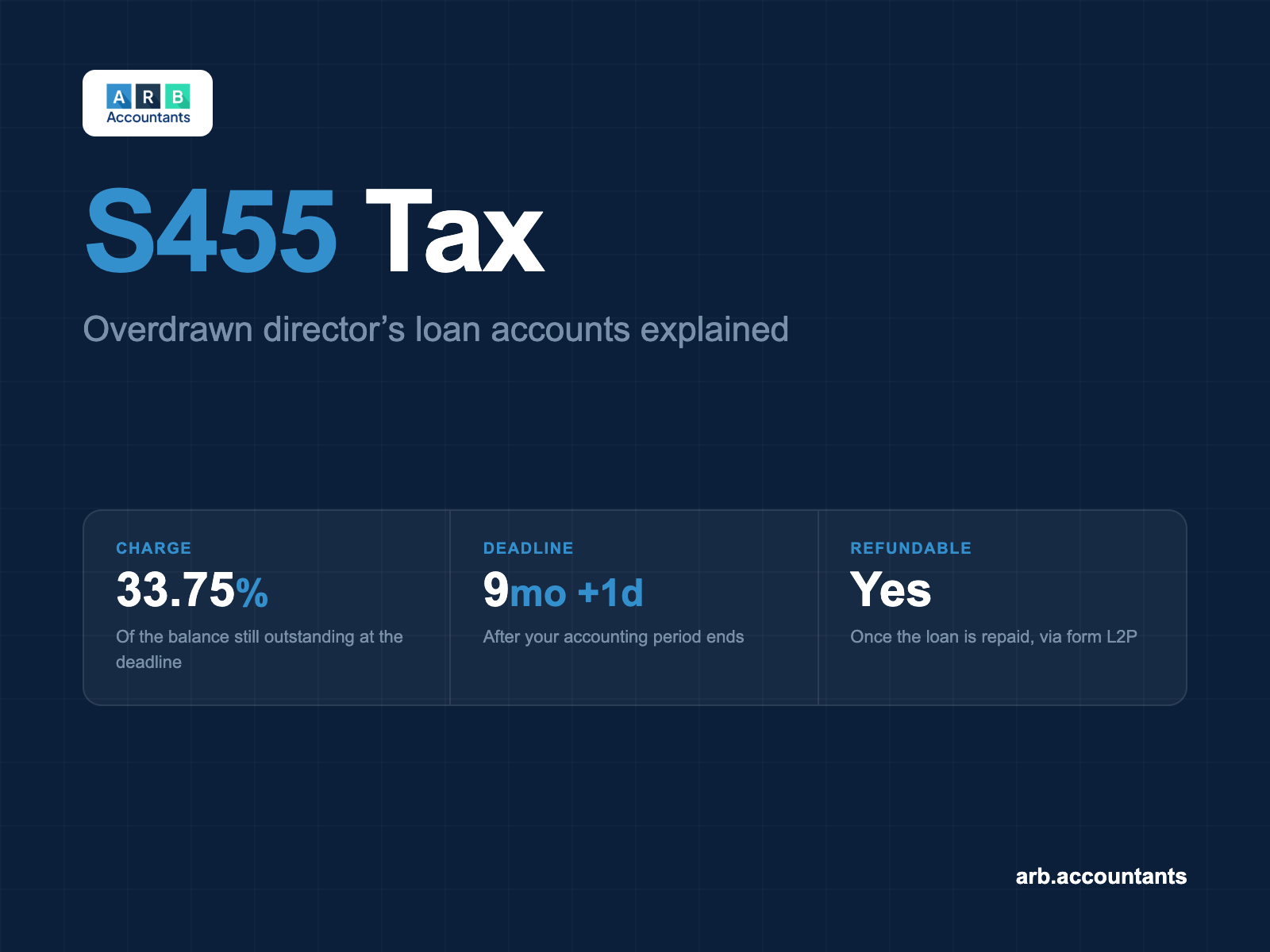
S455 is a 33.75% charge your company pays on money you owe it, if the balance is still outstanding 9 months and 1 day after the end of your accounting period. It is refundable once the loan is repaid, so it's a deposit rather than a permanent cost. The problem is timing: the refund isn't due until nine months after the end of the year in which you repay, so the money can sit with HMRC for well over a year. Clear the loan before the deadline and no charge arises at all.
S455 at a glance
- Rate: 33.75% of the outstanding balance (32.5% for loans made before 6 April 2022).
- Due: 9 months and 1 day after the accounting period ends.
- Refundable once the loan is repaid, but the refund is slow.
- Repaying and redrawing within 30 days does not work.
- Separate trap: a balance over £10,000 creates a benefit in kind.
Table Of Contents
- What Is S455 Tax?
- How an Overdrawn Loan Account Happens
- When S455 Is Charged
- How to Clear an Overdrawn Loan Account
- The 30-Day and £15,000 Anti-Avoidance Rules
- The Separate £10,000 Benefit in Kind Trap
- How to Reclaim S455 Tax
- Writing Off the Loan
- Why HMRC Looks at Loan Accounts
- Get Help With a Director’s Loan Account
What Is S455 Tax?
S455 is a charge under section 455 of the Corporation Tax Act 2010. Where a close company lends money to a participator (a shareholder or director) and the loan is still outstanding 9 months and 1 day after the accounting period ends, the company pays 33.75% of the balance to HMRC.
The rate is not arbitrary. It matches the higher rate of dividend tax, and that tells you exactly what the rule is for. Without it, a shareholder could take money out of their company indefinitely as a “loan” and never pay dividend tax on it. S455 removes the advantage by charging the same rate up front.
Two features make it unusual:
- It’s the company that pays, not you. The charge sits on the company’s Corporation Tax return even though the benefit was personal.
- It’s refundable. Unlike most tax, you get it back once the loan is repaid. Think of it as a deposit HMRC holds until the position is regularised.
That refundability is why s455 is less frightening than it first looks, and also why it catches people out: the money is recoverable but the cash flow damage is immediate and the recovery is slow.
How an Overdrawn Loan Account Happens
Almost nobody sets out to borrow from their own company. The overdrawn balance builds up quietly, usually because money was taken as drawings during the year with the intention of declaring dividends later, and then the dividends were never properly declared or the reserves weren't there.
The usual routes in:
- Drawings taken monthly against dividends that were never formally voted or minuted.
- Personal spending on the company card. A holiday, school fees, a car. Each one is a debit to the loan account.
- Dividends declared without distributable reserves. If the profits weren’t there, it isn’t a valid dividend, and it reverts to a loan.
- A bad year. Drawings were set when trading was good. Profits fell, the reserves didn’t cover them, and what looked like dividends became a loan retrospectively.
- Expenses that aren’t allowable. Disallowed costs paid by the company on the director’s behalf land in the loan account.
The last two are the ones that produce genuine shock, because the director did nothing different. The company’s performance changed underneath them, and an account they believed was in credit turns out to be overdrawn once the year end accounts are prepared. This is typically discovered nine months after the event, by which point the s455 deadline is close or gone.
When S455 Is Charged
The trigger date is 9 months and 1 day after the end of the accounting period, the same day the Corporation Tax is due. If the balance is cleared before then, no s455 arises. If any of it remains, the company pays 33.75% of what's left.
A worked example. Company year end 31 March 2026:
| Date | Event |
|---|---|
| 31 March 2026 | Year end. Loan account overdrawn £60,000 |
| 1 January 2027 | S455 deadline (9 months + 1 day) |
| 1 January 2027 | If still £60,000 outstanding: £20,250 payable |
Partial repayment helps proportionately. Reduce the balance to £20,000 before 1 January and the charge is £6,750 rather than £20,250. There is no all-or-nothing cliff, which means clearing part of the loan is always worth doing even if you can’t clear it all.
How to Clear an Overdrawn Loan Account
Three routes, and the right one depends on your reserves and your personal tax position for the year.
1. Repay it in cash
Cleanest and cheapest. You pay the money back from personal funds before the deadline and no s455 arises. Obvious, but often not available, since the reason the account is overdrawn is usually that the cash was spent.
2. Declare a dividend
Available only if the company has distributable reserves, meaning accumulated realised profits after tax. The dividend is credited against the loan account rather than paid in cash, clearing the balance without money moving.
You pay dividend tax personally at 8.75%, 33.75% or 39.35% depending on your band. Note that the higher rate is 33.75%, identical to s455, which is the point of the design. The difference is that dividend tax is a real cost while s455 is refundable, so this is a genuine decision rather than an obvious one.
If the reserves are not there, this route is closed. Declaring a dividend anyway creates an unlawful distribution which the company can reclaim from you, and which can cause problems in an insolvency.
3. Vote a bonus through payroll
Always available, including where there are no reserves, because a bonus is a cost rather than a distribution. The company gets a Corporation Tax deduction, but you pay income tax at your marginal rate plus employee National Insurance, and the company pays employer’s National Insurance on top.
Usually the most expensive in total tax, but sometimes the only option, and the Corporation Tax deduction narrows the gap more than people expect.
| Route | Needs reserves? | Company relief | Your cost |
|---|---|---|---|
| Cash repayment | No | None needed | Nothing, if you have the cash |
| Dividend | Yes | None | 8.75% / 33.75% / 39.35% |
| Bonus | No | CT deduction | Income tax + employee NI |
Our guide to salary vs dividends works through the comparison in more detail.
The 30-Day and £15,000 Anti-Avoidance Rules
Repaying the loan just before the deadline and taking it straight back out again does not work. Where the balance is £5,000 or more and you redraw £5,000 or more within 30 days of repaying, HMRC treats the repayment as though it never happened and charges s455 anyway.
This practice is known as bed and breakfasting, and HMRC closed it deliberately. There is a second, wider rule aimed at larger arrangements: where the balance is £15,000 or more and, at the time of repayment, there were arrangements or an intention to redraw, the repayment can be disregarded even outside the 30-day window.
The practical point is that the escape route has to be real. Clearing the account with borrowed money you intend to take straight back out afterwards will not survive scrutiny, and an enquiry into it is considerably more unpleasant than simply paying the s455 and reclaiming it later.
The Separate £10,000 Benefit in Kind Trap
This one is missed constantly because it is a completely separate charge from s455, on a different person, measured over a different period. If the loan balance exceeds £10,000 at any point in the tax year, and you paid no interest or interest below HMRC's official rate, it is a taxable benefit in kind.
What that means in practice:
- You pay income tax on the benefit, calculated as interest at HMRC’s official rate on the balance.
- The company pays Class 1A National Insurance on it.
- It’s reported on a P11D, or through payrolled benefits.
Three details worth holding on to. It’s measured over the tax year (to 5 April), not your company’s accounting period. It bites if the threshold is breached at any point, not just at the year end. And it applies whether or not s455 is also charged, so a loan repaid within nine months can still produce a P11D charge.
You can avoid it entirely by paying interest to the company at HMRC’s official rate. The company then has taxable interest income, but at small sums this is usually cheaper than the benefit charge and the Class 1A on top.
How to Reclaim S455 Tax
S455 is repaid once the loan is repaid, released or written off, using form L2P. The timing is the part that surprises people: the refund is not due until 9 months and 1 day after the end of the accounting period in which the repayment happened. Repay in month two of a new year and you wait nearly a full year for the money.
The mechanics:
- Claim using form L2P, online or attached to the company tax return for the period in which the loan was repaid.
- You have 4 years from the end of the accounting period in which the loan was repaid to make the claim. Miss that and the money is gone permanently.
- Any interest paid on late Corporation Tax is not reclaimable. Only the s455 itself comes back.
A worked timeline, continuing the earlier example:
| Date | Event |
|---|---|
| 1 January 2027 | £20,250 s455 paid |
| June 2027 | Loan repaid in full |
| 31 March 2028 | End of the accounting period in which repayment fell |
| 1 January 2029 | Refund due |
Two years between paying and recovering. The tax was never permanently lost, but £20,250 sat with HMRC throughout, which for most businesses of this size is a real cash flow cost rather than an accounting footnote.
That gap is the argument for dealing with the balance before the deadline rather than paying and reclaiming. Directors often assume that because s455 is refundable, paying it is a soft option. The cash flow says otherwise.
Writing Off the Loan
Tempting, and usually the worst option available.
Where a company writes off or releases a director’s loan, the amount is treated as a distribution and taxed on the director at dividend rates. HMRC may also pursue National Insurance, arguing it’s earnings from employment. The company gets no Corporation Tax deduction for the write-off, so the loss is real.
Net effect: you pay tax at dividend rates on money you have already spent, the company gets no relief, and there’s a reasonable chance of an NI argument. The s455 does come back, but a write-off should be a last resort when there is genuinely no prospect of repayment, not a planning route.
Why HMRC Looks at Loan Accounts
Director’s loan accounts are a standing item in HMRC compliance work, for a straightforward reason: they sit exactly where personal and company money meet, and that’s where errors concentrate.
What draws attention:
- A balance that never moves, or grows year on year, suggesting remuneration being disguised as a loan.
- Dividends declared without reserves, which the accounts reveal directly.
- Personal expenditure through the company that hasn’t been posted to the loan account at all.
- A repayment immediately before the deadline followed by a withdrawal after it.
This connects to the wider personal expenditure work HMRC has been doing, where lifestyle that outstrips declared income prompts a closer look at how money is actually leaving the company. Our guide to how likely you are to be investigated by HMRC covers how those cases usually start.
The defensible position is simple and worth maintaining: keep the loan account current in your bookkeeping, minute dividends properly at the time, check reserves before declaring, and don’t run personal spending through the company without posting it correctly.
Get Help With a Director’s Loan Account
Most s455 problems are discovered late, when the year end accounts are prepared and the deadline is weeks away rather than months. At that point the options narrow quickly and the cheapest route may already be closed.
ARB Accountants deals with overdrawn loan accounts for owner-managed companies: working out the real balance, comparing the cost of dividend against bonus against repayment, handling the L2P reclaim, and keeping the account straight going forward so it doesn’t recur.
Overdrawn loan account and a deadline approaching?
Free 60-minute consultation. We'll work out the real balance, compare the three ways to clear it against your personal tax position, and tell you what it costs to do nothing. ACCA-chartered. Fixed fees.
"ARB Accountants helped me resolve an issue with HMRC that had been dragging on for months. Their knowledge and persistence saved me a lot of stress — and money. I can't recommend them enough." Jay Sach · Google Review (Tax Audit)
Read next
- What can a director’s loan be used for?: the rules on taking money out in the first place
- Salary vs dividends: comparing the routes for clearing a balance
- Year end accounts for a limited company: when the balance usually gets discovered
- How likely are you to be investigated by HMRC?: why loan accounts attract attention
Frequently Asked Questions
What is s455 tax?
S455 is a charge under section 455 of the Corporation Tax Act 2010. If a director or shareholder owes their company money and the balance is still outstanding 9 months and 1 day after the end of the company's accounting period, the company pays 33.75% of that balance to HMRC. It is refundable once the loan is repaid, but the refund is slow.
What is the s455 tax rate?
33.75% of the outstanding loan balance, matching the higher rate of dividend tax. Loans made before 6 April 2022 were charged at 32.5%. The rate deliberately mirrors dividend tax so there is no advantage in taking money as a loan instead of a dividend.
When is s455 tax due?
9 months and 1 day after the end of the company's accounting period, the same date as the Corporation Tax payment deadline. If the loan is cleared before that date, no s455 charge arises at all.
Is s455 tax refundable?
Yes. It is a temporary charge, not a permanent cost, and it is repaid once the loan is repaid, released or written off. The catch is timing: the refund is not due until 9 months and 1 day after the end of the accounting period in which the repayment happened, so the money can be with HMRC for a long time.
How do I reclaim s455 tax?
Use form L2P, either online or attached to the company tax return for the period in which the loan was repaid. You can reclaim within 4 years of the end of the accounting period in which the loan was repaid. Interest paid on late Corporation Tax cannot be reclaimed, only the s455 itself.
How do I avoid s455 tax?
Clear the loan before the 9 month deadline. The three routes are repaying in cash, declaring a dividend if the company has distributable reserves, or voting a bonus through payroll. Which is cheapest depends on your personal tax position, so compare them rather than defaulting to one.
What is the 30 day rule on director's loans?
Anti-avoidance. If you repay a loan of £5,000 or more and then take a new loan of £5,000 or more within 30 days, HMRC treats the repayment as if it never happened and charges s455 on the original balance. It stops directors clearing the account briefly around the deadline and redrawing afterwards.
What happens if my director's loan is over £10,000?
A separate issue arises. Where the balance exceeds £10,000 at any point in the tax year, the loan is a taxable benefit in kind unless you pay interest at HMRC's official rate. It is reported on a P11D, the director pays income tax on the benefit and the company pays Class 1A National Insurance. This applies whether or not s455 is also charged.
Can I just write off the director's loan?
You can, but it is usually the most expensive option. A written-off loan is treated as a distribution and taxed on the director at dividend rates, and HMRC may also seek National Insurance. The company gets no Corporation Tax deduction. Writing off is a last resort, not a planning tool.
Do I pay s455 if I repay the loan before the year end?
No. S455 only applies to balances outstanding 9 months and 1 day after the accounting period ends. If the account is cleared before that date, and you do not fall foul of the 30 day rule, no charge arises.
Is the director's loan account the same as taking dividends?
No, and confusing the two is the most common cause of the problem. A dividend requires distributable reserves and must be properly declared and documented. Money taken without that paperwork is a loan, regardless of what you intended, which is how directors discover an overdrawn account they did not know they had.
What if the company has no distributable reserves?
Then a dividend is not legally available and declaring one anyway creates an unlawful distribution, which can be reclaimed from the director. The realistic routes are repaying in cash or voting a bonus through payroll, which is deductible for the company but attracts income tax and National Insurance.
About The Author

Saurabh Bedi | Director
Saurabh is a tax advisor at ARB Accountants, specialising in Self-Assessment and small business tax. He's dedicated to making tax simple and stress-free, helping clients stay compliant and confident with HMRC.
Qualifications & Experience
- Fellow of Chartered Certified Accountants (ACCA)
- MSc Chartered Certified Accountancy 2008
- Working in accountancy since 2008