Tax Office Reference Number: How to Find and Use It
What is a tax office reference number?
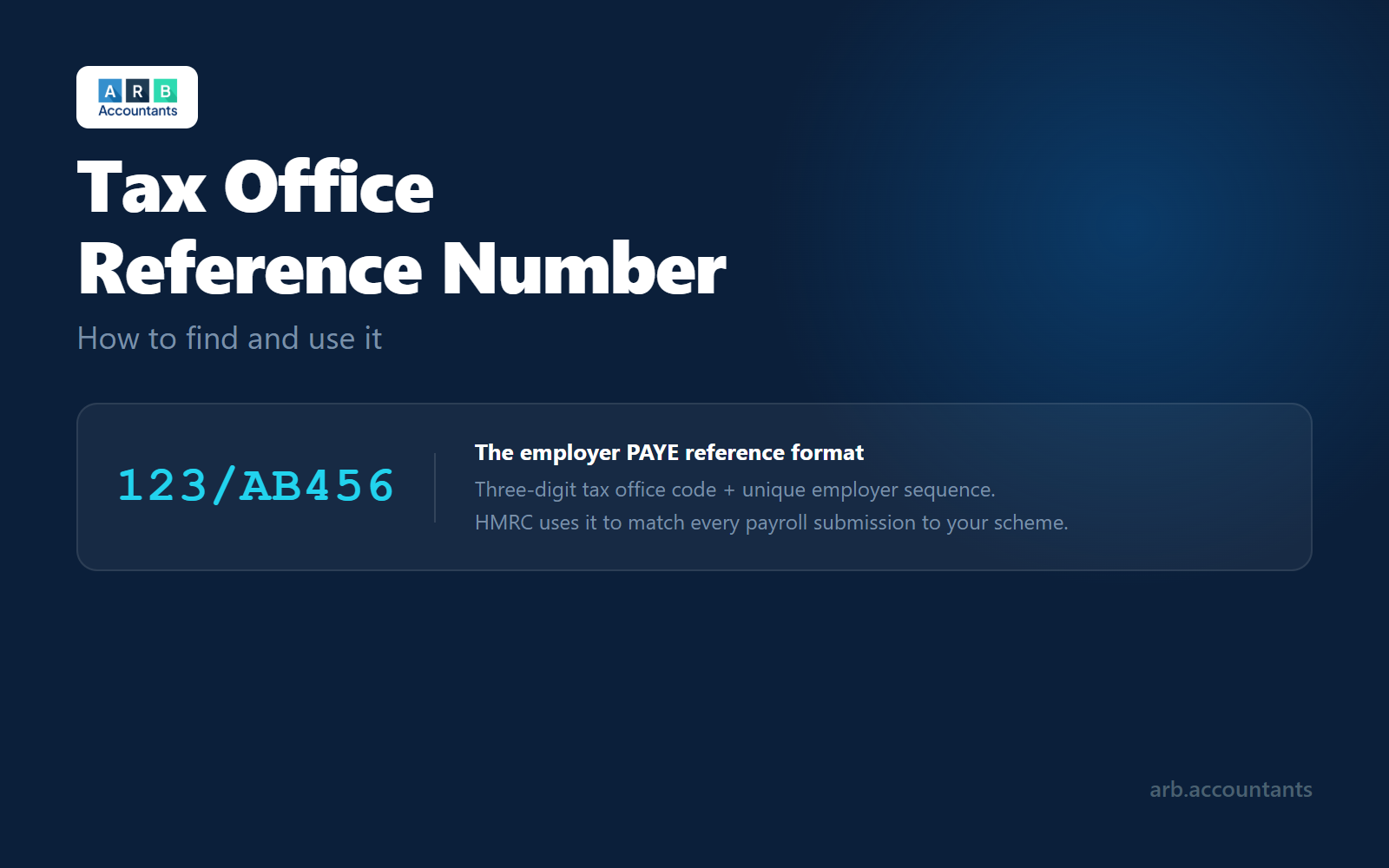
A tax office reference number is the unique identifier HMRC assigns to every employer when they register for PAYE, also called the employer PAYE reference. It has two parts: a three-digit tax office code and a unique employer sequence, formatted as 123/AB456. HMRC uses it to match your payroll submissions and payments to the correct employer account. Without it, or with the wrong one, filings appear missing and penalty notices follow.
Whether you’re an employer setting up payroll, a director dealing with HMRC, or an employee sorting out a tax query, knowing what this number is, where to find it, and what it does will save you time and frustration. This guide covers everything you need to know.
Table Of Contents
- What Is a Tax Office Reference Number?
- What Is a Tax Office Reference Number Used For?
- Where to Find Your Tax Office Reference Number
- A Practical Example: When the Wrong Reference Causes Real Problems
- Tax Office Reference Number vs Other Tax Identifiers
- What If You Have More Than One Job?
- Does the Tax Office Reference Number Change?
- What Happens When the Tax Office Reference Number Is Used Incorrectly?
- Keeping Your Tax Office Reference Number Records Clean
What Is a Tax Office Reference Number?
A tax office reference number is the unique identifier HMRC assigns to every employer when they register for PAYE. You'll also hear it called the employer PAYE reference. Both terms mean the same thing.
The number has two parts: a three-digit code that identifies the HMRC tax office responsible for your payroll scheme, followed by a unique sequence of letters and numbers specific to your business. Together they look something like this: 123/AB456.
HMRC uses it to match your payroll submissions to the right employer account. Without the correct reference in place, your Full Payment Submissions and Employer Payment Summaries can’t be allocated properly, which creates compliance problems and can trigger penalty notices even when you’ve submitted everything correctly.
It’s also worth being clear about what it isn’t. Your tax office reference number is not the same as your Accounts Office Reference, which is a separate number used specifically when making PAYE payments to HMRC. Mixing them up is one of the most common payroll errors, and it’s the kind of mistake that causes payment allocation problems that take weeks to untangle.
What Is a Tax Office Reference Number Used For?
For employers, this reference connects your payroll records to HMRC’s systems. Every time you file an FPS, HMRC uses your tax office reference number to confirm the submission belongs to your PAYE scheme and applies any related payments or adjustments to the right account.
If the reference is wrong or missing, HMRC’s systems may treat your filing as incomplete or not received. That generates automated late filing notices regardless of whether you actually submitted on time. Under HMRC’s penalty framework, repeated mismatches attract real charges, not just warnings.
For employees, the tax office reference number is just as relevant. When you contact HMRC to query a tax code, deal with an underpayment, or have an employment record corrected, HMRC will typically ask you to confirm your employer’s reference. Without it, the call takes longer and the query takes longer to resolve.
Where to Find Your Tax Office Reference Number
There are several places to look. Which one applies depends on whether you’re an employee, an employer, or a company director.
Tax Office Reference Number on Your Payslip
For most employees, the payslip is the most accessible starting point. Your tax office reference number on payslip documents appears under a field labelled 'Employer PAYE Reference' or similar wording. It sits near your employer's name and address, not next to your personal tax details.
One common source of confusion: your payslip also shows your tax code, which looks like a number followed by a letter, for example 1257L. That’s your personal income tax code. It’s not the tax office reference number on payslip. Make sure you’re reading the correct field before passing the number to anyone. If that code doesn’t look right, see what to do when your tax code is wrong.
On Your P60 and P45
Your annual P60 shows the employer’s tax office reference number, usually at the top alongside your employer’s name and address. Your P45, which you receive when you leave a job, includes it too. The P60 is the most useful because you receive one at the end of every tax year. If you need to confirm what your employer’s reference was during a specific period, your P60 is the most reliable source.
In HMRC Correspondence
Any official letter HMRC has sent to you as an employer will include the tax office reference number. Look at the section showing your registered employer details. Letters about PAYE submissions, tax code updates, or compliance queries all carry it.
Through Your HMRC Business Tax Account
If you’re registered for PAYE as an employer, your HMRC Business Tax Account shows your employer PAYE reference alongside your scheme details. This is the most reliable place to confirm the current live reference, particularly when switching payroll software or onboarding a new provider.
From Your HMRC Welcome Pack
When your business first registered for PAYE, HMRC sent a registration confirmation letter. That document contains your tax office reference number. If you’ve kept your HMRC correspondence, this is one of the first places to check.
| Where to look | Best for |
|---|---|
| Payslip | Employees needing the reference quickly |
| P60 or P45 | Confirming a reference for a specific tax year |
| HMRC correspondence | Employers with letters on file |
| HMRC Business Tax Account | Most reliable: live, confirmed reference |
| HMRC welcome pack | Original registration reference |
A Practical Example: When the Wrong Reference Causes Real Problems
A small accountancy firm with eight employees switches payroll software midway through the tax year. During the migration, the new provider imports a test reference from the demo environment rather than the live employer PAYE reference.
For two months, Full Payment Submissions go out under the wrong tax office reference number. HMRC can’t match them to the firm’s PAYE scheme. The firm starts receiving automated penalty notices for apparently missing submissions.
When the error is identified, the firm has to provide HMRC with evidence of the correct submissions, request reallocation of affected records, and dispute the penalty notices. None of it is quick. All of it was avoidable with a single verification step before go-live: confirm the live tax office reference number against the HMRC Business Tax Account before the first real submission goes out.
This scenario is more common than it should be during payroll migrations. A simple reference check built into the handover process prevents it entirely.
Tax Office Reference Number vs Other Tax Identifiers
People regularly confuse the tax office reference number with other HMRC identifiers. The differences matter because using the wrong one in the wrong context creates problems that aren't always obvious until they've stacked up.
| Identifier | Format | Purpose | Who holds it |
|---|---|---|---|
| Tax office reference number | 123/AB456 | Identifies employer PAYE scheme | Employer |
| Accounts Office Reference | 123PA00012345 | Used when paying PAYE to HMRC | Employer |
| National Insurance Number (NIN) | AB123456C | Tracks personal NI contributions | Individual |
| Unique Taxpayer Reference (UTR) | 1234567890 | Self-assessment and corporation tax | Individual or company |
National Insurance Number (NIN): Your NIN is a personal identifier in the format AB123456C. It tracks your individual National Insurance contributions and state benefit entitlements. It’s tied to you as a person, not to an employer. HMRC needs both your NIN and your employer’s tax office reference number to locate your employment records.
Unique Taxpayer Reference (UTR): Your UTR is a ten-digit number used for self-assessment and corporation tax. If you’re a sole trader or company director filing a personal tax return, your UTR is the reference for that. If you’re unsure whether you need to register, see our guide on registering for self-assessment. It’s entirely separate from the tax office reference number and serves a different purpose entirely.
Accounts Office Reference: This HMRC identifier is used specifically when making PAYE and National Insurance payments. It follows a different format to the employer PAYE reference. Using the wrong one when paying HMRC causes payment allocation failures that can appear as outstanding debts on your account even when you’ve paid on time.
What If You Have More Than One Job?
If you work for multiple employers, each will have their own tax office reference number. HMRC administers your income and deductions from each employer separately before reconciling your total tax position for the year.
This matters when you’re querying a tax refund or asking HMRC to review a specific employment period. You’ll need the correct employer’s reference for each job to make sure HMRC is looking at the right records.
Does the Tax Office Reference Number Change?
Under normal circumstances, your tax office reference number stays with your PAYE scheme for the lifetime of the business. A change of address doesn't affect it. Rebranding or renaming your company doesn't change it either.
It can change if your PAYE scheme is restructured, if the business is acquired and payroll migrated into the acquirer’s scheme, or if HMRC internally reallocates your scheme to a different tax office. When that happens, HMRC writes to you with confirmation of the new reference. Until that confirmation arrives in writing, continue using the existing one. Switching references based on assumption causes exactly the kinds of submission mismatches described above.
If you run multiple entities with separate PAYE schemes, each will have its own tax office reference number. Managing these correctly when staff move between entities is genuinely complex. It’s one of those areas where getting a payroll outsourcing specialist involved early is worth more than the cost.
What Happens When the Tax Office Reference Number Is Used Incorrectly?
The consequences build up quietly.
FPS submissions filed under the wrong tax office reference number appear to HMRC as missing from your scheme. Late filing notices follow. Those notices carry penalty charges if not addressed promptly. PAYE payments made with the wrong reference can appear as outstanding debts on the correct scheme, while another scheme shows an unexplained credit. Resolving these takes direct HMRC engagement and supporting evidence.
In a compliance check, HMRC will look at whether submissions and payments consistently used the correct reference. Inconsistency here is the kind of thing that leads to deeper scrutiny of your payroll records. To understand how HMRC selects who to investigate, see our guide on how likely you are to be investigated by HMRC.
A note on complexity: while finding your tax office reference number is straightforward in most cases, the rules around PAYE schemes, mergers, and multiple employment are not always simple. Tax rules and HMRC processes change. The information here reflects the position as understood at the time of writing. Always check current HMRC guidance or speak with a qualified accountant before making decisions that affect your PAYE compliance.
Keeping Your Tax Office Reference Number Records Clean
The most effective controls are simple ones. Store your HMRC registration letter and all subsequent PAYE correspondence in a dedicated folder, physical or digital. When you onboard a new payroll provider, confirm the exact live reference before they submit anything on your behalf.
If you run multiple PAYE schemes, maintain a clear internal log that maps each reference to the correct scheme. Include reference verification in any payroll governance review. The time it takes to confirm a reference before go-live is a fraction of the time it takes to resolve the problems that follow when the wrong one is used.
Need help with payroll or HMRC compliance?
ARB Accountants handles PAYE setup, payroll migrations, and HMRC compliance for businesses across the UK. ACCA-chartered. Straightforward advice, no jargon.
Frequently Asked Questions
What is a tax office reference number?
A tax office reference number is the unique identifier HMRC assigns to an employer's PAYE scheme. It combines a three-digit tax office code with a unique employer sequence, formatted as 123/AB456. HMRC uses it to match payroll submissions and payments to the correct employer account.
What is a tax office reference number on a payslip?
The tax office reference number on a payslip is your employer's PAYE reference. Look for a field labelled 'Employer PAYE Reference'. It contains a combination of letters and numbers and is different from your personal tax code, which appears nearby but serves a different purpose.
What is a tax office reference number for self-employed people?
If you're self-employed and don't employ anyone, you won't have a tax office reference number. Your main HMRC identifier for income tax and self-assessment is your Unique Taxpayer Reference (UTR). If you do employ staff, you'll have a separate employer PAYE reference for your payroll scheme.
Is the tax office reference number the same as a UTR?
No. A UTR is a ten-digit number used for self-assessment and corporation tax purposes. The tax office reference number is specifically an employer payroll identifier for PAYE. They're issued separately and used in different contexts.
Can I have more than one tax office reference number?
As an employee, you don't hold your own reference; your employer does. If you have multiple jobs, each employer has their own tax office reference number. If you're an employer running more than one PAYE scheme, each scheme has its own distinct reference.
What happens if my payroll uses the wrong tax office reference number?
HMRC may not recognise the submission as belonging to your PAYE scheme. You can receive late filing notices even if you submitted correctly. Payments may also be misallocated. HMRC will need evidence of the correct submissions, and resolving it takes time.
Does the tax office reference number change if I move accountants?
No. The reference stays with your PAYE scheme regardless of which accountant or payroll provider you use. Always confirm the correct reference with a new provider before they make their first submission on your behalf.
About The Author

Saurabh Bedi | Director
Saurabh is a tax advisor at ARB Accountants, specialising in Self-Assessment and small business tax. He's dedicated to making tax simple and stress-free, helping clients stay compliant and confident with HMRC.
Qualifications & Experience
- Fellow of Chartered Certified Accountants (ACCA)
- MSc Chartered Certified Accountancy 2008
- Working in accountancy since 2008