40% Tax Bracket: When It Starts and What You Actually Pay
When does the 40% tax bracket start?
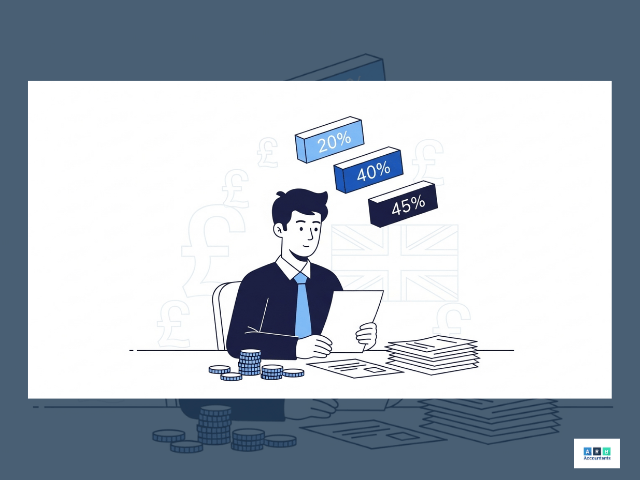
At £50,271 of taxable income in England, Wales and Northern Ireland, and at £43,663 in Scotland, where the rate is 42% rather than 40%. Crucially, only the slice above the threshold is taxed at 40%. Earn £55,000 and just £4,730 sits in the higher rate band. A pay rise that crosses the line never leaves you worse off. The threshold has been frozen since April 2021 and is now frozen until April 2031, so more people cross it every year without any change in the rates.
The 40% tax bracket in 2026/27 at a glance
- Starts at £50,271 (England, Wales, NI) and runs to £125,140.
- Scotland has no 40% band: the higher rate is 42% from £43,663.
- Your real marginal rate at the threshold is about 42%, because NI drops from 8% to 2% at the same point.
- Between £100,000 and £125,140 the Personal Allowance tapers away, creating an effective 60% rate.
- Thresholds are frozen until April 2031.
Table Of Contents
- What Is the 40% Tax Bracket?
- How Much Can I Earn Before I Pay 40% Tax?
- A Worked Example on £75,000
- What You Actually Pay: The National Insurance Twist
- The 40% Bracket in Scotland
- Which Income Counts Towards the Threshold?
- The Two Cliff Edges Above the Threshold
- Is the 40% Tax Threshold Changing?
- How to Stay Below the 40% Tax Bracket
- If You’ve Already Crossed It
- Get Help With Higher Rate Tax Planning
What Is the 40% Tax Bracket?
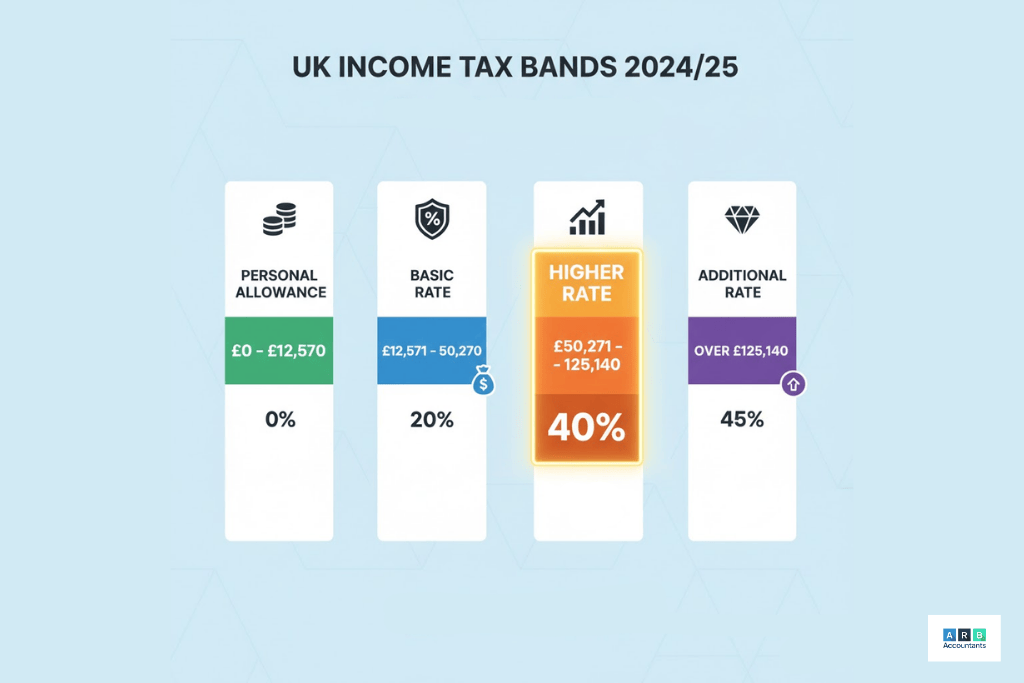
The 40% tax bracket, properly called the higher rate, is the band of taxable income taxed at 40%. In England, Wales and Northern Ireland it runs from £50,271 to £125,140 in 2026/27. Only income inside that band is taxed at 40%. Everything below it is still taxed at 0% and 20% exactly as before.
The full picture for 2026/27:
| Band | Taxable income | Rate |
|---|---|---|
| Personal Allowance | Up to £12,570 | 0% |
| Basic rate | £12,571 to £50,270 | 20% |
| Higher rate | £50,271 to £125,140 | 40% |
| Additional rate | Over £125,140 | 45% |
The single most common misunderstanding about the higher rate is worth stating plainly: crossing the threshold does not tax your whole income at 40%. The UK uses marginal rates, so each band only applies to the income that falls within it.
This matters because people turn down overtime, bonuses and pay rises in the belief that earning slightly more will leave them worse off. It won’t. On an income of £51,000, exactly £730 is taxed at 40% and the tax on the other £50,270 is unchanged. You keep 60p of every extra pound rather than 80p, but you never go backwards.
How Much Can I Earn Before I Pay 40% Tax?
£50,270 of taxable income in England, Wales and Northern Ireland. That figure is your £12,570 Personal Allowance plus the £37,700 basic rate band. In Scotland the equivalent point is £43,662. Taxable income means income after allowable expenses and reliefs, so pension contributions and Gift Aid raise the amount you can earn before the higher rate applies.
The £37,700 figure causes a recurring confusion. PAYE and employer guidance often describe the basic rate band as “up to £37,700”, because payroll works from taxable pay after the allowance has been applied. People then assume the 40% rate starts around £37,700 of salary. It doesn’t. Add the Personal Allowance back and the real starting point is £50,270 of gross income for someone with the standard 1257L code.
To work out your own position:
- Add up all taxable income: salary, bonuses, self-employment profit, rental profit after allowable expenses, dividends, savings interest above your Personal Savings Allowance, and taxable benefits such as a company car or medical cover.
- Deduct your reliefs: gross personal pension contributions, Gift Aid donations, allowable expenses.
- Compare the result against £50,270, or £43,662 if you live in Scotland.
If you’re employed, check your tax code first. A code well below 1257 usually means benefits or untaxed income are already being collected through PAYE, which affects the arithmetic. If it looks wrong, see how to check and fix a wrong tax code.
A Worked Example on £75,000
Take a contractor with £75,000 of taxable income for 2026/27, no benefits, living in England.
| Slice | Amount | Rate | Tax |
|---|---|---|---|
| Personal Allowance | £12,570 | 0% | £0 |
| Basic rate | £37,700 | 20% | £7,540 |
| Higher rate | £24,730 | 40% | £9,892 |
| Total | £75,000 | £17,432 |
So £24,730 of the £75,000 is taxed at 40%, and the income tax bill is £17,432. That is an average rate of 23.2%, even though the person is unambiguously “a higher rate taxpayer”. The gap between the 40% marginal rate and the 23.2% average is exactly why the bracket is so widely misunderstood.
What You Actually Pay: The National Insurance Twist
Income tax is only half the picture. The National Insurance upper earnings limit sits at £50,270, the same point as the higher rate threshold. Employee NI drops from 8% to 2% there. So as income tax rises 20 points, NI falls 6. Your real combined marginal rate goes from 28% to 42%, a 14 point jump rather than 20.
| Income band | Income tax | Employee NI | Combined marginal rate |
|---|---|---|---|
| £12,571 to £50,270 | 20% | 8% | 28% |
| £50,271 to £100,000 | 40% | 2% | 42% |
| £100,001 to £125,140 | 40% + allowance taper | 2% | ~62% |
| Over £125,140 | 45% | 2% | 47% |
Two things follow from this that are worth knowing.
First, the jump at £50,270 is real but smaller than people fear. Second, and far more significant, the worst marginal rate in the UK system is not the additional rate. It is the band between £100,000 and £125,140, where the effective rate is around 62% once NI is included. An additional rate taxpayer on £150,000 faces a lower marginal rate than someone on £110,000.
The 40% Bracket in Scotland
Scotland has no 40% band at all. Income tax on earnings is devolved, and the Scottish higher rate is 42%, starting at £43,663, nearly £6,600 earlier than the rest of the UK. Which rates apply depends on where you live, not where your employer is based.
| Band | Taxable income | Rate |
|---|---|---|
| Personal Allowance | Up to £12,570 | 0% |
| Starter rate | £12,571 to £16,537 | 19% |
| Basic rate | £16,538 to £29,526 | 20% |
| Intermediate rate | £29,527 to £43,662 | 21% |
| Higher rate | £43,663 to £75,000 | 42% |
| Advanced rate | £75,001 to £125,140 | 45% |
| Top rate | Over £125,140 | 48% |
For someone on £60,000, living in Scotland rather than England costs about £1,750 more in income tax a year (£13,182 against £11,432). If you’ve moved across the border in either direction and your tax code hasn’t picked up the S prefix, tell HMRC: it is not a cosmetic difference.
One quirk worth knowing. The devolved rates apply to earnings, pensions and property income, but savings and dividend income is still taxed at UK-wide rates wherever you live. A Scottish landlord’s rental profit is taxed at 42% while their dividends are taxed at 33.75%.
Which Income Counts Towards the Threshold?
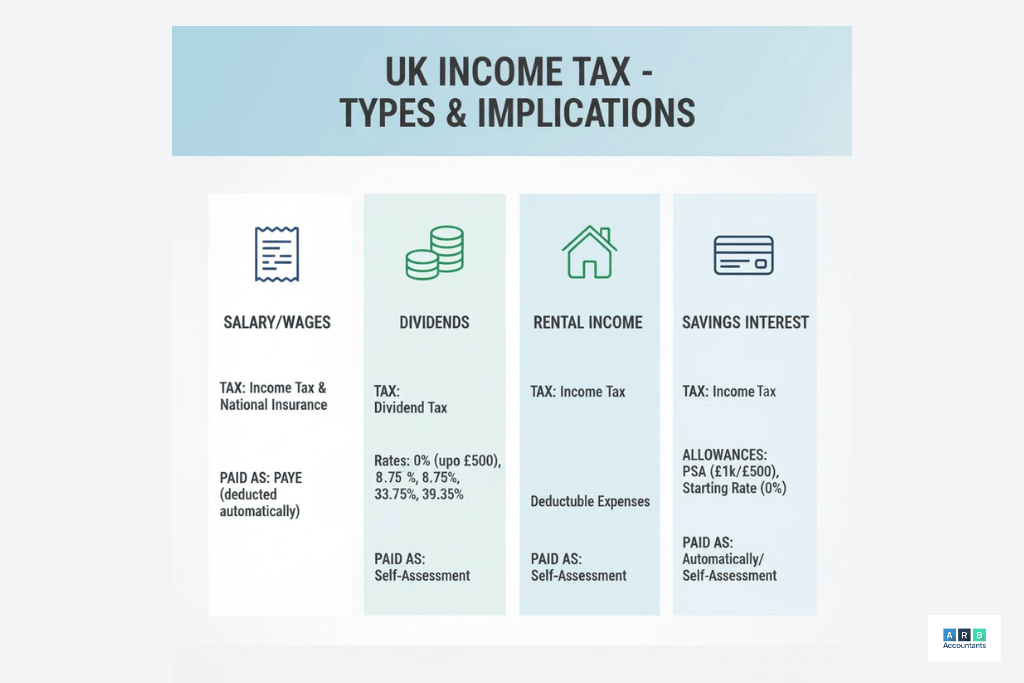
Everything taxable is added together before the bands are applied. For contractors, landlords and company directors the combination is what usually causes the surprise.
- Salary, bonuses and taxable benefits. A company car or medical insurance counts as income even though no cash changes hands.
- Self-employment profit, after allowable expenses.
- Rental profit, after allowable expenses. Our guide to allowable expenses for landlords covers what can be deducted.
- Dividends. These sit on top of other income for band purposes, so they can push you over the threshold, but dividends inside the higher rate band are taxed at 33.75%, not 40%.
- Savings interest above your Personal Savings Allowance, which itself halves from £1,000 to £500 once you become a higher rate taxpayer. Crossing the threshold therefore costs you twice.
That last point catches people out. A basic rate taxpayer gets £1,000 of tax-free savings interest. Cross into the higher rate and the allowance drops to £500, so interest that was previously untaxed becomes taxable at 40%.
The Two Cliff Edges Above the Threshold
The higher rate threshold itself is a gentle slope. Two points further up are genuine cliff edges, and both are worth planning around far more carefully than £50,270.
£60,000: the High Income Child Benefit Charge
If you or your partner claim Child Benefit and the higher earner’s adjusted net income passes £60,000, HMRC claws back 1% of the Child Benefit for every £200 of income above it. By £80,000 the whole amount has gone.
For a family with two children, that clawback stacked on 40% income tax and 2% NI produces an effective marginal rate comfortably above 50% across the whole £60,000 to £80,000 band. A pension contribution that brings adjusted net income back under £60,000 can therefore be worth far more than the headline relief suggests.
£100,000: the 60% trap
Above £100,000 of adjusted net income, the Personal Allowance is withdrawn at £1 for every £2 earned, disappearing entirely at £125,140.
You are taxed at 40% on the income and losing tax-free allowance at the same time, which produces an effective marginal rate of about 60%, or roughly 62% with NI. A £1,000 bonus in this band leaves you with about £380.
There is a second, less visible cost. Adjusted net income above £100,000 also removes eligibility for tax-free childcare and the funded childcare hours. For a parent of pre-school children, crossing £100,000 by a small margin can genuinely leave the household worse off, which is one of the very few places in the UK system where that is true.
Is the 40% Tax Threshold Changing?
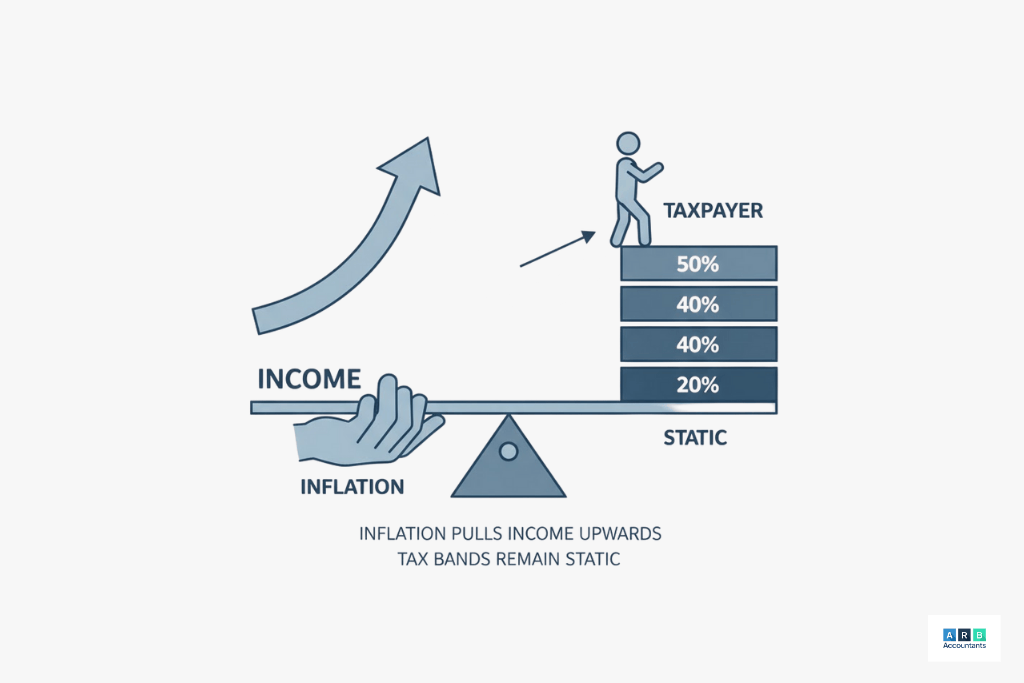
Not in cash terms, and not for a long time. The Personal Allowance and higher rate threshold have been frozen since April 2021, and the Autumn 2025 Budget extended the freeze to April 2031. Rates are unchanged, but as wages rise against a fixed threshold, more income is pulled into the higher rate every year. That is fiscal drag.
The scale is easy to underestimate. The Office for Budget Responsibility has estimated that by 2030/31 the Personal Allowance would be around £4,920 higher and the higher rate threshold about £20,120 higher had they simply risen with inflation. The three-year extension alone is expected to raise roughly £22 billion.
In practice that means a threshold of £50,270 in 2031 will represent a materially lower real income than the same figure did in 2021. Pay rises that merely track inflation will keep moving people into the 40% band.
Two consequences for planning:
- Income that would once have stayed in the basic rate band now spills into the higher rate without you earning any more in real terms.
- Mitigation that used to be a concern for people approaching £60,000 is now relevant much earlier, and needs revisiting annually rather than once.
How to Stay Below the 40% Tax Bracket
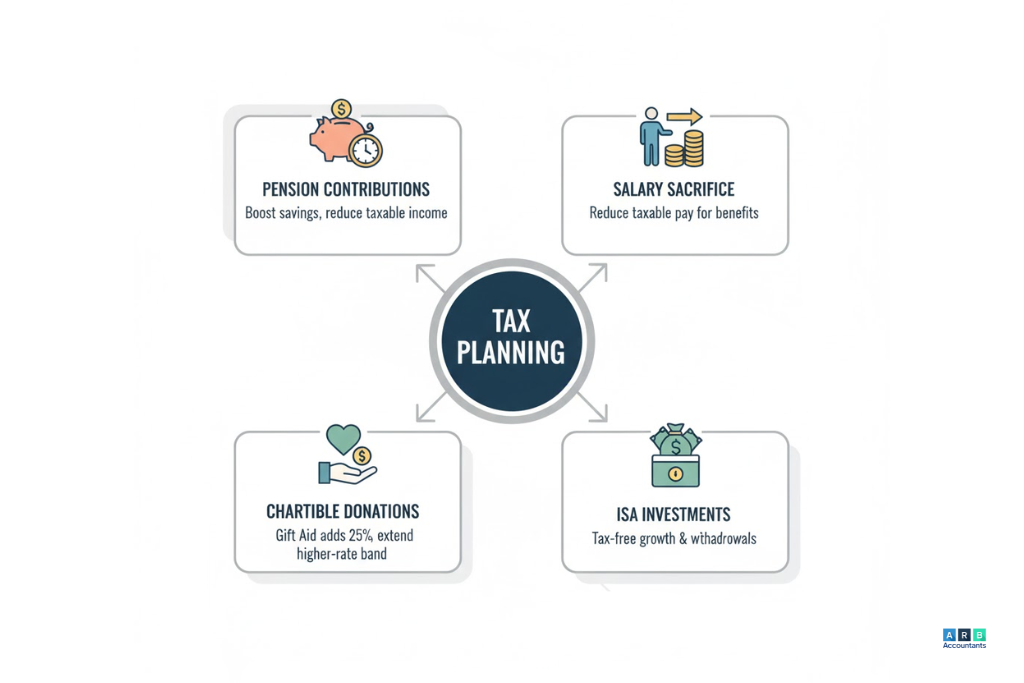
Every legitimate route works the same way: reduce the income measured against the threshold, rather than the income you receive. Pension contributions and Gift Aid do this directly. Timing, income splitting and remuneration mix do it indirectly.
Pension contributions
The most reliable lever. A gross personal contribution reduces the income measured against the threshold pound for pound. On £55,000, a £5,000 gross contribution brings you to £50,000 and out of the higher rate entirely.
The annual allowance is £60,000 for most people, and unused allowance from the previous three tax years can often be carried forward. The taper applies only at much higher incomes: threshold income above £200,000 and adjusted income above £260,000.
If you contribute through a workplace scheme by net pay or salary sacrifice, the relief is already given. If you pay into a personal pension from taxed income, the basic rate relief is added automatically but the higher rate relief must be claimed, through your tax return or by contacting HMRC. This is one of the most commonly unclaimed reliefs we see.
Gift Aid
Gift Aid donations also reduce adjusted net income. A useful feature: you can carry a donation back to the previous tax year, provided you make the election before you file that year’s return. It is one of the few genuinely retrospective levers in the system.
Salary and dividend mix for directors
If you control your own company, the split between salary and dividends changes when income crosses the threshold, because dividends in the higher rate band are taxed at 33.75% rather than 40%. Our guide to salary vs dividends works through the arithmetic.
Timing income
Deferring a bonus, invoice or dividend into the next tax year can keep the current year below the threshold, but only if next year has room. Done without forecasting, it moves the problem rather than solving it.
Splitting income with a spouse
Where assets are genuinely jointly owned, rental income and dividends can be shared with a lower-earning spouse or civil partner so that more of the total sits in the basic rate band. The ownership has to be real, and for property the split follows beneficial ownership unless a Form 17 election is made.
EIS and SEIS
Enterprise Investment Scheme and Seed Enterprise Investment Scheme investments carry income tax relief. They also carry genuine risk of losing the capital, so they belong at the end of a planning conversation rather than the start.
If You’ve Already Crossed It
You cannot change the band retrospectively, but two things are still available after the tax year has ended.
Higher rate pension relief you never claimed. If you paid into a personal pension from taxed income, basic rate relief went in automatically but the higher rate portion has to be claimed. You can go back four tax years, so during 2026/27 that reaches 2022/23. See our UK tax refund guide for how to make the claim.
Gift Aid carried back. A donation made in the current year can be treated as made in the previous one, if you elect before filing that year’s return.
Beyond that, the work is forward-looking: make sure every allowable expense is claimed, check whether a bonus or dividend can be timed differently, and model next year before it starts rather than after it ends.
A case we see often: a landlord with projected taxable income of £60,000 for the year. A £5,000 pension contribution reduces it to £55,000, cutting the higher rate slice from £9,730 to £4,730 and saving £2,000 of tax at 40%. Simple, entirely legitimate, and only possible if the position is modelled before 5 April rather than discovered afterwards.
Get Help With Higher Rate Tax Planning
Most people cross the 40% threshold without planning for it, because it happens through a pay rise, a second property, or a good year in the business rather than a decision. The cost of noticing in January, when the return is due, instead of the previous spring is usually the whole of the saving that was available.
ARB Accountants works with contractors, freelancers, landlords and company directors on exactly this: forecasting where the year will land, identifying which lever is worth pulling, and making sure reliefs like higher rate pension relief are actually claimed.
Heading into the higher rate this year?
Free 60-minute consultation. We'll model where your income lands, flag the £60,000 and £100,000 cliff edges if they apply, and tell you what's worth doing before 5 April. ACCA-chartered. Fixed fees.
"ARB Accountants helped me resolve an issue with HMRC that had been dragging on for months. Their knowledge and persistence saved me a lot of stress — and money. I can't recommend them enough." Jay Sach · Google Review (Tax Audit)
Read next
- How to reduce tax on your salary in the UK: the legitimate levers, in order of impact
- Salary vs dividends: the most tax-efficient mix once you’re over the threshold
- Wrong tax code?: why your code matters more once you’re a higher rate taxpayer
- UK tax refund: claiming higher rate pension relief you never claimed
- Do I need to register for Self Assessment?: when the higher rate brings a filing obligation
Frequently Asked Questions
What is the 40% tax bracket?
The 40% tax bracket, properly called the higher rate, is the band of taxable income taxed at 40%. In England, Wales and Northern Ireland it runs from £50,271 to £125,140 in 2026/27. Only the income inside that band is taxed at 40%. Income below it is still taxed at 0% and 20% as normal.
When does the 40% tax bracket kick in?
Once your taxable income passes £50,270 in England, Wales and Northern Ireland. That figure is your £12,570 Personal Allowance plus the £37,700 basic rate band. In Scotland the higher rate starts much earlier, at £43,663, and the rate is 42% rather than 40%.
How much can I earn before I pay 40% tax?
£50,270 of taxable income in England, Wales and Northern Ireland, and £43,662 in Scotland. Taxable income means everything after allowable expenses and reliefs, so pension contributions and Gift Aid donations can raise the amount you can earn before the higher rate bites.
Does the 40% rate apply to all my income once I cross the threshold?
No, and this is the most common misunderstanding. Only the slice above the threshold is taxed at 40%. If you earn £55,000, just £4,730 of it is taxed at 40%. The rest is taxed at 0% and 20% exactly as before, so a pay rise that takes you over the line never leaves you worse off overall.
What is my real marginal rate at £50,270?
Around 42%, not 40%. National Insurance falls from 8% to 2% at the same point, so as income tax rises from 20% to 40%, NI drops by 6 points. The combined marginal rate goes from 28% to 42%. It is a 14 point jump, not a 20 point one.
What is the 40% tax bracket in Scotland?
Scotland has no 40% band. The Scottish higher rate is 42% and starts at £43,663, nearly £6,600 earlier than the rest of the UK. Above that come the advanced rate at 45% from £75,001 and the top rate at 48% above £125,140. Which rates apply depends on where you live, not where you work.
Is the 40% tax threshold changing?
Not in cash terms. The Personal Allowance of £12,570 and the higher rate threshold of £50,270 have been frozen since April 2021, and the Autumn 2025 Budget extended that freeze to April 2031. Because wages keep rising while the threshold does not, more people are pulled into the higher rate each year. That effect is called fiscal drag.
What is the 60% tax trap?
Between £100,000 and £125,140 of adjusted net income, your £12,570 Personal Allowance is withdrawn at £1 for every £2 earned. You pay 40% on the income and lose allowance at the same time, giving an effective marginal rate of about 60%. Above £125,140 the allowance is gone and the additional rate of 45% applies.
Can pension contributions keep me out of the 40% bracket?
Yes. Personal pension contributions reduce the income measured against the threshold. On £55,000 of income, a £5,000 gross contribution brings you back to £50,000 and out of the higher rate. The annual allowance is £60,000 for most people, and unused allowance from the previous three tax years can often be carried forward.
Do dividends count towards the 40% threshold?
Yes. Dividends sit on top of your other income when working out which band they fall into, so they can push you over the threshold even though they are taxed at their own rates. Dividends falling in the higher rate band are taxed at 33.75% rather than 40%.
Does rental income count towards the 40% tax bracket?
Yes. Rental profit, meaning rent received less allowable expenses, is added to your other taxable income. A landlord with a £45,000 salary and £8,000 of rental profit is in the higher rate band, and the rental profit above £50,270 is taxed at 40%.
What happens at £60,000 if I claim Child Benefit?
The High Income Child Benefit Charge starts once the higher earner's adjusted net income passes £60,000, clawing back 1% of the Child Benefit for every £200 above it, and all of it by £80,000. Combined with 40% income tax, the effective marginal rate in that band can exceed 50% for a family with two or more children.
I've already crossed the threshold, can I do anything now?
You cannot change the band retrospectively, but you can still reduce the income measured against it. Personal pension contributions and Gift Aid donations both reduce adjusted net income, and Gift Aid can be carried back to the previous tax year if you elect before filing. Both are worth checking before the return is submitted.
Do I need to file a tax return if I'm in the 40% bracket?
Not automatically. PAYE usually collects the right tax even at higher rate. You will need to file if you have untaxed income such as rent or dividends above the allowances, if you are liable to the High Income Child Benefit Charge, or if you want to claim higher rate relief on personal pension contributions that were not made through salary sacrifice.
About The Author

Saurabh Bedi | Director
Saurabh is a tax advisor at ARB Accountants, specialising in Self-Assessment and small business tax. He's dedicated to making tax simple and stress-free, helping clients stay compliant and confident with HMRC.
Qualifications & Experience
- Fellow of Chartered Certified Accountants (ACCA)
- MSc Chartered Certified Accountancy 2008
- Working in accountancy since 2008