UK Tax Refund: How to Claim What HMRC Owes You
Does HMRC owe me a tax refund?
Quite possibly, if any of these applied in the last four years: an emergency tax code (one ending W1, M1 or X), changing jobs mid-year, stopping work part-way through a year, a pension lump sum, work expenses you paid yourself, or Marriage Allowance you never claimed. HMRC issues P800 letters automatically for some of these, but it cannot refund what it doesn't know about. Check your Personal Tax Account, pick the right form, and claim online: the money reaches your bank in 5 working days. It costs nothing, and you can go back to 2022/23.
HMRC tax refunds at a glance
- You can claim back four completed tax years. In 2026/27 that reaches 2022/23, which closes on 5 April 2027.
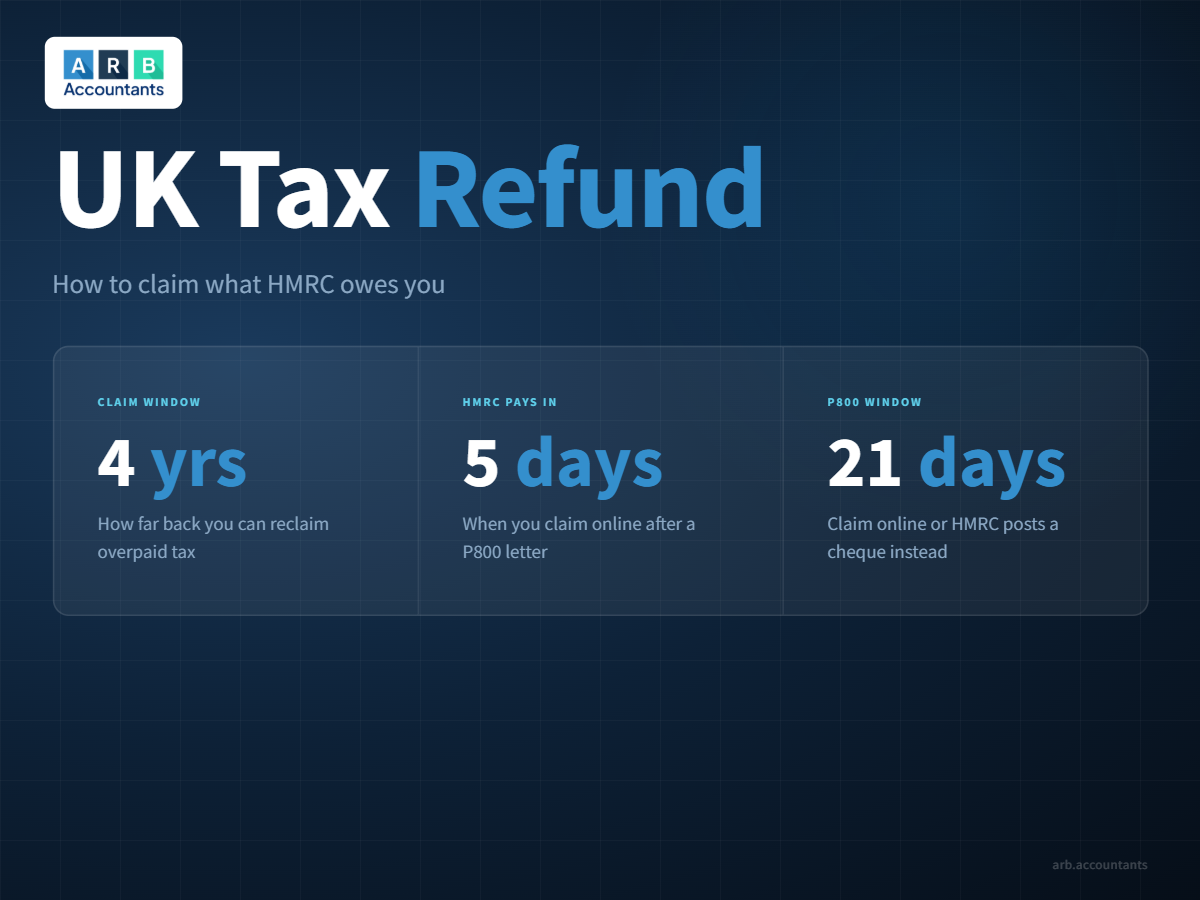
- Claim a P800 refund online and the money arrives in 5 working days. Ask for a cheque and it takes about 6 weeks.
- HMRC refunds some overpayments automatically, but never the ones it can’t see: work expenses, Marriage Allowance, pension lump sum forms.
- Claiming direct is free. Refund companies charge 25% to 48% of what you get back.
- HMRC never texts or emails to offer a refund. Those messages are always scams.
Every year, millions of people in the UK pay more income tax than they owe. It’s rarely obvious when it happens, and HMRC only corrects the overpayments it can see in its own data. A UK tax refund, also called an HMRC tax rebate, is simply HMRC returning tax you already paid but didn’t owe.
The process is more straightforward than most people expect. You don’t need a specialist company and you don’t need to wait years. What you do need is to know whether you qualify, which form applies, and what mistakes cost people money.
Table of Contents
- Am I Owed a Tax Refund? 8 Signs
- What Is a UK Tax Refund?
- Does HMRC Refund Overpaid Tax Automatically?
- Why You Might Have Overpaid Tax in the UK
- A Real-World Example: The Emergency Tax Code Problem
- How to Check If You’re Owed a UK Tax Refund
- How to Claim an HMRC Tax Refund
- Which Tax Refund Form Do I Need?
- How Far Back Can You Claim a UK Tax Refund?
- What Work Expenses Can You Claim Tax Back On?
- The Refunds People Miss Most Often
- Third-Party Tax Refund Companies: Read This First
- Scam Warning
- A Note on Tax Rules
Am I Owed a Tax Refund? 8 Signs
Work through this list for each of the last four tax years. If any line applies, there is a realistic chance HMRC owes you money, and checking costs nothing but a few minutes in your Personal Tax Account.
| Sign | Why it causes an overpayment | Where to claim |
|---|---|---|
| Your tax code ended W1, M1 or X | Emergency code taxes each pay period in isolation, ignoring allowance you haven’t used | Fix the code, refund follows through PAYE |
| You changed jobs and had no P45 | New employer had no previous pay and tax figures, so you were emergency taxed | P800 or Personal Tax Account |
| You stopped working part-way through a tax year | You only used part of your £12,570 allowance but paid tax as if you’d work all year | Form P50 |
| You took a pension lump sum | HMRC applies an emergency rate to the first withdrawal, often taxing thousands too much | P55, P53Z or P50Z |
| You paid for work expenses yourself | Uniforms, tools, professional fees and business mileage attract relief you must claim | Form P87 |
| You’re married and one of you earns under £12,570 | Marriage Allowance transfers 10% of the allowance, worth over £1,000 backdated | Marriage Allowance service |
| You had two jobs at once | Second job often taxed at BR or 0T with no allowance applied | P800 or Personal Tax Account |
| You had tax deducted from savings or a PPI payout | Low earners shouldn’t pay it at all, and most people have a Personal Savings Allowance | Form R40 |
The emergency tax code is the single most common cause, and the one people are least likely to notice. If you’re not sure what your code means, see our guide to what to do when your tax code is wrong.
What Is a UK Tax Refund?
A UK tax refund is a repayment from HMRC when you've paid more income tax, National Insurance, or other tax than you were legally required to pay in a given tax year. It's the same thing as an HMRC tax rebate. The words are used interchangeably, both by HMRC and in everyday language.
The UK tax system often collects tax before HMRC has the full picture of your income for the year. PAYE taxes you month by month, based on projected annual earnings. If your circumstances change mid-year, the projections can go wrong. That’s when overpayments happen.
HMRC is obliged to return money it has taken that it wasn’t entitled to keep. But it won’t always chase you down to do it. In many cases, you have to start the claim yourself.
Does HMRC Refund Overpaid Tax Automatically?
Sometimes, but only for the overpayments it can see. After each tax year ends, HMRC reconciles PAYE records from employers and pension providers. Where that reconciliation shows you paid too much, it issues a P800 tax calculation letter, and these go out between June and March of the following tax year.
What that process cannot catch is anything HMRC was never told about:
- Work expenses you paid for personally. Your employer doesn’t report these, so HMRC has no record of them.
- Marriage Allowance you never applied for. HMRC won’t transfer it on your behalf.
- Pension lump sum overpayments, where waiting for reconciliation can mean holding out until the following year instead of using a P55 now.
- Savings or investment tax deducted at source where your income was too low to owe it.
So the honest answer is that HMRC catches the straightforward PAYE reconciliations and misses almost everything that needs a form. That is exactly the gap refund companies make their money in.
Why You Might Have Overpaid Tax in the UK
Overpaying tax is more common than most people realise. Tax refunds in UK cases arise for a wide range of reasons, and some of them happen to almost everyone at some point in their working life.
| Reason for Overpayment | Who It Affects |
|---|---|
| Wrong or emergency tax code | New starters, job changers, anyone without a P45 |
| Multiple jobs in the same tax year | Anyone who changed employer or worked two jobs |
| Left work and didn’t work the rest of the year | Redundancy, career break, retirement |
| Paid too much National Insurance | Employees with two or more jobs in the same period |
| Work expenses not claimed during the year | Employees who paid for uniforms, tools, or mileage |
| Pension lump sum taken in one go | Those accessing defined contribution pensions |
| Marriage Allowance not applied | Married couples or civil partners within income thresholds |
The most frequent cause is an emergency tax code. When you start a new job without providing a P45, HMRC doesn’t know your previous earnings for the year. It puts you on an emergency code, which typically applies the Personal Allowance on a Month 1 basis only. You get one-twelfth of your allowance each month instead of the full year’s allowance. If your income is uneven or you previously earned less, you’ll overpay.
A Real-World Example: The Emergency Tax Code Problem
Say you leave one employer in August and start a new job in October. You earn £28,000 a year at the new role. Because you’ve lost your P45, your new employer puts you on an emergency tax code.
Under an emergency code (1257L M1 or W1), your new employer treats each pay period as if it were the start of the year. You don’t get credit for the tax-free Personal Allowance you didn’t use during your gap in work, or for the tax already paid with your previous employer. Over the remainder of the tax year, you pay more tax than you should.
When the tax year ends on 5 April, HMRC reconciles your records. If all your income and tax paid figures match up, it identifies the overpayment. You may receive a P800 letter confirming a UK tax refund is due. If HMRC doesn’t spot it, you can still claim tax back in the UK yourself by checking your tax account online or calling HMRC.
How to Check If You’re Owed a UK Tax Refund
The quickest way to check is through your Personal Tax Account on GOV.UK. Log in with your Government Gateway credentials, go to 'Check your Income Tax', and select the relevant tax year. You can see what tax you paid and what you should have paid.
HMRC also provides a simple tax checker tool. You’ll need your payslips or P60 to hand. If you’ve had multiple employments in the year, gather records from each one before you check.
If you’ve received a P800 letter from HMRC, that means HMRC has already identified a discrepancy. The P800 tells you how much UK tax refund you’re owed and how to receive it. Don’t ignore it. It has a deadline.
How to Claim an HMRC Tax Refund
Five steps: check your Personal Tax Account, identify which situation applies, use the right form, claim online rather than by cheque, and repeat for each of the four open years. Claiming online after a P800 gets the money to your bank in 5 working days. Asking for a cheque takes about 6 weeks.
Which Tax Refund Form Do I Need?
| Your Situation | How to Claim | Timescale |
|---|---|---|
| Employed (PAYE), P800 received | Claim online via the link on the letter or the HMRC app | 5 working days to your bank |
| P800 says a cheque is coming | Nothing to do, it’s posted automatically | Within 14 days of the letter date |
| You want a cheque instead | Request one online | About 6 weeks |
| Self Assessment | Calculated in the return, paid to your bank | Usually within 5 working days of processing |
| Work expenses | Form P87 online or by post, or via Self Assessment | 6 to 12 weeks |
| Stopped working mid-year | Form P50, after 4 weeks out of work | Several weeks |
| Pension lump sum, partial withdrawal | Form P55 | Up to 30 days |
| Pension emptied, other income | Form P53Z | Up to 30 days |
| Pension emptied, no other income | Form P50Z | Up to 30 days |
| Left the UK | Form P85 | Several weeks |
| Tax on savings, investments or PPI interest | Form R40 | 6 to 12 weeks |
| Marriage Allowance | Marriage Allowance service on GOV.UK | Backdated as a lump sum |
PAYE Employees
If HMRC sends you a P800 letter confirming you’re owed an HMRC tax rebate, you can claim online via GOV.UK and receive the money within five working days. If you don’t claim online within 21 days, HMRC sends a cheque to your registered address, which takes up to six weeks.
If you believe you’ve overpaid but haven’t received a P800, you can still request a review. Contact HMRC directly through your Personal Tax Account or by phone. Have your P60 or payslips ready.
Self Assessment Filers
If you file a Self Assessment tax return, any overpayment is calculated automatically as part of the return. If your return shows a tax refund from UK earnings, HMRC will usually pay it directly to your bank account within a few working days of the return being processed. You need to have your bank details on file with HMRC for this to happen.
If you’re owed a UK tax refund through Self Assessment and it isn’t paid within 30 days, contact HMRC. Don’t assume it’s on its way if you haven’t heard anything.
Work Expenses
Employees often overpay tax simply because they don’t claim the work expenses they’re entitled to. Claim tax back in the UK for allowable work costs using form P87 online or by post, or through your Self Assessment return if you file one.
You can claim for uniforms and protective clothing (including the flat-rate laundry allowance), professional subscriptions and union fees, tools and equipment, mileage for business travel in your own vehicle at HMRC’s approved rates, and working from home at £6 per week using the flat rate for weeks you were required to work from home.
Pension Lump Sums
Taking a pension lump sum often triggers a large overpayment because HMRC applies an emergency tax rate to the withdrawal. This is a significant and underreported cause of tax refunds in the UK.
If you took a partial withdrawal, complete form P55. If you emptied the pension entirely, use form P53Z if you had other income in the year, or P50Z if the pension was your only income. Submitting the correct form gets your money back in weeks rather than waiting for HMRC’s end-of-year reconciliation, which can mean waiting until the following spring.
If You’ve Stopped Working
Form P50 covers people who stop work part-way through a tax year. You can claim once you have been out of work for four weeks or more, provided you don't expect to return to work in the same tax year.
You can’t use P50 if you’re claiming Jobseeker’s Allowance, taxable Incapacity Benefit, contribution-based Employment and Support Allowance or Carer’s Allowance. It also covers retiring permanently without a pension from your old employer, and returning to full-time study.
The reason a refund arises is simple arithmetic. Your £12,570 Personal Allowance is spread across twelve months of PAYE. Stop working in September and you’ve only used half of it, but you were taxed as though you’d earn all year.
Savings Interest and PPI Payouts
Form R40 claims back tax deducted from savings or investment income where you shouldn’t have paid it. It also covers the tax taken from the interest element of a PPI compensation payment, which catches a lot of people who assume the whole payout was tax-free.
How Far Back Can You Claim a UK Tax Refund?
You can claim going back four complete tax years. Claiming during 2026/27, you can reach back to 2022/23, and that year closes on 5 April 2027. Anything earlier is out of time, and the deadline is strict.
| Tax year | Claim deadline |
|---|---|
| 2022/23 | 5 April 2027 |
| 2023/24 | 5 April 2028 |
| 2024/25 | 5 April 2029 |
| 2025/26 | 5 April 2030 |
Note the asymmetry worth knowing about: you get four years to reclaim overpaid tax, while HMRC gets four, six, twelve or twenty years to assess tax you underpaid, depending on the behaviour involved.
Each tax year is a standalone claim. If you overpaid across multiple years, you submit a separate claim for each. You can do this for each of the four years in one session through your Personal Tax Account.
Don’t assume the money is gone just because it happened a few years ago. Many people discover unclaimed tax refunds from the UK when they finally check their records. Four years can represent a meaningful sum, particularly if you had an emergency tax code for an extended period or didn’t claim work expenses.
What Work Expenses Can You Claim Tax Back On?
Claim tax back in the UK on expenses you paid personally that were required to do your job and that your employer didn’t reimburse. HMRC calls these allowable deductions.
Common qualifying expenses include:
- Subscriptions to professional bodies relevant to your work (check HMRC’s list of approved organisations)
- Cleaning or replacing a uniform or protective clothing that your employer requires you to wear
- Business mileage in your own vehicle at the HMRC approved rates, 55p per mile for the first 10,000 business miles in a tax year from 6 April 2026, 25p after that
- Tools, equipment, or materials you had to buy yourself
- Home working costs if you were required to work from home (£6 per week flat rate, or actual costs with documentation)
Ordinary commuting from home to your usual workplace doesn’t qualify. Neither do meals, general clothing, or training that your employer chose not to fund. If you’re not sure whether a cost qualifies, check HMRC’s guidance or ask an accountant before you claim.
The Refunds People Miss Most Often
In practice, four claims account for most of the money left unclaimed: Marriage Allowance, pension lump sum overpayments, work expenses, and CIS deductions. None of them are refunded automatically, because HMRC has no way of knowing they apply to you.
Marriage Allowance. One partner earns under the £12,570 Personal Allowance, the other is a basic-rate taxpayer, and 10% of the unused allowance transfers across. Backdated four years it’s worth over £1,000, paid as a lump sum. HMRC will never apply it for you.
Pension lump sums. The first flexible withdrawal is taxed on an emergency basis, which routinely takes thousands more than due from a single payment. Submitting P55, P53Z or P50Z gets it back in weeks instead of the following tax year.
Work expenses. Tools, uniforms, professional subscriptions and business mileage at 55p per mile from 6 April 2026. Employers don’t report any of this, so nothing appears in HMRC’s reconciliation.
CIS deductions. Contractors deduct 20% before you’re paid, or 30% if you’re unverified, which almost always exceeds the tax actually due once your Personal Allowance and allowable expenses are counted. The refund arrives through your Self Assessment return. Our CIS expenses guide covers what subcontractors can claim.
Third-Party Tax Refund Companies: Read This First
You’ll see advertisements for companies promising to get your HMRC tax rebate quickly with minimal effort. Some of these companies are legitimate agents. But the fees they charge are significant — typically 25% to 48% of whatever you receive — and claiming tax back in the UK directly through HMRC is free.
Some companies also ask you to sign a deed of assignment, which gives them the legal right to receive all your future tax refunds from UK sources for a set period, not just the one you originally engaged them to claim. HMRC has made it harder for companies to register these assignments, but they still exist.
The HMRC Personal Tax Account does everything these companies do. It’s free. It’s direct. And the refund goes straight to you. Use it.
Scam Warning
HMRC will never contact you by text message or email to offer a tax refund. If you receive a message saying you’re owed a refund and asking you to click a link or provide bank details, it’s a scam. Report it to HMRC’s phishing email address: [email protected].
Genuine refund communications come through your Personal Tax Account, the HMRC app, or by post as a P800 letter. HMRC never asks for payment by gift card, cryptocurrency, or bank transfer to an unfamiliar account.
One change worth knowing: since April 2026 HMRC has been moving to digital by default, so if you use the app or a Personal Tax Account, letters increasingly appear there with an email telling you to log in. The email itself will never contain a claim link asking for your bank details. Always log in through GOV.UK or the app directly rather than following a link.
A Note on Tax Rules
Tax rates, thresholds, approved expense rates, and HMRC processes change regularly. The information in this article reflects the position as understood at the time of writing. HMRC’s guidance on tax refunds in the UK and what qualifies as an allowable expense is updated periodically.
If you’re unsure whether you have a valid claim, how much you might be owed, or how to handle a complex situation such as multiple employments, a pension withdrawal, or income from abroad, speak with a qualified accountant. Getting professional advice upfront is considerably cheaper than submitting an incorrect claim and dealing with the consequences.
Want help claiming your UK tax refund?
ARB Accountants helps individuals across the UK identify overpaid tax and claim it back correctly — covering emergency tax codes, work expenses, pension withdrawals, and multi-year claims. ACCA-chartered. Fixed fees. No percentage taken from your refund.
Frequently Asked Questions
How do I know if I'm owed a UK tax refund?
Check your Personal Tax Account at gov.uk or the HMRC app, select 'Check your Income Tax' and compare tax paid against tax owed for each year. The strongest signs you have overpaid are an emergency tax code (one ending W1, M1 or X), changing jobs mid-year, stopping work part-way through a year, taking a pension lump sum, or never claiming work expenses or Marriage Allowance.
How long does a UK tax refund take?
If you claim online after a P800 letter, HMRC pays within 5 working days. If you ask for a cheque instead, allow around 6 weeks. Where the P800 says HMRC will send a cheque automatically, it arrives within 14 days of the date on the letter and you don't need to do anything. Self Assessment refunds usually arrive within a few working days of the return being processed. P87 work expense claims can take 6 to 12 weeks.
Can I claim tax back from the UK for previous years?
Yes. You can claim for up to four completed tax years. In the 2026/27 tax year that means back to 2022/23, and the 2022/23 claim window closes on 5 April 2027. Each year is a separate claim and all four can be submitted through your Personal Tax Account.
Do I need to pay to claim an HMRC tax rebate?
No. Claiming directly through your Personal Tax Account, by phone, or by post costs nothing. Third-party refund companies charge significant fees, typically a percentage of whatever you receive. You don't need them. The HMRC self-service tools handle the same claims for free.
What is the difference between a UK tax refund and an HMRC tax rebate?
There's no difference. They refer to the same thing: money HMRC returns because you paid more tax than you owed. 'Tax rebate' and 'tax refund' are used interchangeably by HMRC, in official guidance, and in general use.
I received a P800 letter. What should I do?
A P800 tax calculation letter tells you HMRC has worked out you overpaid. Claim it online through the link on the letter or the HMRC app and the money reaches your bank within 5 working days. Some P800s say HMRC will send a cheque automatically, in which case it arrives within 14 days of the letter date and you need do nothing. If you think the calculation is wrong, contact HMRC and tell them which figures are incorrect and what they should be.
Can I claim tax back in the UK if I've left the country?
Yes. If you've left the UK and paid income tax while you were resident, you may be entitled to a tax refund from UK earnings. Complete form P85 and send it to HMRC. The process can take several weeks. If you also earned income in another country during the same tax year, the situation becomes more complex and professional advice is worth having.
Can I claim the HMRC tax rebate for working from home?
Yes, if your employer required you to work from home and didn't reimburse your home working costs. HMRC allows a flat rate of £6 per week (£312 per year) without receipts, or you can claim actual costs if they're higher and you can document them. You claim through P87 online or through your Self Assessment return.
Am I owed a tax rebate?
You are more likely to be owed one if any of these applied in the last four years: you were on an emergency tax code (ending W1, M1 or X), you changed jobs or had two jobs at once, you stopped working part-way through a tax year, you took a pension lump sum, you paid for work expenses your employer didn't reimburse, you are married and neither of you claimed Marriage Allowance, or you had tax deducted from savings interest. Checking your Personal Tax Account takes a few minutes and costs nothing.
Does HMRC refund overpaid tax automatically?
Sometimes. After the tax year ends HMRC reconciles PAYE records and issues P800 letters between June and March where it spots an overpayment. But it only sees what employers and pension providers report. It cannot know about work expenses you never claimed, Marriage Allowance you never applied for, or a pension lump sum form you never submitted. Those need a claim from you.
How do I claim a tax refund if I've stopped working?
Use form P50. You can claim once you have been out of work for four weeks or more, provided you are not claiming Jobseeker's Allowance, taxable Incapacity Benefit, contribution-based Employment and Support Allowance or Carer's Allowance, and you don't expect to go back to work in the same tax year. It also covers retiring permanently or returning to full-time study.
Can I claim a tax refund on savings interest?
Yes, using form R40, where tax was deducted from savings or investment income and your income was low enough that you shouldn't have paid it. This also covers the tax deducted from the interest element of a PPI compensation payment. The same four-year limit applies.
Can I backdate Marriage Allowance?
Yes, up to four tax years, provided you met the conditions in each year: one partner earning under the £12,570 Personal Allowance and the other a basic-rate taxpayer. A successful backdated claim can be worth over £1,000 as a lump sum, and it is one of the most commonly missed refunds.
Do CIS subcontractors get a tax refund?
Very often, yes. Contractors deduct 20% (or 30% if unverified) from payments before you receive them, which usually exceeds the tax actually due once your Personal Allowance and allowable expenses are taken into account. The refund comes through your Self Assessment return rather than a separate form.
About The Author

Saurabh Bedi | Director
Saurabh is a tax advisor at ARB Accountants, specialising in Self-Assessment and small business tax. He's dedicated to making tax simple and stress-free, helping clients stay compliant and confident with HMRC.
Qualifications & Experience
- Fellow of Chartered Certified Accountants (ACCA)
- MSc Chartered Certified Accountancy 2008
- Working in accountancy since 2008