Wrong Tax Code? How to Check It and Get Your Money Back
How do I know if my tax code is wrong?
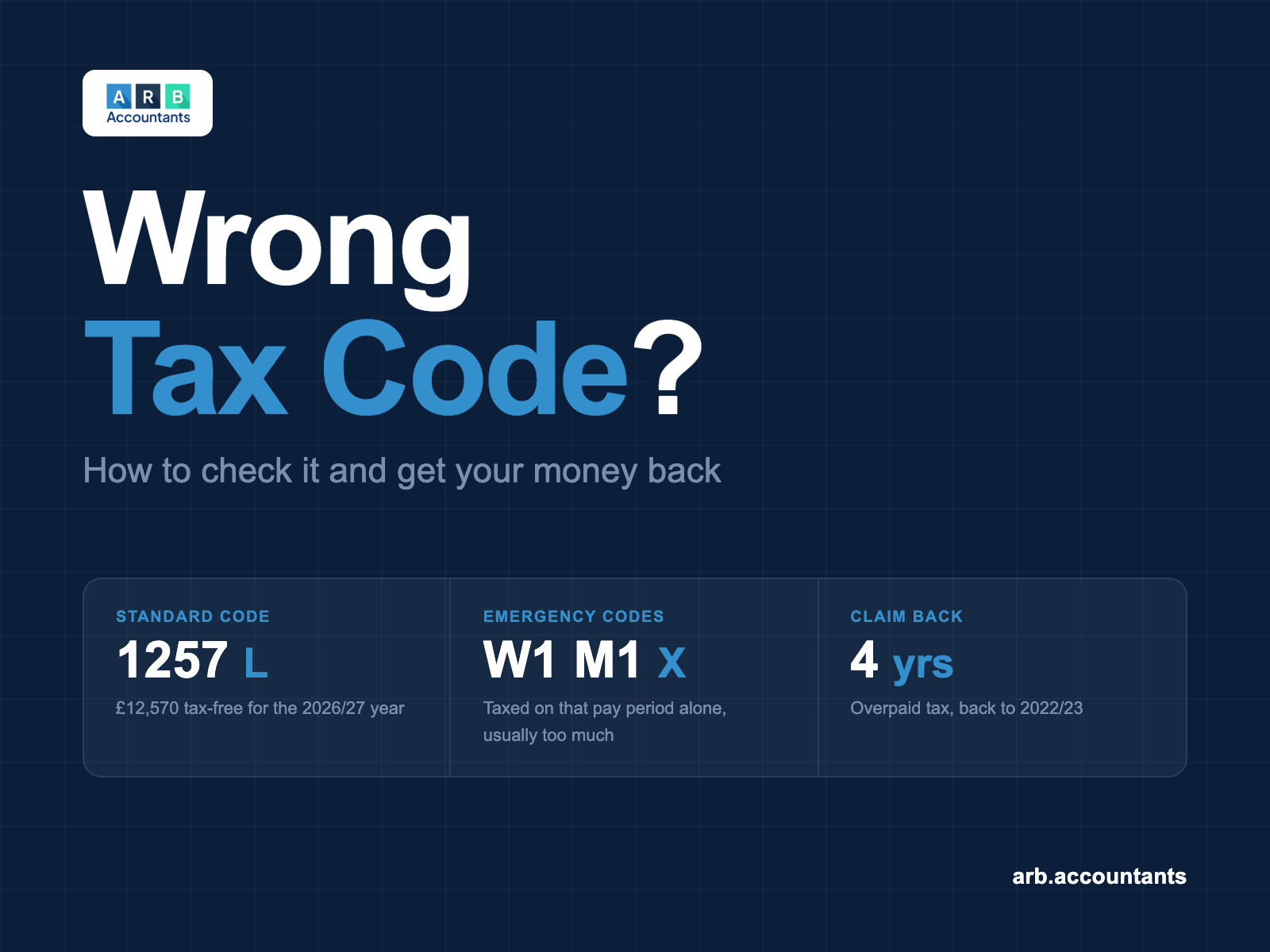
Take the number in your code and multiply it by 10. That's the tax-free income it gives you this year. On the standard code 1257L that's £12,570, the full Personal Allowance. If the figure is far lower and you have no company car, medical cover or untaxed income to explain it, the code is probably wrong. Same if it ends W1, M1 or X (an emergency code), or reads BR or 0T on your only job. Tell HMRC through the Check your Income Tax service and the overpayment usually comes back through your next payslip.
Tax codes in 2026/27 at a glance
- The standard code is 1257L, worth £12,570 of tax-free income.
- Codes ending W1, M1 or X are emergency codes and usually cost you money.
- Only HMRC can change a tax code. Your employer just applies what it’s given.
- After starting a job, allow 35 days before chasing. HMRC usually fixes it on its own.
- Once HMRC agrees a change, you and your employer are told within 15 working days.
- You can reclaim overpaid tax for four tax years, back to 2022/23.
Table Of Contents
- How to Tell If Your Tax Code Is Wrong
- What the Numbers Mean
- What the Letters Mean
- Emergency Tax Codes: W1, M1 and X
- BR, 0T and D0: No Allowance Codes
- K Codes: When Deductions Beat Your Allowance
- Why Your Tax Code Changed
- How to Fix a Wrong Tax Code
- How to Get Back What You Overpaid
- What If the Code Meant You Underpaid?
- Get Help With a Tax Code Problem
How to Tell If Your Tax Code Is Wrong
Your tax code appears on your payslip, your P45 and P60, your PAYE coding notice, and in your Personal Tax Account or the HMRC app. The quickest check is arithmetic: multiply the number by 10. That's how much you can earn before paying tax this year. Compare it against the standard £12,570 and see whether the difference makes sense.
Five patterns that mean something is probably wrong:
- Your code ends W1, M1 or X. That’s an emergency code. Fine for a month or two after starting a job, a problem if it persists.
- Your code is BR or 0T on your only job. Both apply tax with no Personal Allowance at all. On a single job that’s rarely correct.
- The number is far below 1257 with no explanation. Company benefits and untaxed income reduce it legitimately. Nothing else should.
- Your code changed and you don’t know why. HMRC sends a coding notice explaining the calculation. If you didn’t get one, or it doesn’t match your circumstances, check it.
- You have two jobs and both have a full allowance. Pleasant, but you’ll owe the difference back. The allowance is meant to be used once.
The stakes are not trivial. A full year on a BR code when you should have had 1257L costs £2,514 in tax you didn’t owe. A 0T code on a higher earner costs considerably more.
What the Numbers Mean
The number tells your employer how much tax-free income you get from them this tax year. Multiply it by 10. 1257 means £12,570. 1000 means £10,000. The figure starts from your Personal Allowance and is then adjusted for anything HMRC knows about that changes it.
What moves the number up or down:
- Company benefits (a car, fuel, medical insurance) reduce it, because the benefit is taxable income collected through the code.
- Untaxed income HMRC knows about, such as savings interest above your allowance or modest rental profit, reduces it.
- Tax owed from an earlier year reduces it, where HMRC is collecting an underpayment through your code rather than asking for a lump sum.
- Job expenses you’ve claimed, such as professional subscriptions or a uniform allowance, increase it.
- Marriage Allowance received from a partner increases it by £1,260.
So a code of 900L isn’t wrong in itself. It means £9,000 tax-free, presumably because roughly £3,570 of benefits or untaxed income has been set against your allowance. The question is always whether the reduction matches your actual circumstances. Your coding notice shows the workings.
What the Letters Mean
The letters describe your situation. L is the standard allowance, M and N are Marriage Allowance, BR, D0 and D1 apply a flat rate with no allowance, 0T means no details held, NT means no tax at all. An S prefix means Scottish rates and a C prefix means Welsh rates.
| Code | What it means |
|---|---|
| L | You’re entitled to the standard tax-free Personal Allowance |
| M | Marriage Allowance: you’ve received a transfer of 10% of your partner’s allowance |
| N | Marriage Allowance: you’ve transferred 10% of your allowance to your partner |
| T | Your code includes other calculations to work out your Personal Allowance |
| 0T | Your allowance is used up, or a new employer doesn’t have the details to give you a code |
| BR | All income from this job or pension is taxed at the basic rate (20%) |
| D0 | All income from this job or pension is taxed at the higher rate (40%) |
| D1 | All income from this job or pension is taxed at the additional rate (45%) |
| NT | You’re not paying any tax on this income |
| K (prefix) | Deductions exceed your allowance, so income is added rather than allowance given |
| W1 / M1 / X (suffix) | Emergency code, applied to that pay period only |
| S (prefix) | Taxed at Scottish rates (S0T, SBR, SD0, SD1, SD2, SD3) |
| C (prefix) | Taxed at Welsh rates (C0T, CBR, CD0, CD1) |
The S and C prefixes follow where you live, not where you work. If you’ve moved across the border either way and the prefix hasn’t caught up, tell HMRC: the rates and bands genuinely differ, so it isn’t a cosmetic issue.
Emergency Tax Codes: W1, M1 and X
An emergency code ends W1 (paid weekly), M1 (paid monthly) or X (variable pay dates), and some payslips show NONCUM instead. HMRC's wording is that your tax is worked out "based on what you're paid in that week or month only", taxing you as though you were paid that amount every period of the year. It's the single most common cause of an overpaid PAYE bill.
Why it costs you money
A normal code is cumulative: every payslip looks at your total pay and tax for the year so far and works out what’s due. An emergency code is non-cumulative: each payslip is treated in isolation, as though the year just started.
That means you get one-twelfth of your allowance each month regardless of what you’ve actually earned. If you had a gap between jobs, or your pay is uneven, or you already paid tax with a previous employer, the code has no way to account for it. You overpay, and it stays overpaid until the code is corrected or the year ends.
When you get put on one
HMRC lists three situations:
- Starting a new job where your employer doesn’t have your previous income and tax details, usually because there was no P45.
- Starting to receive company benefits.
- Starting to receive the State Pension.
The first is temporary. HMRC updates the code once it has details from your old and new employers, which “can take up to 35 days from when you start your job”. The other two are different: you keep the emergency code until the end of the tax year, and get a normal code in the new one.
What to do about it
Give your employer your P45. If you don’t have one, complete a new starter checklist, which tells them enough to apply a better code than 0T. Then wait out the 35 days before contacting HMRC, because in most cases the correction happens automatically and phoning early rarely speeds it up.
BR, 0T and D0: No Allowance Codes
These three apply tax with no Personal Allowance at all. On a second job that's usually right, since your allowance is already used by the first. On your only job it's almost always wrong, and expensive.
| Code | Tax applied | Usually correct when |
|---|---|---|
| BR | 20% on everything | Second job or pension, where your main job uses the allowance |
| D0 | 40% on everything | Second income for a higher-rate taxpayer |
| D1 | 45% on everything | Second income for an additional-rate taxpayer |
| 0T | Normal bands, no allowance | A new job with no details supplied, or an allowance genuinely used up |
The distinction people miss is between BR and 0T. BR caps everything at 20%. 0T runs through the normal bands, so it starts at 20%, moves to 40% above the higher-rate threshold and 45% above £125,140, but with no tax-free slice at the bottom. On the same salary, 0T can take a great deal more than BR.
A 0T code on a new job is a signal that your employer had nothing to work with. Fixing it means getting your details to them, not arguing with payroll.
K Codes: When Deductions Beat Your Allowance
A K at the front means deductions come to more than your Personal Allowance, so instead of giving you tax-free income, the code adds notional income to what you're taxed on. K475 adds roughly £4,750 to your taxable pay across the year.
K codes usually come from a substantial company benefit such as a car with high emissions, untaxed income HMRC is collecting through PAYE, or tax owed from a previous year being clawed back. They’re unpleasant to look at but often entirely correct.
There is one important safeguard: your employer cannot deduct more than 50% of that pay packet in tax, however the K code computes. If you’re hitting that limit, the shortfall carries forward and the underlying position is worth reviewing, because it usually means the code is trying to collect more in one year than your pay can carry.
Why Your Tax Code Changed
A mid-year change is normal and usually explained on the coding notice HMRC sends. The common triggers:
- HMRC revised its estimate of your income after a pay rise, bonus, overtime or commission.
- You started or stopped receiving a company benefit.
- You started or ended a second job, or a pension came into payment.
- You claimed or cancelled Marriage Allowance, moving £1,260 of allowance between you and your partner.
- HMRC is collecting tax you owe from an earlier year through your code.
- You claimed job expenses, which increases the code.
If the notice doesn’t explain your change, or the figures in it don’t match your circumstances, that’s the point to query it rather than waiting for the year-end reconciliation to sort it out.
How to Fix a Wrong Tax Code
Only HMRC can change a tax code. Your employer applies whatever code it's given, so payroll cannot help you. Use the Check your Income Tax service on GOV.UK or the HMRC app, review your employment, pension, estimated income and company benefit details, and correct anything wrong or missing.
The steps:
- Wait 35 days if you’ve just started a job. HMRC usually issues the right code once it has details from both employers.
- Sign in to Check your Income Tax on GOV.UK, or use the HMRC app.
- Review what HMRC thinks it knows: your employments, pensions, estimated taxable income, company benefits and expenses.
- Update anything wrong or missing. Most bad codes come from an estimate that’s out of date or a benefit that ended.
- Phone 0300 200 3300 if you can’t use the online service, or if the details look right but the code still doesn’t.
Once HMRC agrees the code needs to change, it tells you and your employer the new code within 15 working days. Expect it to appear on your payslip within two or three pay periods, depending on how often you’re paid and where your employer sits in its payroll cycle.
Keep a note of when you contacted HMRC and what you told them. If the code doesn’t change and you need to chase, that record is what moves the conversation along.
How to Get Back What You Overpaid
For the current tax year, the fix and the refund are the same event: once the correct cumulative code is applied, your next payslip repays the overpayment through reduced tax. For earlier years, HMRC calculates after the year ends and sends a P800, which you then claim online.
Current tax year
A cumulative code recalculates the whole year to date. If you’ve paid £800 too much by month seven, the month eight payslip corrects it. You don’t need to make a separate claim, and you don’t need to wait until April.
Previous tax years
HMRC reconciles PAYE records after the tax year ends and issues P800 tax calculation letters between June and March of the following year. If yours shows a refund:
- Claim online through the link on the letter or the HMRC app and the money reaches your bank in 5 working days.
- If the letter says HMRC will send a cheque automatically, it arrives within 14 days of the letter date and you need do nothing.
- If you ask for a cheque instead of a bank transfer, allow about 6 weeks.
If no P800 arrives and you think a past year was wrong, you can still claim. The limit is four completed tax years, so during 2026/27 you can go back to 2022/23, and that year closes on 5 April 2027. Our UK tax refund guide covers the process and the forms for each situation.
Worth checking at the same time: Marriage Allowance can also be backdated four years and is worth over £1,000 as a lump sum. It’s the most commonly missed claim we see, and a wrong tax code is often what prompts people to look.
What If the Code Meant You Underpaid?
It happens, most often where two jobs each applied a full Personal Allowance, or a company benefit went unreported. HMRC will send a P800 or a Simple Assessment letter setting out what's owed. This is not a penalty situation, provided you pay by the deadline given.
Where the amount is under £3,000 and you’re in PAYE, HMRC normally collects it by adjusting next year’s code rather than asking for a lump sum, which spreads it across twelve months. Larger amounts, or cases where there’s no PAYE income to adjust, come as a Simple Assessment with a payment date.
If you can’t pay by the deadline, contact HMRC before it passes and ask about a payment plan. Missing the date without contact is what turns an administrative correction into interest and penalties. Late payment interest currently runs at 7.75%.
One thing to be careful about: an underpayment caused by an employer’s error is still your tax bill. HMRC can direct the liability to the employer in limited circumstances, but that’s the exception. Check the figures yourself rather than assuming payroll got it right.
Get Help With a Tax Code Problem
Most tax code problems resolve themselves within a couple of pay periods. The ones that don’t usually have something structural behind them: two employments HMRC has merged or duplicated, a benefit that ended but is still in the code, a pension that started, or a years-old underpayment quietly being collected.
ARB Accountants sorts out coding notices, multi-year overpayments and PAYE reconciliation for employees, directors and pensioners. Fixed fees, and we don’t take a percentage of anything we recover for you.
Think you've been on the wrong tax code for years?
Free 60-minute consultation. We'll check your codes across the open tax years, work out what you overpaid, and claim it back. ACCA-chartered. Fixed fees, no percentage of your refund.
"ARB Accountants helped me resolve an issue with HMRC that had been dragging on for months. Their knowledge and persistence saved me a lot of stress — and money. I can't recommend them enough." Jay Sach · Google Review (Tax Audit)
Read next
- UK tax refund: how to claim what HMRC owes you: the eight signs you’ve overpaid and which form to use
- Tax office reference number: how to find and use it: the other number on your payslip
- Payrolled benefits on your payslip: why benefits change your code
- Planning around the 40% tax threshold: what happens as your income crosses £50,270
Frequently Asked Questions
How do I know if my tax code is wrong?
Multiply the number in your code by 10 to get the tax-free income it gives you for the year. On the standard code 1257L that's £12,570. If the figure is much lower and you have no company car, medical insurance or untaxed income to explain it, or if your code ends W1, M1 or X, or is BR or 0T on your only job, it is probably wrong.
What is an emergency tax code?
An emergency tax code ends in W1 (paid weekly), M1 (paid monthly) or X (variable pay dates), and you may also see NONCUM on your payslip. HMRC's guidance is that your tax is worked out on what you're paid in that week or month only, as though you were paid that amount every period of the year. It's used when HMRC doesn't yet have enough information about you.
Why am I on an emergency tax code?
Usually because you started a new job without giving your employer a P45, so they have no record of your pay and tax so far this year. You can also be put on one when you start receiving company benefits or the State Pension. HMRC normally updates the code once it gets details from your old and new employers, which can take up to 35 days from when you start.
How do I get off an emergency tax code?
Give your new employer your P45 if you have one, or complete a new starter checklist if you don't. If 35 days have passed and the code hasn't changed, sign in to the Check your Income Tax service on GOV.UK, confirm your employment and income details are right, and correct anything wrong. HMRC then tells you and your employer the new code, usually within 15 working days.
What does tax code 1257L mean?
1257L is the standard code for 2026/27. The 1257 means £12,570 of tax-free income for the year, which is the full Personal Allowance, and the L means you're entitled to the standard allowance. It's applied cumulatively, so each payslip accounts for what you've earned and paid so far in the year.
What does tax code BR mean?
BR means all income from that job or pension is taxed at the basic rate of 20%, with no Personal Allowance applied. On a second job this is usually correct, because your allowance is already being used by your main job. On your only job it is almost always wrong and you'll be overpaying.
What does tax code 0T mean?
0T means your Personal Allowance has been used up, or you've started a new job and your employer doesn't have the details needed to give you a code. Unlike BR, a 0T code applies higher and additional rates as your earnings rise, so it can take considerably more tax than BR on the same salary.
What is a K tax code?
A K at the front of your code means deductions, such as company benefits, untaxed income or tax owed from a previous year, come to more than your Personal Allowance. Instead of tax-free income, the code adds notional income to what you're taxed on. There is a safeguard: your employer cannot take more than half of that pay packet in tax.
How do I tell HMRC my tax code is wrong?
Use the Check your Income Tax online service on GOV.UK or the HMRC app. Review your employment, pension, estimated taxable income, company benefit and expenses details, and update anything wrong or missing. If you can't use the online service, phone HMRC on 0300 200 3300. If you've just started a job, wait 35 days first.
How long does HMRC take to change a tax code?
Once HMRC decides the code needs to change, it tells you and your employer within 15 working days. The new code usually shows up on your payslip within two to three pay periods, depending on how often you're paid and where your employer is in its payroll cycle.
Will I get the overpaid tax back automatically?
For the current tax year, usually yes. Once the correct cumulative code is applied, the refund comes through your next payslip as reduced tax or a repayment from your employer. For earlier tax years, HMRC works it out after the year ends and sends a P800 calculation, which you then claim online.
How far back can I claim overpaid tax from a wrong tax code?
Four completed tax years. Claiming during 2026/27 you can go back to 2022/23, and that year closes on 5 April 2027. Each year is a separate claim through your Personal Tax Account.
Can my employer change my tax code?
No. Only HMRC can issue or change a tax code. Your employer simply applies the code HMRC gives them, or the emergency code if none has been issued. If you think the code is wrong, contacting your employer won't fix it, you need to contact HMRC.
Why did my tax code change mid-year?
Common reasons are HMRC updating its estimate of your income after a pay rise, bonus or overtime, a new company benefit such as a car or medical insurance, starting or stopping a second job, claiming or cancelling Marriage Allowance, or HMRC collecting tax you owe from an earlier year through the code. Your coding notice sets out the calculation.
What does an S or C at the start of my tax code mean?
S means your income is taxed using Scottish rates, and C means Welsh rates, based on where you live rather than where you work. If you've moved between Scotland, Wales and England and the prefix hasn't followed you, tell HMRC, because the rates and bands genuinely differ.
About The Author

Saurabh Bedi | Director
Saurabh is a tax advisor at ARB Accountants, specialising in Self-Assessment and small business tax. He's dedicated to making tax simple and stress-free, helping clients stay compliant and confident with HMRC.
Qualifications & Experience
- Fellow of Chartered Certified Accountants (ACCA)
- MSc Chartered Certified Accountancy 2008
- Working in accountancy since 2008