Associated Companies and Marginal Relief: Why Your CT Bill Jumped
How do associated companies affect corporation tax?
They divide the limits. Corporation tax is 19% on profits below £50,000 and 25% above £250,000, with marginal relief in between. But those two limits are split by the number of associated companies, including the company itself. Two companies under the same control means limits of £25,000 and £125,000 each, so the 25% rate arrives at a fifth of the profit. The test is worldwide, ignores whether the other company trades, and catches the position at any point in the year. Miss one and you underpay.
Associated companies and marginal relief at a glance
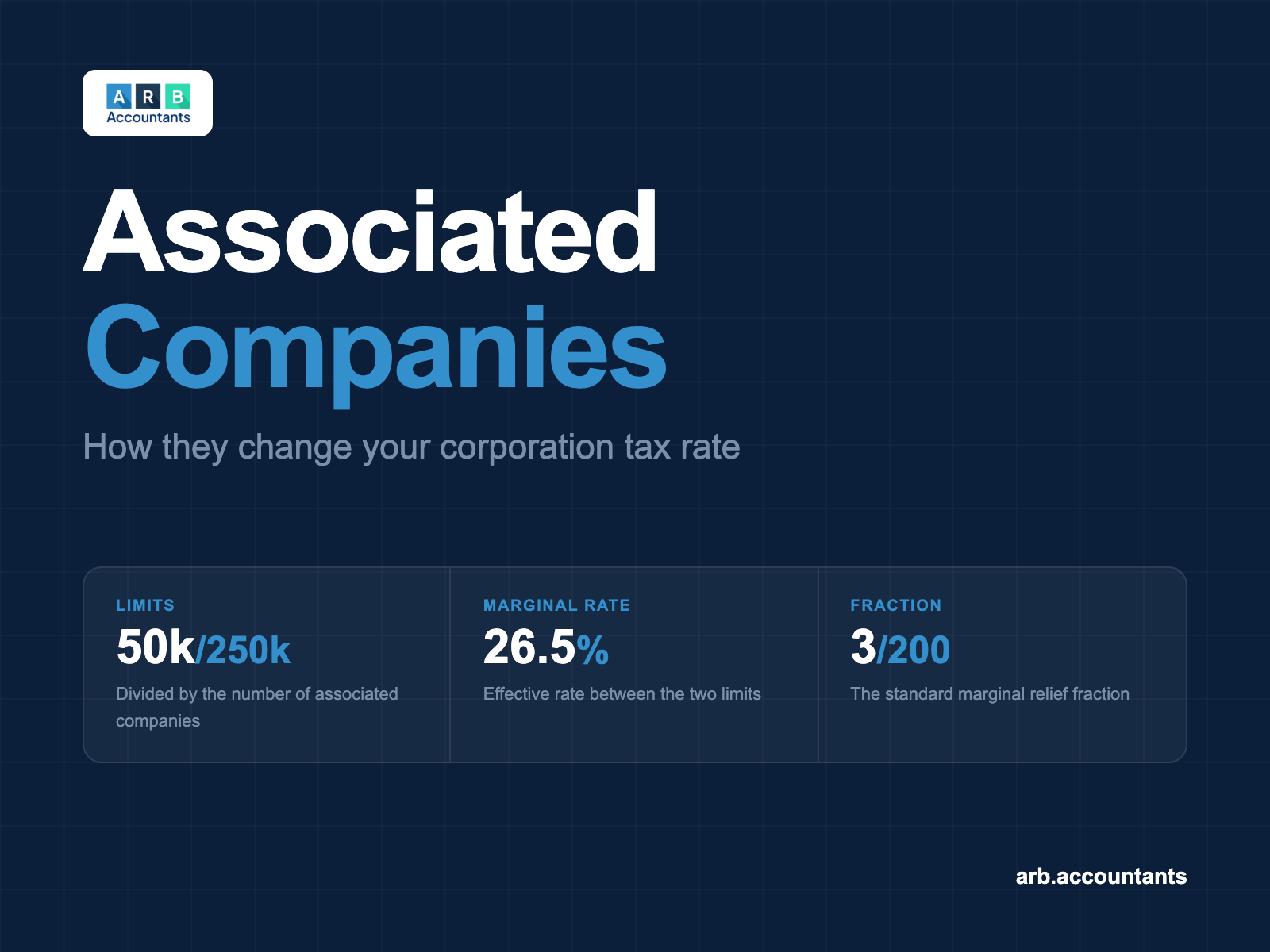
- Limits: £50,000 and £250,000, divided by the number of associated companies.
- Effective marginal rate in the band: 26.5%, higher than either headline rate.
- Marginal relief fraction: 3/200.
- The test is worldwide and includes non-trading companies.
- HMRC wrote to companies about this between 7 April and 30 September 2026.
Table Of Contents
- Corporation Tax Rates and the Two Limits
- How Marginal Relief Works
- The 26.5% Marginal Rate Nobody Mentions
- How to Count Associated Companies
- What Counts and What Doesn’t
- Worked Examples
- Short Accounting Periods
- HMRC’s 2026 Letters About Associated Companies
- What to Do If You Got It Wrong
- Get Help With Associated Companies
Corporation Tax Rates and the Two Limits
Since 1 April 2023 there have been two corporation tax rates: the small profits rate of 19% on profits up to £50,000, and the main rate of 25% on profits above £250,000. Between the two, marginal relief tapers the rate upwards.
| Augmented profits | Rate |
|---|---|
| Up to £50,000 | 19% |
| £50,001 to £250,000 | 25% less marginal relief |
| Over £250,000 | 25% |
The figure compared against those limits is augmented profits: taxable total profits plus exempt distributions from companies that aren’t 51% subsidiaries. For most owner-managed companies augmented profits and taxable profits are the same number, but if your company receives dividends from a minority shareholding in another company, they’re counted for the limits even though they aren’t taxed.
Everything above assumes one company. The moment there’s a second under the same control, the limits move.
How Marginal Relief Works
Marginal relief is calculated as (upper limit − augmented profits) × 3/200, deducted from tax charged at the main rate of 25%. The 3/200 figure is the standard fraction, unchanged since April 2023.
Take a company with £150,000 of profits and no associated companies:
- Tax at the main rate: £150,000 × 25% = £37,500
- Marginal relief: (£250,000 − £150,000) × 3/200 = £1,500
- Corporation tax due: £37,500 − £1,500 = £36,000
That’s an average rate of 24%. HMRC provides a marginal relief calculator that does this, and it’s worth using rather than doing it by hand, particularly where there are associated companies or a short period.
The 26.5% Marginal Rate Nobody Mentions
Here's the part that changes decisions. Inside the marginal band, each additional pound of profit is effectively taxed at 26.5%, which is higher than the 25% main rate. The taper works by withdrawing relief as profits rise, so you lose relief and pay tax at the same time.
The arithmetic:
- A company at £50,000 pays £9,500.
- A company at £250,000 pays £62,500.
- The difference is £53,000 of tax on £200,000 of extra profit.
- £53,000 ÷ £200,000 = 26.5%.
This matters practically. A company sitting at £240,000 of profit pays 26.5% on its last slice, while one at £300,000 pays 25% on its last slice. The marginal band is the most expensive stretch of the corporation tax system, exactly as the £100,000 to £125,140 band is for income tax.
It changes the value of anything that reduces profit. A £10,000 pension contribution or capital purchase made by a company inside the marginal band saves £2,650, not £2,500. Small difference per pound, but it’s the opposite of what most directors assume, and it means timing a large expense into a marginal-band year is worth slightly more than timing it into a main-rate year.
How to Count Associated Companies
A company is associated with another if one controls the other, or if both are under the control of the same person or persons. Count the company itself plus every associate. Two associates means three companies, and both limits are divided by three.
The effect on the limits:
| Companies in total | Lower limit | Upper limit |
|---|---|---|
| 1 | £50,000 | £250,000 |
| 2 | £25,000 | £125,000 |
| 3 | £16,666 | £83,333 |
| 4 | £12,500 | £62,500 |
| 5 | £10,000 | £50,000 |
At five companies, the upper limit has fallen to the level that was the lower limit for a standalone company. A group of five modest companies each making £60,000 pays the full 25% throughout, while a single company making £300,000 pays a lower average rate on the same total profit.
Control means the power to secure that the company’s affairs are conducted in accordance with your wishes, usually through holding more than 50% of share capital, voting power, or entitlement to assets on a winding up.
What Counts and What Doesn’t
Counts:
- Companies you control anywhere in the world, not just the UK.
- Companies that are trading, investing or holding assets.
- A company associated for only part of the accounting period.
- Companies controlled by an associate of yours (spouse, civil partner, parent, child, business partner) where there is substantial commercial interdependence between the two businesses.
Doesn’t count:
- Companies dormant throughout the accounting period.
- Companies where the only relationship is a passive minority shareholding with no control.
- A relative’s company with no substantial commercial interdependence with yours.
Two of these cause most of the errors.
“Dormant” is a technical test, not a description. A company that files dormant accounts and has had no significant accounting transactions is excluded. A company that is merely quiet, holds a property, receives a little interest, or has one transaction in the year is not dormant and counts.
Substantial commercial interdependence is what decides whether a relative’s company is caught. HMRC looks at financial interdependence (one funds the other), economic interdependence (same customers, common economic objective) and organisational interdependence (shared premises, staff, management). A spouse running a genuinely unrelated business from separate premises with separate customers is normally not associated. A spouse’s company invoicing yours, sharing your office and your bookkeeper very likely is.
Worked Examples
One company, £200,000 profit. Lower £50,000, upper £250,000. Inside the band. Tax at 25% is £50,000, less relief of (£250,000 − £200,000) × 3/200 = £750. Due: £49,250 (24.6%).
Two associated companies, £200,000 profit each. Limits halve to £25,000 and £125,000. Both are above the upper limit, so both pay the full main rate. Each due: £50,000. The second company has cost the first £750 and vice versa.
Three companies, one dormant, £80,000 profit. The dormant company is excluded, so the count is two. Limits become £25,000 and £125,000. £80,000 is inside the band. Tax at 25% is £20,000, less (£125,000 − £80,000) × 3/200 = £675. Due: £19,325. Had the dormant company been counted in error, the limits would have been £16,666 and £83,333, relief would have been £50, and the company would have overpaid £625.
That last example shows the error runs both ways. Most attention goes to under-counting, because that means underpaid tax. Over-counting means overpaying, and nobody sends you a letter about that.
Short Accounting Periods
The limits are time-apportioned for accounting periods shorter than 12 months, and that applies on top of any division for associated companies.
A company with one associate and a six-month accounting period:
- Start: £50,000 and £250,000
- Divide by 2 for associated companies: £25,000 and £125,000
- Halve for the six-month period: £12,500 and £62,500
Short periods usually arise on incorporation, on a change of year end, or in the period before a sale. The marginal relief fraction itself stays at 3/200 regardless, because the apportioned limits already reflect the shorter period.
HMRC’s 2026 Letters About Associated Companies
Between 7 April and 30 September 2026, HMRC ran a one-to-many campaign writing to companies that may not have declared associated companies when claiming marginal relief. The letters ask recipients to check all Company Tax Returns for accounting periods from 1 April 2023 onwards and correct any errors.
This is a nudge letter, not a formal enquiry. There’s no statutory deadline attached and no automatic penalty for not replying. But HMRC records who was written to, and if it later finds an error in a company it warned, the behaviour is much harder to argue as simply careless.
It’s a sensible campaign from HMRC’s point of view. The associated company rules were reintroduced in April 2023 after years of absence, they’re easy to get wrong, and the information needed to check them (directorships and shareholdings at Companies House) is data HMRC can match automatically.
If you received one, our guide to HMRC nudge letters covers how to respond, and specifically why you shouldn’t sign the certificate of tax position that comes with some campaigns.
What to Do If You Got It Wrong
Under-declaring associated companies means the limits were too high, marginal relief was overclaimed, and corporation tax was underpaid. Interest runs from the original due date.
The sequence:
- Establish the correct count for each affected accounting period from 1 April 2023 onwards. The count can differ year to year as companies are formed, sold or struck off.
- Recalculate the marginal relief and the tax for each period.
- Amend the returns. You can amend a Company Tax Return within 12 months of the filing deadline. Outside that window, disclose in writing instead.
- Pay the tax and interest as soon as the figure is known, since interest continues to run until payment.
Correcting it yourself is treated as an unprompted disclosure, which attracts a lower penalty range than the same error found by HMRC. Where reasonable care was genuinely taken and the rules were misunderstood rather than ignored, there’s often no penalty at all. A disclosure after a nudge letter is prompted for that issue, which is another reason not to sit on the letter.
For how far HMRC can reach back if this isn’t dealt with, see how far back can HMRC go.
Get Help With Associated Companies
The counting rules look simple and aren’t. Worldwide scope, a technical definition of dormant, attribution from spouses and relatives, and a test applied at any point in the period rather than at the year end. Two directors with identical-looking structures can have different counts.
ARB Accountants reviews group and multi-company structures for owner-managed businesses: establishing the correct count for each period, recalculating marginal relief, handling amendments and disclosures, and responding to HMRC’s letters.
Had a letter, or not sure your count is right?
Free 60-minute consultation. We'll work out the correct number of associated companies for each period since April 2023, tell you whether anything needs correcting, and deal with HMRC if it does. ACCA-chartered.
Read next
- HMRC nudge letters explained: how to respond to the associated companies campaign
- Do all businesses pay corporation tax?: the basics of who pays what
- Year end accounts for a limited company: where the count gets checked
- How far back can HMRC go?: the limits if an error goes uncorrected
Frequently Asked Questions
What is an associated company for corporation tax?
A company is associated with another if one controls the other, or if both are controlled by the same person or group of persons. The test covers companies anywhere in the world, applies whether or not they trade, and catches the position at any point in the accounting period rather than just the year end.
How do associated companies affect corporation tax?
They divide the marginal relief limits. The £50,000 lower limit and £250,000 upper limit are split by the total number of associated companies, including the company itself. Two associated companies means limits of £25,000 and £125,000 each, so profits reach the 25% main rate far sooner.
Do dormant companies count as associated companies?
Generally no. A company that is dormant throughout the accounting period is excluded from the count. But dormant is a specific test, not simply a company that is quiet, and a company with any trading activity or that is not genuinely dormant will count. This is one of the most common errors we see.
What is marginal relief for corporation tax?
Marginal relief tapers the rate between 19% and 25% for companies whose profits fall between the lower and upper limits. It is calculated as the upper limit minus augmented profits, multiplied by the standard fraction of 3/200, and deducted from tax charged at the main rate.
What is the effective corporation tax rate between £50,000 and £250,000?
26.5% on each additional pound of profit in that band. A company at £50,000 pays £9,500 and one at £250,000 pays £62,500, so £53,000 of extra tax falls on £200,000 of extra profit. The average rate is between 19% and 25%, but the marginal rate is higher than both.
Does my spouse's company count as associated?
It can. The rules attribute the rights of associates, which includes spouses, civil partners, parents, children and business partners, where there is substantial commercial interdependence between the two companies. Without that interdependence, a spouse's genuinely separate business usually does not count.
Do overseas companies count?
Yes. The associated company test is worldwide, so a company you control in another country divides your UK limits even though it pays no UK corporation tax. This catches directors with interests abroad who reasonably assume the UK rules only look at UK companies.
What is the marginal relief fraction?
3/200, which is the same as 1.5%. It is the standard fraction used in the marginal relief formula and it has not changed since the current rates took effect on 1 April 2023.
Why has HMRC written to me about associated companies?
HMRC ran a one-to-many campaign between 7 April and 30 September 2026 writing to companies that may not have declared associated companies when claiming marginal relief. The letters ask you to check all Company Tax Returns for accounting periods from 1 April 2023 onwards and correct any errors. It is not a formal enquiry, but ignoring it makes one more likely.
What happens if I got the associated company count wrong?
You will have underpaid corporation tax, and interest runs from the original due date. Correcting it yourself before HMRC finds it is treated as an unprompted disclosure, which attracts a lower penalty than the same error found by HMRC, and in many cases no penalty at all where reasonable care was taken.
Do the limits change for a short accounting period?
Yes. They are time-apportioned. A six month accounting period halves both limits, and that is applied on top of any division for associated companies. A company with one associate and a six month period has a lower limit of £12,500 rather than £50,000.
Is it worth restructuring to reduce associated companies?
Sometimes, but rarely for tax alone. Striking off genuinely redundant dormant companies tidies the position. Beyond that, the commercial reasons for a group structure usually outweigh the rate difference, and restructuring purely to reduce the count invites scrutiny. Get the counting right before considering the structure.
About The Author

Saurabh Bedi | Director
Saurabh is a tax advisor at ARB Accountants, specialising in Self-Assessment and small business tax. He's dedicated to making tax simple and stress-free, helping clients stay compliant and confident with HMRC.
Qualifications & Experience
- Fellow of Chartered Certified Accountants (ACCA)
- MSc Chartered Certified Accountancy 2008
- Working in accountancy since 2008