
How Far Back Can HMRC Go? The 4, 6, 12 and 20 Year Rules (2026)
How far back can HMRC go?
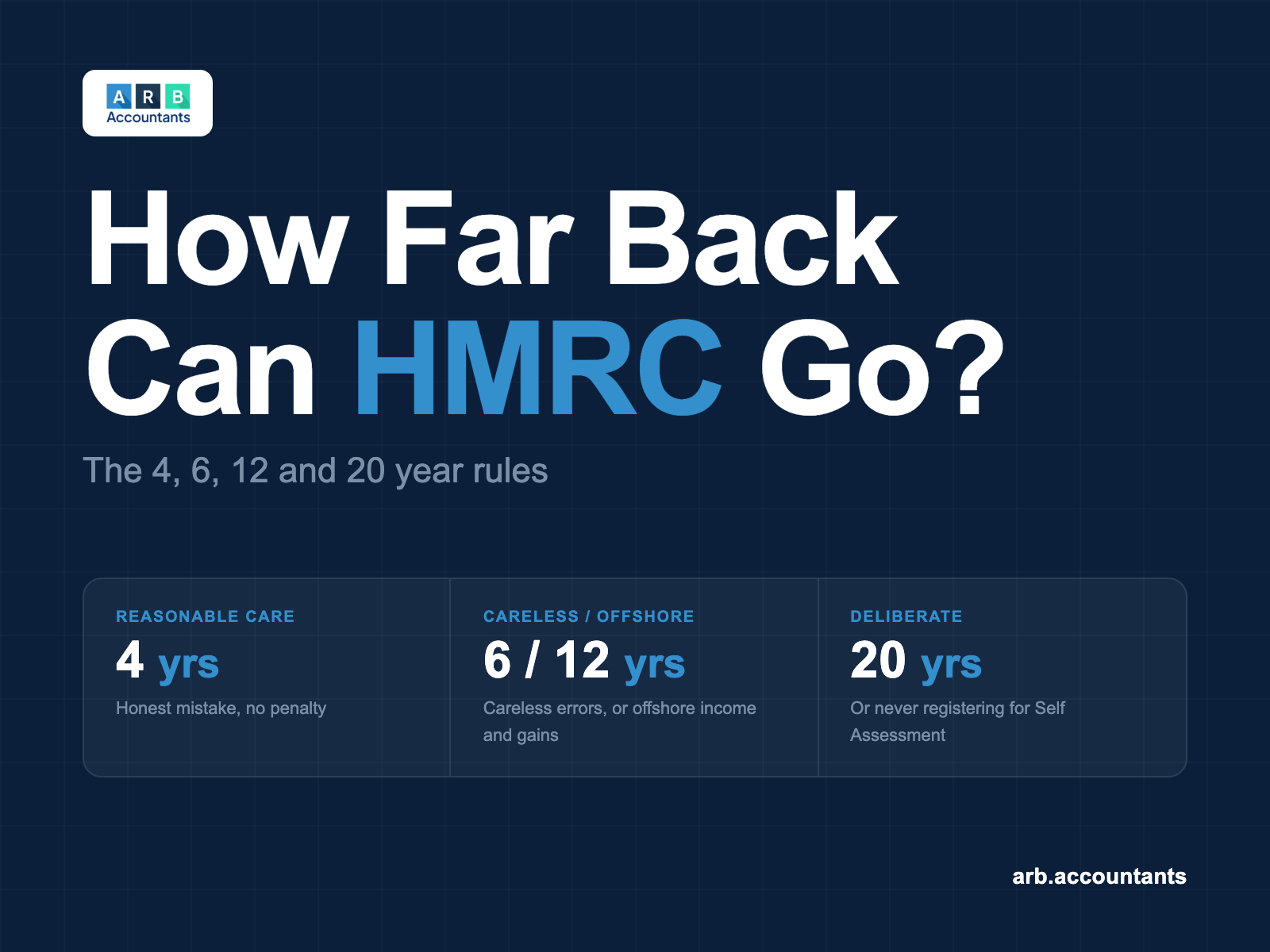
It depends on why the tax was underpaid. 4 years if you took reasonable care and still got it wrong. 6 years if you were careless. 12 years where offshore income or gains are involved, even if you took reasonable care. 20 years for deliberate behaviour, or where you never told HMRC you were chargeable to tax at all. All four limits run from the end of the tax year, and HMRC has to prove the behaviour before it can use the longer ones.
HMRC Time Limits in 2026 at a Glance
- Standard enquiry window: 12 months from the date HMRC received your return.
- After that, HMRC needs a discovery assessment, capped at 4, 6, 12 or 20 years by behaviour.
- As at September 2026: the 4-year rule reaches 2022/23, the 6-year rule 2020/21, the 20-year rule 2006/07.
- Never registered for Self Assessment? That is failure to notify. The limit is 20 years.
- Keep records 5 years after the 31 January deadline if self-employed or a landlord.
Table Of Contents
- How Far Back Can HMRC Go? The Four Limits
- Which Tax Years Are Still Open in 2026?
- The 12-Month Enquiry Window
- Discovery Assessments: How HMRC Reopens Closed Years
- 4 Years: Reasonable Care
- 6 Years: Careless Errors
- 12 Years: Offshore Income and Gains
- 20 Years: Deliberate Behaviour and Failure to Notify
- Time Limits for Other Taxes
- Can HMRC Go Back More Than 20 Years?
- How Far Back Can You Go?
- How Long to Keep Your Records
- What to Do If an Old Return Is Wrong
How Far Back Can HMRC Go? The Four Limits
HMRC's power to assess underpaid Income Tax and Capital Gains Tax is capped by section 34, 36 and 36A of the Taxes Management Act 1970. The cap depends on behaviour, not on how much tax is involved. Take reasonable care and get it wrong: 4 years. Careless: 6 years. Offshore and not deliberate: 12 years. Deliberate, or never registered without excuse: 20 years. Each period runs from the end of the tax year, so a limit for 2022/23 is counted from 5 April 2023.
| Behaviour | Time limit | Runs from | Legislation | Penalty band (% of tax) |
|---|---|---|---|---|
| Reasonable care taken, error still made | 4 years | End of tax year | TMA 1970 s34 | 0% |
| Careless (didn’t take reasonable care) | 6 years | End of tax year | TMA 1970 s36(1B) | 0 to 30% unprompted; 15 to 30% prompted |
| Offshore matter, not deliberate | 12 years | End of tax year | TMA 1970 s36A | As above, plus offshore uplift |
| Failure to notify, no reasonable excuse | 20 years | End of tax year | TMA 1970 s36(1A)(b) | 0 to 30% or higher by behaviour |
| Deliberate | 20 years | End of tax year | TMA 1970 s36(1A) | 20 to 70% unprompted; 35 to 70% prompted |
| Deliberate and concealed | 20 years | End of tax year | TMA 1970 s36(1A) | 30 to 100% unprompted; 50 to 100% prompted |
Two points people miss. First, the behaviour of your agent counts as well as your own: a careless accountant can extend HMRC’s reach against you. Second, the burden of proving careless or deliberate behaviour sits with HMRC. It cannot simply assert a 20-year limit; it has to show why.
Which Tax Years Are Still Open in 2026?
As at 15 September 2026, HMRC can still raise assessments for: 2022/23 onwards under the 4-year rule; 2020/21 onwards for careless errors; 2015/16 onwards for offshore matters where reasonable care was taken (2014/15 if careless); and 2006/07 onwards for deliberate behaviour or failure to notify. On 5 April 2027 each of those oldest years drops out and the next one becomes the limit.
| Rule | Oldest year HMRC can still assess | That year closes on |
|---|---|---|
| 4 years (reasonable care) | 2022/23 | 5 April 2027 |
| 6 years (careless) | 2020/21 | 5 April 2027 |
| 12 years (offshore, careless) | 2014/15 | 5 April 2027 |
| 12 years (offshore, reasonable care) | 2015/16 | 5 April 2028 |
| 20 years (deliberate / failure to notify) | 2006/07 | 5 April 2027 |
The year 2021/22 closed for reasonable-care errors on 5 April 2026. If HMRC wants to touch it now, it has to show carelessness at minimum.
The 12-Month Enquiry Window
Before any of the long limits apply, HMRC has a short, clean window to open a formal enquiry into a Self Assessment return under section 9A TMA 1970. For a return filed on time, that window is 12 months from the date HMRC received it. File your 2024/25 return on 20 January 2026 and HMRC has until 20 January 2027 to open an enquiry without needing to prove anything about your behaviour.
The rule changes if you filed late or amended the return. HMRC’s Enquiry Manual puts it this way: the window “will in these cases not close until the quarter day next following the first anniversary of the day on which the return was made”. The quarter days are 31 January, 30 April, 31 July and 31 October. A return filed late on 15 March 2026 therefore stays open until 30 April 2027. An amendment gets its own window, again running to the quarter day after the first anniversary of the amendment.
One detail worth knowing: the enquiry notice must actually reach you before the window closes. HMRC has to allow for postal delivery, and a notice that arrives a day late is out of time.
Inside the enquiry window, HMRC can ask about anything on the return. Outside it, HMRC’s only route back in is a discovery assessment.
Discovery Assessments: How HMRC Reopens Closed Years
A discovery assessment under section 29 TMA 1970 is how HMRC collects tax for a year whose enquiry window has closed. It needs two things: a discovery that tax has been under-assessed, and one of two conditions. Either your behaviour (or your agent's) was careless or deliberate, or the HMRC officer could not reasonably have been expected to know about the under-assessment from the information available when the window closed.
That second condition matters more than people think. If you disclosed everything relevant on the return, and HMRC simply didn’t act within 12 months, it generally cannot come back later under the 4-year rule. The discovery has to be of something the officer couldn’t have seen. That is why “white space” disclosures on a return, explaining an unusual position in plain words, are worth making.
In practice most discovery assessments we see arise from new third-party data: overseas interest reported under the Common Reporting Standard, platform sales flagged by HMRC Connect, tenancy deposit records that don’t match a landlord’s return. The data arrives, the mismatch is found, and HMRC reaches back as far as the behaviour label allows.
One of our clients had sold her business after 20 years and claimed Business Asset Disposal Relief on her tax return, saving a significant amount in tax by paying only 10%. About 12 years later, HMRC sent a compliance check letter asking for clarifications. We prepared a response with all documentation, answered follow-up questions, and the case was closed successfully with no penalties.
It's important to note this wasn't a full-blown investigation. HMRC didn't accuse her of wrongdoing — they just wanted to verify the claim. This is a good example of a compliance check that looked serious but was resolved smoothly.
That case illustrates the limits in action. Twelve years on, HMRC could only have assessed the relief if it could show deliberate behaviour. With the documentation in order and no suggestion of anything deliberate, there was nowhere for the check to go.
4 Years: Reasonable Care
If you made a genuine mistake despite taking reasonable care, HMRC has 4 years from the end of the tax year to assess it, and the penalty is nil. Reasonable care means what a prudent person in your position would have done: keeping records, checking figures, asking for advice on anything unfamiliar, and following that advice.
Common reasonable-care errors we see: a savings account with interest slightly above the personal savings allowance that nobody thought to declare, a P11D benefit the employer reported late, a capital gain miscalculated because base cost records were incomplete. HMRC will want the tax and interest. Interest currently runs at 7.75% from the original due date, unchanged since 9 January 2026. But there is no penalty, and nothing before 2022/23 is in scope.
6 Years: Careless Errors
Careless means you did not take reasonable care. The time limit extends to 6 years from the end of the tax year, and a penalty of 0% to 30% of the tax applies (15% to 30% if HMRC prompted you). As at September 2026 that reaches back to 2020/21.
The line between reasonable care and careless is where most disputes sit. Forgetting to declare a second property’s rent for one year might be careless. Estimating expenses with no receipts is usually careless. Relying on a qualified accountant who got it wrong is normally reasonable care on your part, though HMRC can still use the 6-year limit because the agent’s carelessness counts.
The way to stay in the 0% end of the careless band is to disclose before HMRC asks, cooperate fully, and give HMRC access to records without being chased. Those three factors, which HMRC calls telling, helping and giving, decide where in the range you land.
12 Years: Offshore Income and Gains
Since 2019, section 36A TMA 1970 gives HMRC 12 years to assess Income Tax and Capital Gains Tax involving an offshore matter or transfer, even where the error was not deliberate. It applies from 2013/14 onwards for careless errors and 2015/16 onwards where reasonable care was taken. Deliberate offshore behaviour keeps the standard 20-year limit.
An offshore matter is income arising outside the UK, assets held outside the UK, or a transfer of money or assets out of the UK. A fixed deposit in India, a rental flat in Spain, a Revolut balance held in an EEA entity, dividends from a foreign shareholding: all in scope.
The reason the rule exists is the data flow. Under the Common Reporting Standard, more than 100 jurisdictions send HMRC account-holder information every year: balances, interest, dividends and disposal proceeds. Parliament’s view was that offshore mismatches take longer to surface and HMRC should have longer to act on them.
HMRC now receives international banking data under global information sharing agreements. One of our clients received a letter saying they had discovered undisclosed foreign interest income — in this case, from fixed deposits in India.
Her previous accountant had never informed her that UK tax residents must declare worldwide income. We helped her prepare a disclosure, calculating interest, penalties, and the additional tax owed for several years. HMRC hasn't responded yet, but we expect the matter to be resolved similarly with tax and penalties paid, and no further consequences.
This case highlights the importance of proper advice, especially for clients with overseas assets or accounts.
If you have undeclared offshore income, the Worldwide Disclosure Facility is the route HMRC expects you to use. Penalties for offshore matters carry an uplift over the domestic bands, so the difference between disclosing now and being found later is larger than for UK income.
20 Years: Deliberate Behaviour and Failure to Notify
The 20-year limit applies in two situations, and the second catches far more ordinary people than the first. Deliberate behaviour: knowingly submitting a wrong return. Failure to notify: never telling HMRC you were chargeable to tax at all, without a reasonable excuse. A landlord who has let a flat for 15 years and never registered for Self Assessment is in the second category, whether or not they meant any harm.
Deliberate behaviour
The Supreme Court settled what “deliberate” means in Tooth v HMRC [2021] UKSC 17: it requires an intention to mislead HMRC. A wrong figure, even a large one, is not deliberate unless you knew it was wrong when you filed. That is a high bar, and it is HMRC’s to clear. Penalties run from 20% to 70% of the tax (35% to 70% prompted), or 30% to 100% (50% to 100% prompted) if the inaccuracy was also concealed. Where HMRC suspects deliberate behaviour it will often open a Code of Practice 9 investigation, offering immunity from prosecution in return for a full disclosure.
Failure to notify
This is the one to understand if you have income HMRC has never seen. Under section 7 TMA 1970 you must tell HMRC by 5 October after the end of the tax year if you have income or gains that need a return. Miss that and never file, and HMRC’s Compliance Handbook is explicit: the time limit is 20 years unless you had a reasonable excuse for the failure and put it right without unreasonable delay once the excuse ended.
Reasonable excuse is narrow. “I didn’t know rental income was taxable” is not usually accepted. Serious illness, bereavement or a genuine misunderstanding based on wrong HMRC advice can be.
For landlords the practical route is the Let Property Campaign, which lets you disclose all years voluntarily on better penalty terms. See our guide to making a voluntary disclosure to HMRC.
Time Limits for Other Taxes
The 4, 6 and 20 year pattern repeats across HMRC's main taxes, with two exceptions. VAT has no 6-year band: careless errors are capped at 4 years like reasonable-care ones. Inheritance Tax counts from the date tax was paid or due rather than a tax year end, and has a 20-year limit where no account was ever delivered.
| Tax | Reasonable care | Careless | Offshore (not deliberate) | Deliberate / failure to notify | Runs from |
|---|---|---|---|---|---|
| Income Tax and CGT | 4 years | 6 years | 12 years | 20 years | End of tax year |
| Corporation Tax | 4 years | 6 years | n/a | 20 years | End of accounting period |
| PAYE | 4 years | 6 years | n/a | 20 years | End of tax year |
| VAT | 4 years | 4 years | n/a | 20 years | End of VAT period |
| Inheritance Tax (account delivered, tax paid) | 4 years | 6 years | 12 years | 20 years | Later of last payment or due date |
| Inheritance Tax (no account, or asset omitted) | 20 years | 20 years | 20 years | 20 years | Date of the transfer |
VAT has one extra safeguard. Where HMRC assesses more than two years after the end of the period, it must also act within one year of having enough evidence to justify the assessment. An officer who sits on the facts loses the right to assess.
Can HMRC Go Back More Than 20 Years?
For civil tax assessments, no. Twenty years is the ceiling for Income Tax, Capital Gains Tax, Corporation Tax, VAT and PAYE, however serious the behaviour. Criminal prosecution is different: cheating the public revenue is a common-law offence with no statutory time limit. In practice HMRC prosecutes a small number of cases each year and almost always offers the Code of Practice 9 civil route first.
Two related points. HMRC can ask questions about years older than 20, and does, but it cannot assess them. And where you have already been assessed for a year and paid, HMRC cannot reopen it again outside the limits above, even if it later regrets the settlement.
How Far Back Can You Go?
The limits cut both ways, and yours are shorter. You can amend a Self Assessment return within 12 months of the filing deadline, so a 2024/25 return until 31 January 2027. After that you can claim overpayment relief in writing up to 4 years after the end of the tax year. Beyond 4 years, overpaid tax is normally lost.
If you discover you have underpaid, there is no time bar on disclosing. HMRC’s Digital Disclosure Service accepts disclosures for any year, and the campaigns (Let Property, Worldwide Disclosure Facility, the crypto disclosure service) all work the same way. Whether disclosing an old year is sensible depends on whether HMRC could still assess it. That is a conversation to have with an adviser before you write to HMRC, not after.
How Long to Keep Your Records
HMRC's record-keeping rules line up with the time limits. Self-employed people and landlords must keep records for at least 5 years after the 31 January filing deadline for the year they relate to. Everyone else must keep records for 22 months after the end of the tax year, or 15 months after filing if the return was late. Companies keep records for 6 years from the end of the accounting period.
| Who | Keep records for | Example: 2024/25 |
|---|---|---|
| Self-employed, partners, landlords | 5 years after the 31 January deadline | Until 31 January 2031 |
| Employees and others filing Self Assessment | 22 months after end of tax year (15 months after filing if late) | Until 5 February 2027 |
| Limited companies | 6 years from end of accounting period | Year to 31 March 2025: until 31 March 2031 |
| VAT-registered businesses | 6 years | Same |
Those are minimums. If HMRC opens a check, you must keep everything until it closes. And because the 6-year and 20-year limits exist, the records that vindicate you in year 8 are worth keeping past year 5. Cloud bookkeeping makes that cheap; a box of receipts in the loft does not.
If records are lost or destroyed, HMRC accepts best estimates on a return provided you flag them as estimated or provisional. It will not accept them as evidence in your favour during a check.
What to Do If an Old Return Is Wrong
Work out which limit applies before you do anything else. If the year is already closed under the behaviour that fits your facts, you may owe nothing. If it is open, a voluntary disclosure before HMRC contacts you is almost always cheaper than waiting: it keeps you in the unprompted penalty band and, in most cases, keeps HMRC from arguing the behaviour was worse than it was.
A short checklist:
- Identify the error and the year. Which return, which figure, how much tax.
- Classify the behaviour honestly. Reasonable care, careless or deliberate. This decides the years in scope and the penalty band.
- Check whether the year is still open using the tables above. Count from the 5 April at the end of the tax year.
- Check whether HMRC has already written to you about the issue. If it has, including a nudge letter, the disclosure is prompted for that matter.
- Choose the disclosure route and prepare the figures with interest at the rates in force for each year.
- Disclose in writing, once, completely. A partial disclosure that HMRC later finds was incomplete is the fastest way to move from careless to deliberate.
We handle disclosures going back 5, 10 and 20 years, and a good number of cases where the right answer turned out to be that the year had already closed.
Not sure which years are still open?
Free 60-minute consultation. We'll work out which time limit applies to your facts, what HMRC can actually assess, and whether a disclosure now is the right move. ACCA-chartered. Handling HMRC enquiries since 2008.
"ARB Accountants helped me resolve an issue with HMRC that had been dragging on for months. Their knowledge and persistence saved me a lot of stress — and money. I can't recommend them enough." Jay Sach · Google Review (Tax Audit)
Read next
- How likely are you to be investigated by HMRC? (2026 guide): triggers, stages and what to do
- HMRC nudge letters explained: the letter that usually arrives before any of these limits are tested
- How to make a voluntary disclosure to HMRC: the process, the facilities and the penalty maths
- HMRC compliance check: steps to pass without issues: if a formal check has already been opened
- Code of Practice 9 explained: what happens when HMRC suspects deliberate behaviour
Frequently Asked Questions
How far back can HMRC go?
Four years for honest mistakes where you took reasonable care, six years for careless errors, twelve years where offshore income or gains are involved even if you took reasonable care, and twenty years for deliberate behaviour or for never registering for Self Assessment without a reasonable excuse. All limits run from the end of the tax year in question.
How many years can HMRC go back for Self Assessment?
As at September 2026, HMRC can still assess 2022/23 onwards under the 4-year rule, 2020/21 onwards for careless errors, 2015/16 onwards for offshore matters where reasonable care was taken (2014/15 if careless), and 2006/07 onwards for deliberate behaviour or failure to notify. Each year drops out on the following 5 April.
How long does HMRC have to open an enquiry into my tax return?
Twelve months from the date HMRC received the return, if you filed on time. If you filed late, or amended the return, the window runs to the quarter day (31 January, 30 April, 31 July or 31 October) after the first anniversary of the filing or amendment. HMRC's enquiry notice must reach you before the window closes.
Can HMRC go back more than 20 years?
For civil tax assessments, no. Twenty years is the maximum for Income Tax, Capital Gains Tax, Corporation Tax, VAT and PAYE. Criminal prosecution for tax fraud (cheating the public revenue) has no statutory time limit, but that route is rare and reserved for the most serious cases, usually after a Code of Practice 9 process has failed.
Can HMRC investigate me if I never registered for Self Assessment?
Yes, and the time limit is the harshest one. Failing to notify HMRC that you are chargeable to tax, for example by never declaring rental income, carries a 20-year assessing limit unless you had a reasonable excuse and put it right without unreasonable delay. This catches many landlords and side-hustle traders who assumed they were under the radar.
How far back can HMRC go for undeclared rental income?
If you filed Self Assessment returns but left the rental income off, 4 years for a reasonable-care error or 6 years if careless. If you never registered for Self Assessment at all, HMRC treats it as a failure to notify and can go back 20 years. The Let Property Campaign lets landlords disclose voluntarily on better terms.
How far back can HMRC go for offshore income?
Twelve years for non-deliberate errors, under section 36A TMA 1970. The rule applies to 2013/14 onwards where the error was careless and 2015/16 onwards where you took reasonable care. Deliberate offshore non-compliance carries the standard 20-year limit. HMRC receives overseas account data automatically each year under the Common Reporting Standard.
How far back can HMRC go for VAT?
Four years from the end of the VAT period for both reasonable-care and careless errors, and 20 years for deliberate behaviour or for failing to register for VAT when you should have. Where HMRC assesses more than two years after the period, it must also act within one year of having enough evidence to do so.
How far back can HMRC go for Inheritance Tax?
Where an account was delivered and tax paid, 4 years from the later of the last payment or the due date, 6 years if careless, 12 years for offshore matters and 20 years if deliberate. Where no account was delivered at all, or a chargeable asset was left off, the limit is 20 years from the date of the transfer.
How long should I keep my tax records?
If you are self-employed or a landlord, at least 5 years after the 31 January filing deadline for the year in question, so 2024/25 records until 31 January 2031. If you are not self-employed, at least 22 months after the end of the tax year, or 15 months after filing if you filed late. Companies must keep records for 6 years from the end of the accounting period.
Can I go back and correct an old tax return myself?
You can amend a Self Assessment return within 12 months of the filing deadline, so a 2024/25 return until 31 January 2027. After that you can claim overpayment relief in writing up to 4 years after the end of the tax year, or make a voluntary disclosure of underpaid tax for any year through HMRC's Digital Disclosure Service.
Does HMRC have to prove I was careless or deliberate to go back further?
Yes. The burden is on HMRC to show careless or deliberate behaviour before it can use the 6-year or 20-year limits. The Supreme Court in Tooth v HMRC confirmed that deliberate means an intention to mislead, not just a wrong answer on the return. That is why the behaviour label attached to an error matters as much as the figure.
About The Author

Saurabh Bedi | Director
Saurabh is a tax advisor at ARB Accountants, specialising in Self-Assessment and small business tax. He's dedicated to making tax simple and stress-free, helping clients stay compliant and confident with HMRC.
Qualifications & Experience
- Fellow of Chartered Certified Accountants (ACCA)
- MSc Chartered Certified Accountancy 2008
- Working in accountancy since 2008