HMRC Nudge Letters Explained (2026): Why You Got One and How to Respond
What is an HMRC nudge letter?
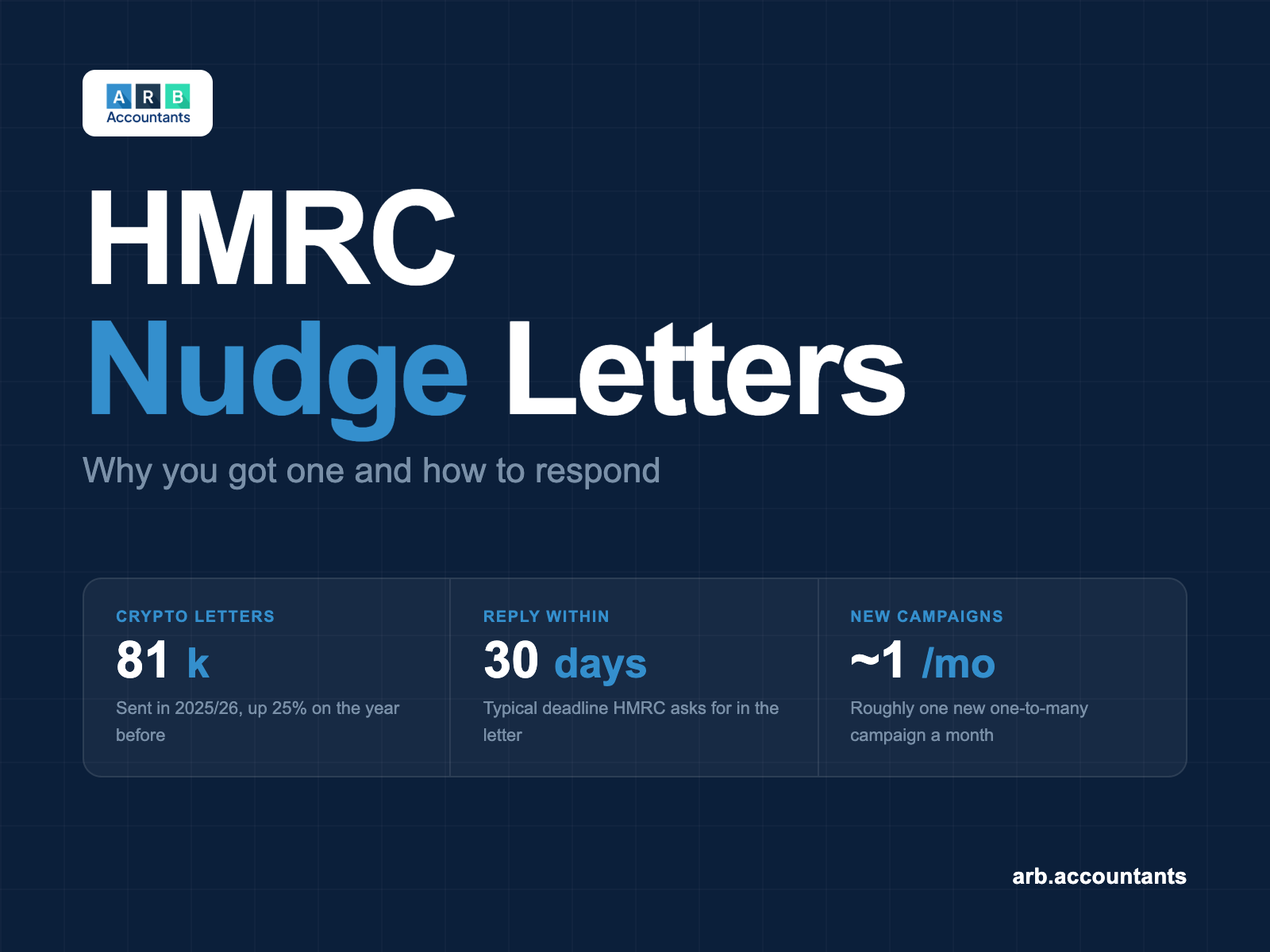
An HMRC nudge letter (HMRC calls it a one-to-many letter) is a standard letter sent to a batch of taxpayers whose returns HMRC's analytics has flagged for the same issue. It is not a formal enquiry. It tells you HMRC holds data that doesn't match your return, and asks you to check and correct it, usually within 30 days. HMRC launches roughly one new campaign a month. In 2026 a nudge letter is how most people first hear from HMRC's compliance teams.
HMRC Nudge Letters in 2026 at a Glance
- Not a compliance check. No statutory powers behind it, no automatic penalty for not replying.
- Chosen by AI and analytics. HMRC’s own 2026 roadmap says a data mismatch leads to “a nudge letter or formal compliance check”.
- Usually asks for a reply within 30 days. Some campaigns give 60.
- Don’t sign the certificate of tax position. Reply by letter.
- Ignore it and any later disclosure is prompted, penalties rise, and a formal check is far more likely.
Table Of Contents
- What Is an HMRC Nudge Letter?
- Why Did I Get One? How HMRC Picks Recipients
- Is My HMRC Letter Written by AI?
- HMRC Nudge Letter Campaigns in 2026
- Nudge Letter vs Compliance Check vs Investigation
- Should You Sign the Certificate of Tax Position?
- How to Respond to an HMRC Nudge Letter in 5 Steps
- What Happens If You Ignore a Nudge Letter
- Nudge Letters Are Going Digital
- How to Check an HMRC Letter Is Genuine
- Get Help With an HMRC Nudge Letter
What Is an HMRC Nudge Letter?
A nudge letter is HMRC writing to many people at once about one issue. Its analytics has found a gap between what a group of taxpayers reported and what third parties (banks, platforms, exchanges, deposit schemes, overseas tax authorities) reported about them. Rather than open hundreds of enquiries, HMRC sends the same letter to everyone in the group and asks them to check their own position. The name comes from behavioural economics: the letter is designed to nudge you into correcting the return yourself.
Three things make a nudge letter different from a formal check:
- It isn’t opened under HMRC’s enquiry powers. There is no Section 9A notice and no Schedule 36 information request. The 30-day deadline is a request, not a statutory limit.
- It’s generic. The same wording goes to everyone in the campaign. The letter will name the issue (crypto, let property, dividends) but rarely the exact figures HMRC holds.
- It’s a warning shot. HMRC’s own guidance describes the letters as giving people the chance to put things right before formal action. The implied next step if you don’t is a compliance check.
The letter will usually offer three options: confirm your return is correct, amend it, or make a disclosure through the facility it names. Some campaigns also enclose a certificate of tax position for you to sign. More on why you shouldn’t below.
Why Did I Get One? How HMRC Picks Recipients
You received a nudge letter because HMRC's Connect system matched third-party data against your return and found a gap. Connect draws on more than 50 data sources. Each campaign starts with a data set (tenancy deposit records, exchange customer lists, dividend vouchers filed by companies, CRS reports from overseas banks) and a filter: everyone in that data set whose Self Assessment return doesn't show the matching income. That list becomes the mailing list.
This is the part of the process HMRC is open about. Its Transformation Roadmap update, published 2 July 2026, says AI and analytics “highlight tax returns that may contain inaccuracies”, that compliance officers still make the decisions, and that where a mismatch is found the outcome is “a nudge letter or formal compliance check”. The same document reports that AI and analytics protected or recovered £10 billion of tax in 2025-26.
The volume has grown quickly:
- 81,000 crypto nudge letters went out in 2025/26, up from 65,000 the year before and 27,714 in 2023/24, according to HMRC figures obtained by UHY Hacker Young.
- The campaign tracker maintained by rossmartin.co.uk lists six new campaigns in July and August 2026 alone.
- HMRC appointed its first Chief AI Officer in April 2026 and is recruiting 5,500 additional compliance officers by 2029-30, with more than 2,100 already in post.
For a full explanation of how the scoring works, see HMRC Connect explained. For the wider picture on what triggers HMRC’s interest, see how likely you are to be investigated by HMRC.
Is My HMRC Letter Written by AI?
Possibly, but HMRC says a human signs off every one. AI decides who gets a letter; whether AI writes the letter is contested. HMRC's official position, given in September 2025 after a tribunal ordered it to answer, is that generative AI "was not approved for use in generating taxpayer letters" and that enquiries are "opened, managed and decided by a human". Since then HMRC has issued 28,000 Microsoft Copilot licences to staff for drafting and summarising, with 50,000 planned during 2026.
The question only reached a tribunal because of what advisers were seeing on the page. In 2023, R&D tax relief specialist Tom Elsbury noticed that HMRC rejection letters had started to contain American spellings, unusual formatting and generic reasoning that didn’t match the claim in front of him. He submitted a Freedom of Information request asking whether HMRC was using large language models. HMRC refused, citing prejudice to tax collection, and the Information Commissioner backed the refusal.
In Elsbury v Information Commissioner [2025] UKFTT 915 (GRC), the First-tier Tribunal overturned both decisions and ordered HMRC to answer by 18 September 2025. Judge Alexandra Marks found the arguments for disclosure “compelling”, noting that secrecy around AI in decision-making undermines trust. HMRC’s answer was that its R&D compliance team did not use generative AI as part of its work on R&D claims, and that the technology was not approved for generating taxpayer letters. Reports at the time said a number of staff in HMRC’s small business compliance directorate had been disciplined for unauthorised use of AI in correspondence. Elsbury described the response as “smoke and mirrors”.
What this means for you, in practice:
- A generic letter is not a weak letter. The wording may be boilerplate. The data behind it is specific to you.
- Don’t assume HMRC has proof. A nudge letter says HMRC holds information, not that it has established a liability. Sometimes the data is gross rather than net, or relates to the other holder of a joint account.
- Read it as a human would. If the letter contains figures, dates or reasoning that make no sense for your situation, say so in your reply. Officers do review responses.
HMRC Nudge Letter Campaigns in 2026
HMRC runs roughly one new one-to-many campaign a month. Below are the campaigns we know of from HMRC's own published letter list, professional-body announcements and adviser trackers, as at 15 September 2026. If you've received a letter that isn't listed, it may be new, or it may not be genuine (see how to check).
| When | Who got the letter | What HMRC wants | Disclosure route |
|---|---|---|---|
| 14 to 28 September 2026 | Self Assessment filers who claimed retirement annuity relief | Check the 2024/25 claim | Amend the return |
| July to August 2026 | People with undeclared online sales, social media or card-payment income | Tells them they’ve been registered for Self Assessment | File the return |
| August 2026 | Executors of estates valued close to nil-rate-band thresholds (£325k, £500k, £650k, £1m) | Re-check the estate valuation | Amend the IHT account |
| August 2026 | Trusts and estates that gave notice of intent to disclose but didn’t complete within 90 days | Finish the disclosure | Existing disclosure |
| July 2026 | Landlords whose returns don’t match tenancy deposit scheme data | Check and correct rental income | Let Property Campaign |
| July 2026 | Cryptoasset holders | Review Income Tax and CGT on disposals | Crypto disclosure service |
| July 2026 | Taxpayers with provisional Business Asset Rollover Relief claims from 2022/23 | Submit the final claim | Amend the return |
| July 2026 | Businesses running prize draws | Account for output VAT on entry fees | VAT error correction |
| 7 April to 30 September 2026 | Companies that may not have declared associated companies when claiming Marginal Relief | Check Company Tax Returns from April 2023 | Amend the CT600 |
| April 2026 | People affected by the end of the non-dom regime | Review obligations under the new rules | Self Assessment |
| April 2026 | Businesses engaging “behind camera” workers | Check employment status | PAYE correction |
| March 2026 | Filers who used provisional or round-sum figures for 2024/25 | Replace estimates with actuals | Amend the return |
| January to May 2026 | Business Asset Disposal Relief claimants | Confirm the £1m lifetime limit wasn’t breached | Amend the return |
| Early 2026 | Taxpayers whose 2024/25 return looked wrong | Check and amend within 30 days (by 25 April 2026) | Amend the return |
| Late 2025 | Undeclared dividend income (2023/24); High Income Child Benefit Charge for PAYE earners over £60k; wealthy non-filers over £200k | Review and amend | Self Assessment |
Two earlier campaigns still generate follow-up letters and are worth knowing about: online marketplace sales (eBay, Vinted, Etsy, Airbnb data from January 2025 onwards) and Persons with Significant Control (anyone listed as a PSC at Companies House who didn’t file a return).
The crypto campaign deserves a note of its own. HMRC currently relies on data requests to UK exchanges. From 31 May 2027 it will receive exchange data automatically under the OECD’s Crypto-Asset Reporting Framework. As one adviser put it to Accountancy Age, once that data lands, investigations into crypto investors “will be like shooting fish in a barrel”. The 2026 letters are the last cheap chance to disclose.
Nudge Letter vs Compliance Check vs Investigation
The three are different stages, not different names for the same thing. A nudge letter is informal and generic. A compliance check is formal, specific and backed by statutory powers. An investigation is a compliance check that has grown. Most people who respond properly to a nudge letter never reach stage two.
| Nudge letter | Compliance check | Full investigation / COP9 | |
|---|---|---|---|
| Legal basis | None; a request | Section 9A TMA 1970 (SA), Schedule 36 FA 2008 | Same powers, wider scope; COP9 under the Contractual Disclosure Facility |
| Who receives it | Everyone in a data-matched group | A named taxpayer | A named taxpayer suspected of significant error or deliberate behaviour |
| Wording | Standard for the campaign | Specific to your return | Specific, often across several years and taxes |
| Deadline | Usually 30 days, requested | 30 days for information notices, backed by penalties | Set per stage; 60 days to accept a COP9 offer |
| Disclosure status | Prompted for the issue named | Prompted | Prompted |
| Typical length | Closed on reply | 3 to 16 months | 12 months or more |
If your letter names an officer, quotes Section 9A or Schedule 36, and asks for specific documents, it is a compliance check, not a nudge letter. Our HMRC compliance check guide covers that process step by step.
Should You Sign the Certificate of Tax Position?
No, in almost every case. The certificate asks you to declare that your tax affairs are complete and correct, or that you will make a disclosure. It is not a statutory document, there is no legal obligation to sign it, and it has no time limit: it covers every year, not just the one HMRC wrote about. If HMRC later finds an error, a signed certificate makes it far easier to argue your behaviour was careless or deliberate, which lengthens the look-back period to 6 or 20 years and pushes the penalty up. The Chartered Institute of Taxation's guidance is to reply by letter instead, and HMRC has confirmed to the CIOT that it will accept a letter.
A reply by letter can say exactly what the certificate says, but on your terms: which years you’ve reviewed, what you checked, and what you concluded. It can also say “I have reviewed the 2023/24 return and it is correct” without making a sworn statement about 2009/10. That precision is the whole point.
If you do want to confirm your position is correct, a short letter is enough. If you’ve found an error, the letter should say that a disclosure will follow and by when.
How to Respond to an HMRC Nudge Letter in 5 Steps
Respond within the deadline, reply by letter rather than certificate, and disclose anything you find before HMRC finds it. Done properly, most nudge letters close with a single exchange of correspondence.
-
Check the letter is genuine. Compare it with HMRC’s list of current letters. Genuine letters quote your UTR or National Insurance number and give a GOV.UK page or an 03000 number. Any email should come from an address ending hmrc.gov.uk, and HMRC never asks for bank details by email or text.
-
Work out what data HMRC has matched. The letter names the issue. Identify the third-party data behind it: exchange records for crypto, tenancy deposit scheme data for let property, dividend vouchers filed by the company, CRS reports for overseas accounts. Pull your own records for the same years before you form a view.
-
Decide whether your return is actually wrong. Sometimes it isn’t. HMRC’s data can be gross rather than net, can double-count transfers between your own accounts, or can belong to the other holder of a joint account. If the return is right, say so in writing with a short explanation of why.
-
Reply by letter, not by certificate. Confirm either that your affairs are correct for the years you’ve checked, or that a disclosure will follow. Keep a copy and send it recorded delivery, or upload it through your HMRC account if the letter arrived digitally.
-
If there is an error, disclose before the deadline. Use the Digital Disclosure Service, or the specific facility the letter points to: the Let Property Campaign for rental income, the crypto disclosure service, the Worldwide Disclosure Facility for offshore matters. Responding within the 30 days keeps the penalty at the low end of the prompted band, and anything unrelated you find and volunteer at the same time is treated as unprompted.
If you need more time to gather records, write and say so before the date passes. HMRC will normally allow it. Going silent is the one response that never helps.
A client unknowingly failed to declare rental income from a second property. HMRC discovered it through a combination of land registry and council tax data. They knew he wasn't living there and assumed — rightly — that it was being rented out.
He received a letter inviting him to disclose the income voluntarily. We went back through five years of records, calculated the unpaid tax, interest, and penalties, and submitted a full disclosure. HMRC accepted our offer, and the case was closed.
This case shows that HMRC has access to cross-government data, and rental income is a common red flag.
What Happens If You Ignore a Nudge Letter
Nothing automatic, and that's the trap. There is no penalty for not replying, because the letter isn't a statutory notice. But HMRC records who it wrote to. If it later finds the error, any disclosure is prompted, HMRC can argue the behaviour was careless or deliberate because you were warned, and a formal compliance check covering more years becomes far more likely.
The penalty maths is what makes ignoring a nudge letter expensive. For a careless error, the penalty range is 0% to 30% of the tax if you disclose unprompted, and 15% to 30% if prompted. For deliberate behaviour it is 20% to 70% unprompted and 35% to 70% prompted. A nudge letter already moves you into the prompted column for the issue it names. Ignoring it, and then being found, is what moves you from careless towards deliberate.
There is a time-limit consequence as well. A careless error lets HMRC go back 6 years. Deliberate behaviour lets it go back 20. See how far back HMRC can go for how each limit works.
Late payment interest currently runs at 7.75%, unchanged since 9 January 2026, from the date the tax was originally due. On a five-year-old liability that is a meaningful addition before any penalty is applied.
Nudge Letters Are Going Digital
Since April 2026, HMRC has been moving to digital by default. If you use the HMRC app or a Personal Tax Account, letters increasingly land in your online account rather than the post, and you receive an email telling you a new message is waiting. Paper continues for people who haven't gone digital or have opted out. HMRC's stated aim is to cut postal output by around 75% and save £50 million a year by 2028-29.
This matters for nudge letters specifically. A letter you never see is a letter you can’t respond to, and HMRC’s record will still show it was sent. Three habits help:
- Check your HMRC account when you get an email about a new message. Log in through the app or GOV.UK directly, never through a link in the email.
- Keep your email address current in your Personal Tax Account. The notification goes to whatever address HMRC holds.
- If your accountant is authorised, make sure their details are current too. Agent copies of one-to-many letters are common.
If you’d rather keep receiving paper, you can. Simply don’t confirm electronic contact details when prompted. HMRC has said paper “will continue to be available for customers who choose not to engage with us digitally”.
How to Check an HMRC Letter Is Genuine
Scam letters and emails imitating HMRC rise every time a genuine campaign is publicised. Compare any letter with HMRC's own list of current letters on GOV.UK, which is updated as each campaign begins and gives the dates HMRC is sending them.
Signs a letter is genuine:
- It quotes your Unique Taxpayer Reference or National Insurance number correctly.
- It gives a GOV.UK page or an HMRC phone number starting 0300 or 03000 to call. Check the number against GOV.UK, not the letter.
- Any email notification comes from an address ending hmrc.gov.uk and tells you to log in, rather than linking you to a form.
- It does not ask for bank details, card numbers or passwords, and does not threaten arrest or immediate court action.
Signs it isn’t:
- Spelling or grammar that is clearly wrong. Note the irony given the Elsbury case, but scam letters are usually much worse than an HMRC letter with an American spelling.
- A demand for payment by bank transfer to a personal account, gift cards or cryptocurrency.
- Pressure to act within hours.
If in doubt, call HMRC on a number from GOV.UK, or send the letter to your accountant before you reply to it.
Get Help With an HMRC Nudge Letter
Most nudge letters can be closed with one careful reply. The mistakes we see are the same every time: signing the certificate, ignoring the letter, or disclosing in a rush without checking whether the return was actually wrong.
ARB Accountants handles nudge letters, disclosures and HMRC compliance checks for individuals, landlords, crypto investors and small businesses. We read the letter, work out what data HMRC holds, tell you whether your return needs correcting, and write the response or run the disclosure on your behalf.
Received an HMRC nudge letter?
Free 60-minute consultation. We'll tell you what HMRC is really asking, whether you need to disclose, and what to send back. ACCA-chartered. Handling HMRC enquiries since 2008.
"ARB Accountants helped me resolve an issue with HMRC that had been dragging on for months. Their knowledge and persistence saved me a lot of stress — and money. I can't recommend them enough." Jay Sach · Google Review (Tax Audit)
Read next
- How likely are you to be investigated by HMRC? (2026 guide): triggers, stages and what to do
- HMRC Connect explained: the data system that decides who gets a letter
- HMRC compliance check: steps to pass without issues: if your letter is the formal kind
- How far back can HMRC go?: the 4, 6, 12 and 20 year rules
- How to make a voluntary disclosure to HMRC: if the letter is right and you need to put it straight
Frequently Asked Questions
What is an HMRC nudge letter?
A nudge letter, which HMRC calls a one-to-many letter, is a standard letter sent to a batch of taxpayers whose returns HMRC's analytics has flagged for the same issue, such as undeclared crypto gains, rental income that doesn't match tenancy deposit data or a missing dividend. It is not a formal enquiry. It asks you to check your return and correct it, usually within 30 days.
Does a nudge letter mean I'm being investigated?
No. A nudge letter is not a compliance check or an investigation, and it is not opened under HMRC's statutory enquiry powers. It means HMRC holds data suggesting your return may be wrong and is giving you the chance to correct it first. If you ignore it and HMRC later finds an error, a formal check is far more likely and the penalty is higher.
Does HMRC use AI to send nudge letters?
Yes, to choose who receives them. HMRC's 2026 Transformation Roadmap update confirms AI and analytics highlight returns that may contain inaccuracies and that a mismatch leads to a nudge letter or a compliance check. Whether AI writes the letter text is contested. HMRC says generative AI was not approved for generating taxpayer letters, but a 2025 tribunal case followed reports of AI-style rejection letters, and HMRC has since given 28,000 staff Microsoft Copilot for drafting.
Should I sign the certificate of tax position?
Generally no. The certificate is open-ended, has no time limit, and confirms a wider review than the letter implies. If HMRC later finds an error, a signed certificate makes it easier to argue the behaviour was careless or deliberate, which increases the penalty and the look-back period. CIOT guidance is to reply by letter, and HMRC has confirmed it will accept that.
What happens if I ignore an HMRC nudge letter?
There is no automatic penalty for not replying, because a nudge letter isn't a statutory notice. But HMRC records who was written to. If it later finds the error, it will treat any disclosure as prompted, may argue the behaviour was careless or deliberate, and is more likely to open a formal compliance check covering more years.
How long do I have to respond to a nudge letter?
Most nudge letters ask for a response within 30 days, though some campaigns give 60. The deadline is HMRC's request rather than a statutory limit, but responding within it is the single easiest way to keep any penalty at the low end of the range. If you need longer to gather records, write and say so before the date passes.
Is a disclosure after a nudge letter prompted or unprompted?
Prompted, for the issue the letter covers. HMRC's position is that once it has written to you about a matter, a disclosure about that matter is no longer unprompted. Within the prompted band, though, a full and quick disclosure still earns the maximum reduction. Anything unrelated you find and disclose at the same time is treated as unprompted.
Why did I get a nudge letter about crypto?
HMRC has been requesting customer data from UK exchanges and sent 81,000 crypto nudge letters in 2025/26, up 25% on the year before. From 31 May 2027 it will receive exchange data automatically under the OECD's Crypto-Asset Reporting Framework, so the letters are a last chance to disclose before the data arrives on its own.
Why did I get a nudge letter about rental income?
HMRC cross-matches Land Registry ownership, council tax records and, since 2026, tenancy deposit scheme data against Self Assessment returns. If you own a property you don't live in and the rental income on your return doesn't match, or isn't there, a letter follows. The Let Property Campaign is the disclosure route it usually points to.
Will my nudge letter arrive by post?
Not necessarily. Since April 2026 HMRC has been moving to digital by default. If you use the HMRC app or a Personal Tax Account, letters land there and you get an email telling you to log in. Paper post continues for people who haven't gone digital or have opted out. Check your HMRC account if you've had an email about a new message.
Can my accountant respond to a nudge letter for me?
Yes. Where HMRC has an agent authorisation in place, a copy of the letter is often sent to the agent as well. Your accountant can review the data HMRC is likely to hold, check the return, and write the response or handle the disclosure on your behalf.
How do I know an HMRC letter is genuine?
Compare it with HMRC's published list of current letters on GOV.UK, which is updated as each campaign starts. Genuine letters quote your UTR or National Insurance number and give a GOV.UK page or an 03000 number to call. HMRC never asks for bank details or passwords by email or text, and any email address should end in hmrc.gov.uk.
About The Author

Saurabh Bedi | Director
Saurabh is a tax advisor at ARB Accountants, specialising in Self-Assessment and small business tax. He's dedicated to making tax simple and stress-free, helping clients stay compliant and confident with HMRC.
Qualifications & Experience
- Fellow of Chartered Certified Accountants (ACCA)
- MSc Chartered Certified Accountancy 2008
- Working in accountancy since 2008