Annual Investment Allowance and Full Expensing: Which Applies?
AIA or full expensing: which one applies?
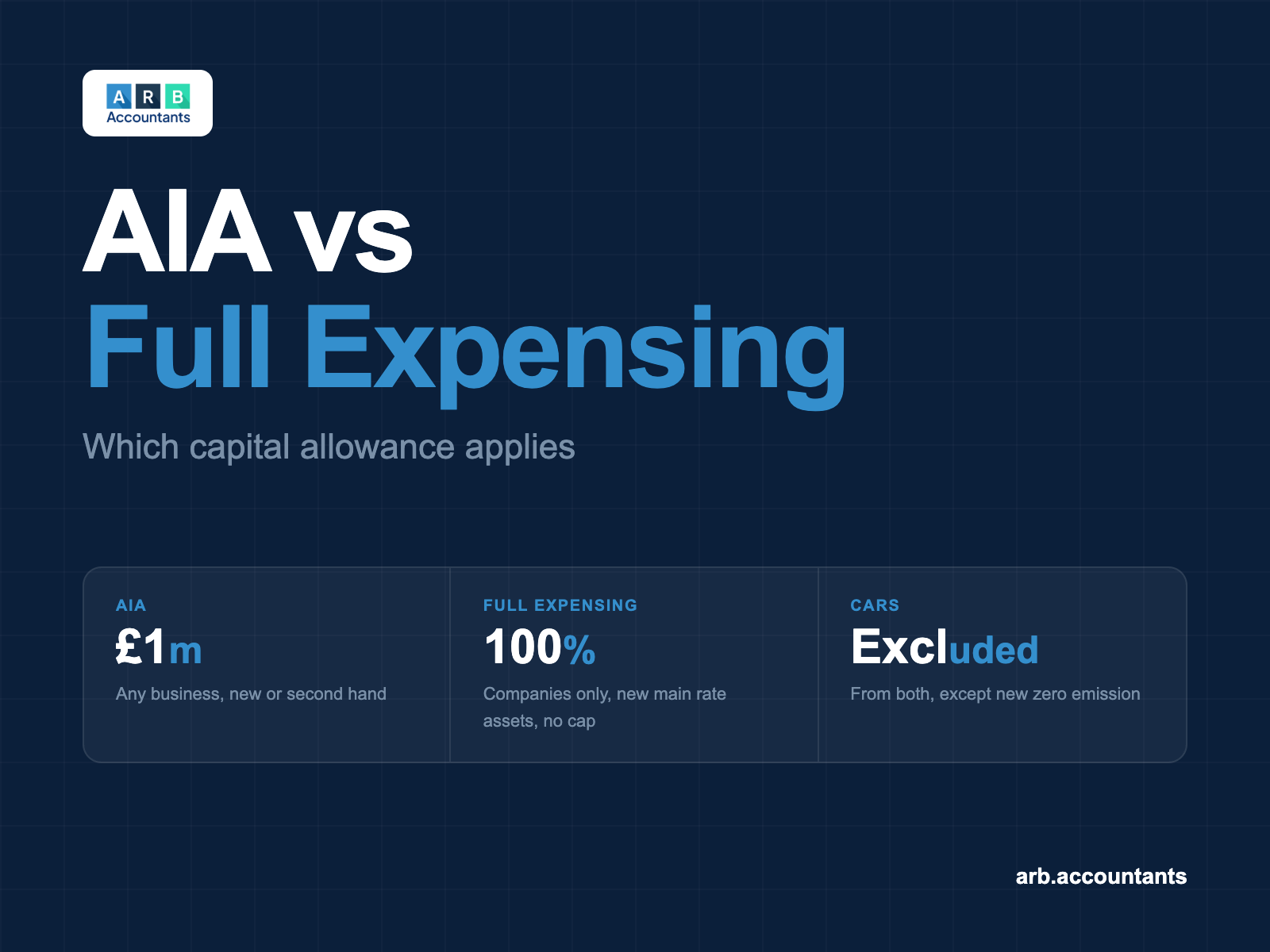
Both give 100% relief in the year of purchase, so in most cases the answer doesn't change your tax bill. AIA covers £1 million a year, is open to any business, and includes second hand assets. Full expensing is unlimited, but is companies only and requires assets to be new and unused. Spending under £1m? Use AIA and stop thinking about it. Above £1m, a company continues with full expensing. Cars are excluded from both.
Capital allowances at a glance
- AIA: £1m cap, any business, new or second hand.
- Full expensing: no cap, companies only, new and unused only.
- 50% FYA: companies, new special rate assets such as integral features.
- Cars are excluded from all three. They go into a pool instead.
- Companies under common control share one AIA between them.
Table Of Contents
- Why There Are Two Allowances
- Which One Applies to You
- What Counts as Plant and Machinery
- Main Rate vs Special Rate
- The Car Exclusion
- Sharing the AIA Between Companies
- The Disposal Trap in Full Expensing
- When Not to Claim Everything
- Timing a Purchase
- Get Help With a Large Purchase
Why There Are Two Allowances
The Annual Investment Allowance has existed since 2008 and is open to every kind of business. Full expensing arrived in April 2023 for companies only, to replace the super-deduction and soften the rise in corporation tax to 25%. They overlap heavily, which is why the choice confuses people.
The logic behind the overlap is straightforward once you see it. AIA was never intended to cover large-scale capital investment; £1 million a year is generous for most businesses but trivial for a manufacturer re-equipping a factory. Full expensing removed the cap, but only for companies, and only for new assets, because the policy aim was to encourage fresh investment rather than the shuffling of used equipment between related businesses.
For the great majority of owner-managed businesses, spend stays well under £1 million and AIA does everything. The distinction only starts to matter at the margins.
Which One Applies to You
| AIA | Full expensing | 50% FYA | |
|---|---|---|---|
| Limit | £1m per period | Unlimited | Unlimited |
| Who can claim | Any business | Companies only | Companies only |
| New or second hand | Both | New and unused only | New and unused only |
| Asset type | Main and special rate | Main rate only | Special rate only |
| Relief in year one | 100% | 100% | 50% |
Working through it:
- Sole trader or partnership? AIA only. Full expensing isn’t available to you at all, which is one of the genuine tax advantages of incorporating for an asset-heavy business.
- Company spending under £1m? AIA covers it, including second hand assets, and avoids the disposal complication below.
- Company spending over £1m? Use AIA on the first £1m (ideally on second hand items and special rate assets, which full expensing either can’t cover or covers at only 50%), then full expensing above it.
- Buying new integral features? The 50% FYA applies, or use AIA if you have headroom, which gives 100% and is therefore better.
That third point is the only real optimisation here, and it’s worth stating plainly: allocate AIA to the assets full expensing handles worst. Second hand equipment and special rate items first, new main rate plant last, because full expensing picks up new main rate plant at 100% anyway.
What Counts as Plant and Machinery
Broadly, the equipment a business uses to trade rather than the premises it trades from:
- Machinery, tools and manufacturing equipment
- Computers, servers, IT equipment and most software
- Vans, lorries and commercial vehicles (not cars)
- Office furniture, fittings and equipment
- Integral features of a building: electrical systems, heating, air conditioning, lifts, cold water systems
- Some fixtures within a property, and thermal insulation
What doesn’t qualify at all:
- Cars, dealt with below
- Land and buildings themselves, which are covered separately by the structures and buildings allowance at a much lower rate
- Items you owned for another purpose before bringing them into the business
- Gifts, including assets given to the business
- Items you lease rather than buy, where the lessor claims instead
That third exclusion catches sole traders regularly. A laptop bought personally two years ago and now used for the business doesn’t attract AIA. It can go in at market value for writing down allowances, but the 100% deduction isn’t available.
Main Rate vs Special Rate
Where an asset can’t be relieved in full immediately, it goes into a pool and attracts writing down allowances on a reducing balance basis:
| Pool | Rate | Typical contents |
|---|---|---|
| Main rate | 18% | Most plant, machinery, IT, commercial vehicles, furniture |
| Special rate | 6% | Integral features, long life assets, thermal insulation, most cars |
The distinction matters for two reasons. Full expensing only covers main rate assets, with special rate limited to the 50% FYA. And relief in the special rate pool is genuinely slow: at 6% reducing balance it takes about 11 years to relieve half the cost, which is why using AIA on special rate items is usually the better allocation.
Integral features are the ones people miss. Buying or refurbishing commercial premises often involves substantial spend on electrical and heating systems that qualifies as special rate plant, and a capital allowances review on a property purchase can identify relief nobody claimed at the time.
The Car Exclusion
Cars are excluded from both AIA and full expensing. There's no way to get 100% relief on an ordinary car through either route. Instead cars go into a pool and attract writing down allowances at a rate set by CO2 emissions, with the cleanest attracting 18% and everything else 6%.
The exception is new and unused zero emission cars, which have their own 100% first year allowance. That’s a deliberate policy lever and it’s the reason electric vehicles have become a standard part of director remuneration planning, alongside the very low benefit in kind rate.
Vans, lorries and other commercial vehicles are not cars for this purpose and do qualify for AIA and full expensing in the normal way. The boundary between a car and a commercial vehicle is occasionally contested, particularly for double cab pick-ups and car-derived vans, and it’s worth checking before assuming.
Our guide to leasing an electric car through a limited company covers the wider comparison.
Sharing the AIA Between Companies
Companies under common control get one AIA between them, not one each, and can choose how to share it. The same restriction applies to sole traders and partnerships controlled by the same person where the businesses share premises or carry on similar activities.
This mirrors the associated companies rules for corporation tax, and it catches the same people: a director with three companies who assumes each has its own £1m allowance.
The allocation is yours to make, which is a genuine planning point. Give the AIA to the company that benefits most, normally the one paying the highest effective rate. A company inside the marginal relief band is relieving at 26.5%, higher than a company paying the 25% main rate, so directing allowances there is worth slightly more.
The Disposal Trap in Full Expensing
This is the part that isn't obvious at the time of claim. When you sell an asset on which full expensing was claimed, a balancing charge arises on the full disposal proceeds, taxed immediately. That's harsher than the normal treatment, where proceeds simply reduce a pool balance and the effect is spread across future years.
An example. A company buys new machinery for £300,000 and claims full expensing, relieving the whole amount. Three years later it sells the machinery for £120,000.
- With full expensing: £120,000 is an immediate balancing charge, taxable in that period.
- Had AIA been claimed: the same £120,000 would reduce the main rate pool, relieving at 18% a year, with no immediate charge.
Same relief on the way in, very different treatment on the way out. For a company that regularly cycles equipment, this matters and can make AIA the better claim even within the £1m limit.
Practical consequence: note in your fixed asset register which assets carried full expensing. Three years later, when the asset is sold, nobody remembers, and it’s an easy error to make in a corporation tax computation.
When Not to Claim Everything
Claiming capital allowances is optional, and you can claim part of the cost and leave the rest in a pool. Occasions where restricting the claim is better:
- Sole traders and partners whose profits would fall below the personal allowance. A full claim wastes £12,570 of tax-free income that can’t be carried forward, while the unclaimed allowance sits in a pool and relieves later at 20% or 40%.
- Companies just below the £50,000 small profits limit, where a large claim relieves at 19% but the same allowance carried forward might relieve at 26.5% in a marginal-band year.
- Where losses would be created that can’t be used efficiently.
This is one of the few places where the obvious answer (claim everything now) is regularly wrong, and it’s worth modelling rather than defaulting.
Timing a Purchase
Capital allowances are given for the period in which the expenditure is incurred, which is generally when the obligation to pay becomes unconditional, not when the invoice is paid.
Two timing points worth knowing:
- Buying just before a year end brings relief forward a full year. Buying a week after moves it back twelve months.
- The £1m AIA limit is per accounting period, and is proportionately reduced for periods shorter than 12 months. Spend spread across two periods gets two allowances.
None of which is a reason to buy equipment you don’t need. The relief is worth 19% to 26.5% of the cost to a company; the other 73.5% to 81% is still money spent.
Get Help With a Large Purchase
Most capital allowance questions are simple and AIA answers them. The ones worth advice are large purchases near or above the £1m limit, property acquisitions where integral features can be identified, groups sharing a single allowance, and situations where claiming less this year is worth more overall.
ARB Accountants advises owner-managed companies on capital expenditure: which allowance applies, how to allocate across assets and companies, the disposal consequences, and whether the timing of the spend should move.
Significant capital spend coming up?
Free 60-minute consultation. We'll tell you which allowances apply, how to allocate them across your companies, and whether moving the purchase either side of your year end is worth it. ACCA-chartered.
Read next
- Associated companies and marginal relief: why the rate you relieve at varies
- Why would you not claim capital allowances?: when restricting a claim pays
- Leasing an electric car through a limited company: the exception to the car exclusion
- Buying a van as a sole trader: commercial vehicles and AIA
Frequently Asked Questions
What is the Annual Investment Allowance?
The AIA gives 100% tax relief on qualifying plant and machinery in the year you buy it, up to £1 million per accounting period. It is available to companies, sole traders and partnerships, and it covers second hand assets as well as new ones.
What is full expensing?
Full expensing is a 100% first year allowance for companies on new and unused main rate plant and machinery, with no upper limit. It was introduced by the Finance (No.2) Act 2023 and has since been made permanent. Sole traders and partnerships cannot claim it.
What is the difference between AIA and full expensing?
Three things. AIA is capped at £1 million a year while full expensing is unlimited. AIA is open to any business while full expensing is companies only. AIA covers second hand assets while full expensing requires new and unused. Below £1 million of spend, most companies simply use AIA and never need to think about it.
Which should I claim, AIA or full expensing?
For most businesses spending under £1 million, AIA, because it is simpler and has none of the disposal complications. Full expensing matters when you are a company, spending more than £1 million in a period, and buying new main rate assets. Many companies claim AIA up to the limit and full expensing above it.
Can I claim capital allowances on a car?
Not under AIA or full expensing, both of which exclude cars. Cars go into a pool and attract writing down allowances instead, at a rate depending on CO2 emissions. New and unused zero emission cars have their own first year allowance, which is the exception.
What is the 50% first year allowance?
A companies-only allowance letting you deduct 50% of the cost of new and unused special rate plant and machinery in the year of purchase, with the remaining 50% going into the special rate pool for writing down allowances at 6%. Special rate items include integral features such as electrical and heating systems.
Does full expensing apply to second hand equipment?
No. Full expensing and the 50% first year allowance both require assets to be new and unused. Second hand plant and machinery can still qualify for the Annual Investment Allowance, which is one of the main reasons AIA remains useful to companies.
Do I have to claim capital allowances in the year I buy?
No, and sometimes you should not. Claiming is optional and you can claim part of the cost, leaving the balance in a pool for future years. If a large claim would waste your personal allowance or push you below a threshold where relief is worth less, deferring can be better.
Do group companies get an AIA each?
No. Companies under common control get one Annual Investment Allowance between them and can choose how to share it. The same applies to sole traders and partnerships controlled by the same person where the businesses share premises or have similar activities.
What happens when I sell an asset I claimed full expensing on?
A balancing charge arises on the full disposal proceeds, taxed immediately. This is harsher than the normal position, where proceeds simply reduce the pool balance and the effect is spread over years. It is the main trap in full expensing and worth noting in your fixed asset register at the time of purchase.
Is full expensing worth more than AIA?
Not in the year of purchase. Both give 100% relief, so the tax saving is identical. Full expensing only becomes more valuable once you exceed the £1 million AIA cap, and it is arguably worse on disposal because of the immediate balancing charge.
Can I claim capital allowances on a building?
Not on the structure itself under these allowances, but integral features within it can qualify as special rate plant and machinery: electrical systems, cold water systems, heating and air conditioning, lifts and escalators. A separate structures and buildings allowance covers the fabric at a much lower rate.
About The Author

Saurabh Bedi | Director
Saurabh is a tax advisor at ARB Accountants, specialising in Self-Assessment and small business tax. He's dedicated to making tax simple and stress-free, helping clients stay compliant and confident with HMRC.
Qualifications & Experience
- Fellow of Chartered Certified Accountants (ACCA)
- MSc Chartered Certified Accountancy 2008
- Working in accountancy since 2008