HMRC Compliance Check: Steps to Pass Without Issues (2026 Guide)
What is a HMRC compliance check?
A HMRC compliance check is a review HMRC carries out to confirm you've paid the right amount of tax and claimed only the reliefs you're entitled to. It can cover Self Assessment, Corporation Tax, VAT or PAYE — and it doesn't automatically mean you've done anything wrong. Most checks are triggered by something specific rather than chosen at random, and the way you respond has a direct effect on whether it closes quietly or turns into something bigger.
HMRC Compliance Checks in 2026 at a Glance
- Can be opened into Self Assessment, Corporation Tax, VAT or PAYE, individually or together.
- Most checks are triggered by a specific concern, not random selection.
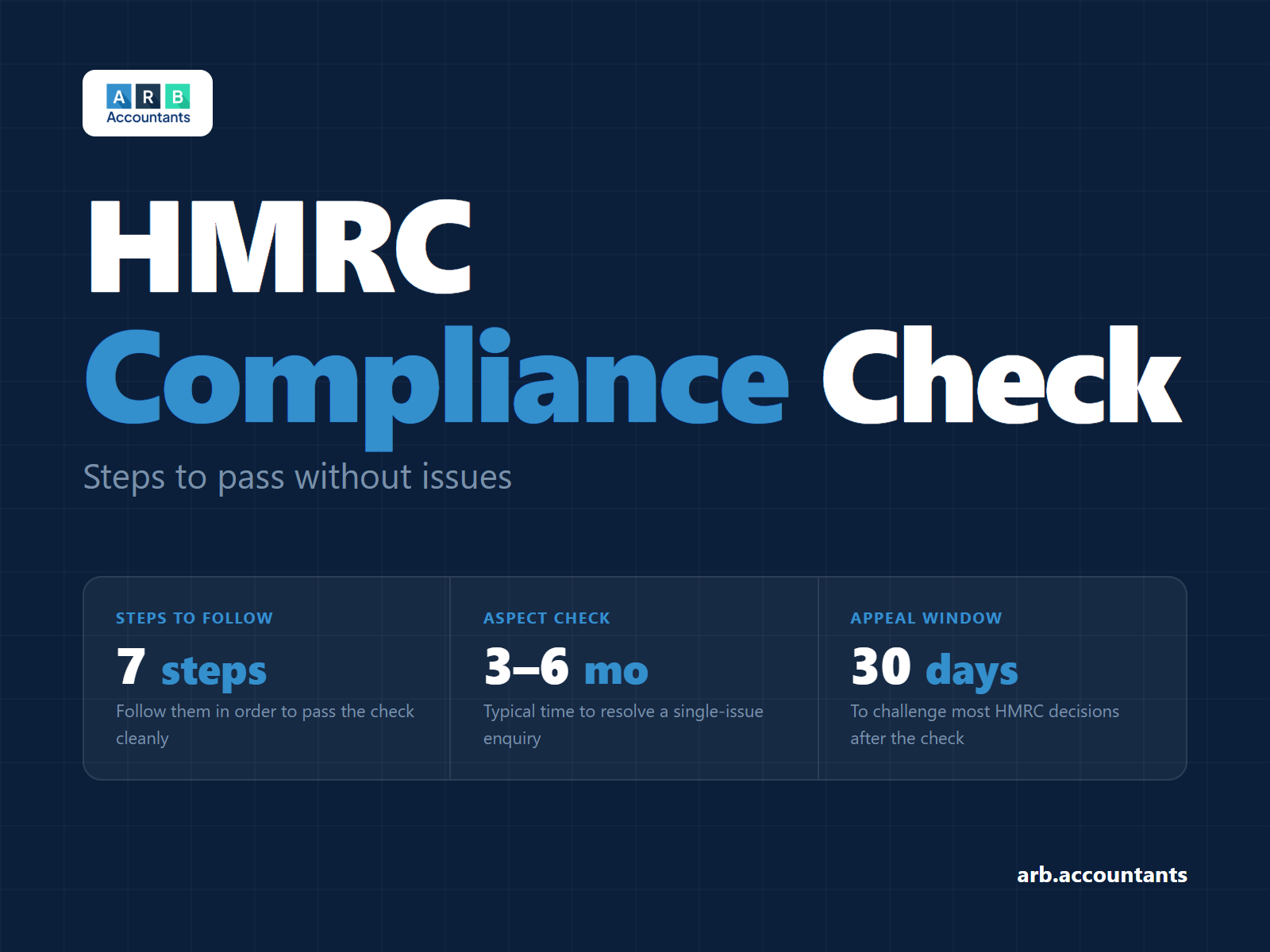
- Straightforward aspect checks often close in 3 to 6 months; full enquiries typically run 9 to 16 months or longer.
- You get 30 days to pay any tax found due, and 30 days to challenge most HMRC decisions.
- Cooperating fully and disclosing errors early is the single biggest factor in how much any penalty gets reduced.
Table Of Contents
- What Is an HMRC Compliance Check?
- How Long Does an HMRC Compliance Check Take?
- Why Has HMRC Opened a Check on Me?
- What HMRC Can Ask For (and What It Can’t)
- 7 Steps to Pass an HMRC Compliance Check Without Issues
- What Happens If You Ignore It or Get It Wrong
- HMRC’s New Compliance Check Support Tool
- Do You Need an Accountant for a Compliance Check?
- What Happens After the Check Closes
- If You Disagree With HMRC’s Decision
What Is an HMRC Compliance Check?
A compliance check, sometimes called a tax enquiry, is HMRC's way of checking that a tax return or tax position is accurate. It can look at any tax you pay — your accounts and tax calculations, your Self Assessment return, your Company Tax Return, or your PAYE records if you employ people. If you use an accountant, HMRC will normally contact them directly rather than you.
Checks range from a single question about one line on a return (an aspect enquiry) to a full review of several years of records across multiple taxes (a full enquiry). Both start the same way: a letter or phone call telling you what’s being checked and why.
Compliance Check vs Tax Investigation: What’s the Difference?
A compliance check is the broader, more routine term. Most are resolved with no changes or a small correction. "Investigation" tends to get used for the more serious end, where HMRC suspects a bigger error or deliberate wrongdoing. Every investigation starts life as a compliance check, but not every compliance check becomes an investigation.
For the fuller picture on triggers, risk factors and how HMRC decides who to look at, see our guide to how likely you are to be investigated by HMRC. If your letter is generic, doesn’t name an officer and simply asks you to “check your return”, it is probably a one-to-many letter rather than a formal check: see HMRC nudge letters explained.
How Long Does an HMRC Compliance Check Take?
There's no fixed length for an HMRC compliance check. A single-issue aspect enquiry often resolves in 3 to 6 months, while a full enquiry covering multiple years or taxes typically takes 9 to 16 months, and can run longer where records are incomplete or the case escalates.
The single biggest factor in how long it takes isn’t the size of your business — it’s how quickly and completely you respond. Delays in providing records are the most common reason a short check turns into a long one.
| Enquiry type | Typical length | Key variable |
|---|---|---|
| Aspect enquiry (single issue) | 3 to 6 months | Speed and completeness of your response |
| Full enquiry (multiple years or taxes) | 9 to 16 months | Complexity of records and number of issues |
| COP9 (suspected fraud) | 12 months or more | Level of disclosure and cooperation |
For Self Assessment, HMRC normally has to open a check within 12 months of the date you filed your return. After that, it can only reopen the year with a discovery assessment, and only where it finds tax that was under-declared and couldn’t reasonably have been spotted earlier. The 4, 6, 12 and 20 year limits are set out in how far back can HMRC go.
Why Has HMRC Opened a Check on Me?
HMRC rarely picks cases for no reason. The most common triggers are figures that don't match data HMRC already holds (bank interest, employer payroll, Land Registry, digital platform sales), numbers that look unusual next to your sector, inconsistencies between different returns, a large VAT refund claim against low turnover, or a small declared tax bill against high turnover.
A small number of checks are opened at random as part of HMRC’s routine sampling, and some follow a tip-off from a third party.
A check does not mean HMRC thinks you’ve done something wrong. HMRC’s own guidance is clear that checks are part of its routine work, and many close with no changes at all.
What HMRC Can Ask For (and What It Can’t)
HMRC's main power to request information during a check comes from Schedule 36 of the Finance Act 2008. Under Schedule 36, an officer can issue a written information notice requiring you to provide documents or information that are "reasonably required" to check your tax position. That word "reasonably" matters: HMRC isn't entitled to a blanket fishing expedition, only to what's relevant to what it's actually checking.
There are different types of notice:
- A taxpayer notice sent directly to you
- A third-party notice sent to your bank, supplier or another business
- A financial institution notice sent directly to a bank, which no longer needs tax tribunal approval to issue
HMRC can also ask to visit your home, your business, or your adviser’s office, and you’re entitled to have an accountant or legal adviser present. You don’t have to agree to a meeting if you don’t want to. Visits are usually arranged in advance, though HMRC does have the power to visit without notice in certain circumstances, provided it can produce the authorisation for doing so.
7 Steps to Pass an HMRC Compliance Check Without Issues
Compliance checks that go smoothly almost always follow the same pattern: read the letter properly, respond on time, send only what's actually been asked for, and correct anything wrong as soon as you spot it. None of this is about outsmarting HMRC.
-
Read the letter before you do anything else. Work out exactly which tax, which years, and which specific issue is being checked. An aspect enquiry into one expense category is a very different conversation to a full enquiry into your whole business. The letter will name the officer and give contact details — keep both.
-
Check the dates. Confirm the check falls within HMRC’s normal time limits (12 months from filing for a standard Self Assessment enquiry). If a letter is checking a year well outside that window, that’s worth raising — ideally with an adviser — rather than assuming it’s fine.
-
Get your records together before you reply. Don’t send a rushed, partial answer just to hit a deadline. If you genuinely need more time, tell HMRC before the deadline passes and give a reason. Asking early is always better than going silent.
-
Send what’s reasonably required, not everything you have. HMRC can only ask for information relevant to what it’s checking. If a request feels broader than the stated scope, it’s fair to ask the officer to explain why it’s needed, or to have an adviser do that for you.
-
Answer honestly, and correct errors as soon as you find them. If you spot a mistake while pulling records together, tell HMRC before it’s found for you. Voluntary, early disclosure consistently leads to lower penalties than the same error found by HMRC first.
-
Keep a written record of everything. Every document sent, every call, every meeting. If the check runs for months, this is what stops “what did we already send them” turning into a real problem.
-
Bring in an accountant early if it’s more than a single simple question. The cost of getting advice at the start is almost always lower than the cost of an answer that makes things worse.
What Happens If You Ignore It or Get It Wrong
Ignoring a compliance check doesn't make it go away — it makes it worse. If you don't respond to an information notice or refuse a visit, HMRC can charge a penalty, in some cases a daily penalty that keeps running until you comply. The only exception is a "reasonable excuse" such as serious illness or a bereavement.
If the check finds you’ve underpaid tax, you’ll be asked to pay within 30 days, usually with interest backdated to when the tax was originally due. On top of that, HMRC may charge a penalty. The size of the penalty depends on:
- Why the error happened (innocent mistake, careless, or deliberate)
- Whether you told HMRC before they found it
- How cooperative you were throughout
The more you help, the more the penalty typically comes down.
In a small number of cases where HMRC suspects deliberate evasion or fraud, a compliance check can escalate into a Code of Practice 9 investigation or, rarely, a criminal investigation. That almost always follows a pattern of non-cooperation or concealment rather than an honest mistake.
HMRC’s New Compliance Check Support Tool
Since late 2025, HMRC has offered an online interactive tool to help taxpayers understand what a compliance check letter means and what to do next. It’s a genuinely useful starting point, pointing you to the right guidance pages and explainer videos depending on what you tell it you need help with.
What it’s good for: understanding the general process, finding out how to appoint an agent, and locating support if you need extra help — for example due to a disability, a mental health condition, or financial hardship.
What it can’t do: it doesn’t look at your specific circumstances. It won’t tell you whether a request for information goes beyond what’s “reasonably required,” it doesn’t explain whether a proposed penalty percentage is fair for your situation, and it won’t check that the letter you’ve received is within HMRC’s time limits. For anything beyond a first, general read of the letter, that’s where an accountant earns their fee.
Do You Need an Accountant for a Compliance Check?
Not always — but it depends on what's being asked. A short, single-issue aspect enquiry is often something you can handle yourself if your records are in order. It's worth getting help when the check covers multiple years or taxes, HMRC's requests feel broader than the stated scope, you're not confident the figures are right, there's a real chance of a penalty, or the letter mentions anything beyond a routine check.
The value an accountant adds isn’t just filling in forms. It’s knowing what HMRC is actually allowed to ask for, spotting when a request has gone beyond that, and managing the correspondence so a small question doesn’t turn into a bigger one through a careless answer. See our tax audit service for how we handle this end to end.
What Happens After the Check Closes
HMRC will write to confirm the outcome:
- If you’ve overpaid, you’ll get a repayment, often with interest.
- If you’ve underpaid, you’ll be asked to pay within 30 days, with interest from the date the tax was originally due, and possibly a penalty on top.
- If the check finds nothing wrong, HMRC will close it and confirm that in writing. Keep that letter.
If You Disagree With HMRC’s Decision
You don't have to accept HMRC's conclusion without question. Within 30 days of a decision you can usually do one of three things: send new information to the officer who handled the check and ask them to reconsider, request an internal review by a different HMRC officer, or appeal directly to the independent First-tier Tax Tribunal.
You can also apply for alternative dispute resolution at any point — during or after the check — if you and HMRC disagree about what’s being checked or how it’s being handled.
Get Expert Help With an HMRC Compliance Check
ARB Accountants offers a full HMRC compliance check and tax investigation service for individuals and businesses — from a single aspect enquiry to a full review across multiple taxes. We read the letter, work out exactly what HMRC is checking, prepare the response, and handle correspondence on your behalf. The earlier we're involved, the better the outcome usually is. Free 60-minute consultation. ACCA-chartered. Handling HMRC compliance checks since 2008.
Frequently Asked Questions
What is a HMRC compliance check?
A HMRC compliance check is a review HMRC carries out to confirm a tax return or tax position is accurate and that the right amount of tax has been paid. It can cover Self Assessment, Corporation Tax, VAT or PAYE, and does not automatically mean something is wrong.
How long does a HMRC compliance check take?
It depends on scope. A single-issue aspect enquiry often resolves in 3 to 6 months. A full enquiry covering multiple years or taxes typically takes 9 to 16 months, longer if records are incomplete or the case escalates. Responding quickly and fully is the biggest factor in keeping it short.
What triggers a HMRC compliance check?
The most common triggers are a mismatch between your return and data HMRC already holds, figures that look unusual for your sector, inconsistencies between returns, or a tip-off. A small number of checks are opened at random.
Can HMRC visit my home or business during a compliance check?
Yes, HMRC can ask to visit, and you can have an accountant or legal adviser present. Visits are usually arranged in advance, though HMRC can visit without notice in certain circumstances if it can show the authorisation for doing so.
What happens if I ignore an HMRC information notice?
HMRC can charge a penalty, including a daily penalty in some cases, until you provide what has been requested. The only exception is a reasonable excuse, such as serious illness or a bereavement.
Will I be fined after an HMRC compliance check?
Only if the check finds an error. The penalty depends on why the error happened, whether you disclosed it before HMRC found it, and how cooperative you were. Full cooperation and early disclosure both reduce it.
Is a compliance check the same as a tax investigation?
Not quite. Compliance check is the broader term for HMRC's routine review work. Investigation is generally used for more serious cases where HMRC suspects a significant error or deliberate wrongdoing. Every investigation starts as a compliance check.
Can I appeal HMRC's decision after a compliance check?
Yes. Within 30 days you can send new information and ask the officer to reconsider, request an internal review by a different HMRC officer, or appeal to the independent First-tier Tax Tribunal. Alternative dispute resolution is also available.
Do I have to meet HMRC in person during a compliance check?
No. HMRC may ask to meet, but you don't have to agree if you'd rather deal with everything in writing or through an adviser.
Can my accountant deal with HMRC on my behalf?
Yes, provided they have formal agent authorisation, or temporary authorisation for that specific check. Once authorised, HMRC will contact them directly rather than you.
About The Author

Saurabh Bedi | Director
Saurabh is a tax advisor at ARB Accountants, specialising in Self-Assessment and small business tax. He's dedicated to making tax simple and stress-free, helping clients stay compliant and confident with HMRC.
Qualifications & Experience
- Fellow of Chartered Certified Accountants (ACCA)
- MSc Chartered Certified Accountancy 2008
- Working in accountancy since 2008