
How to Change Accountants: What Actually Happens
How do you change accountants?
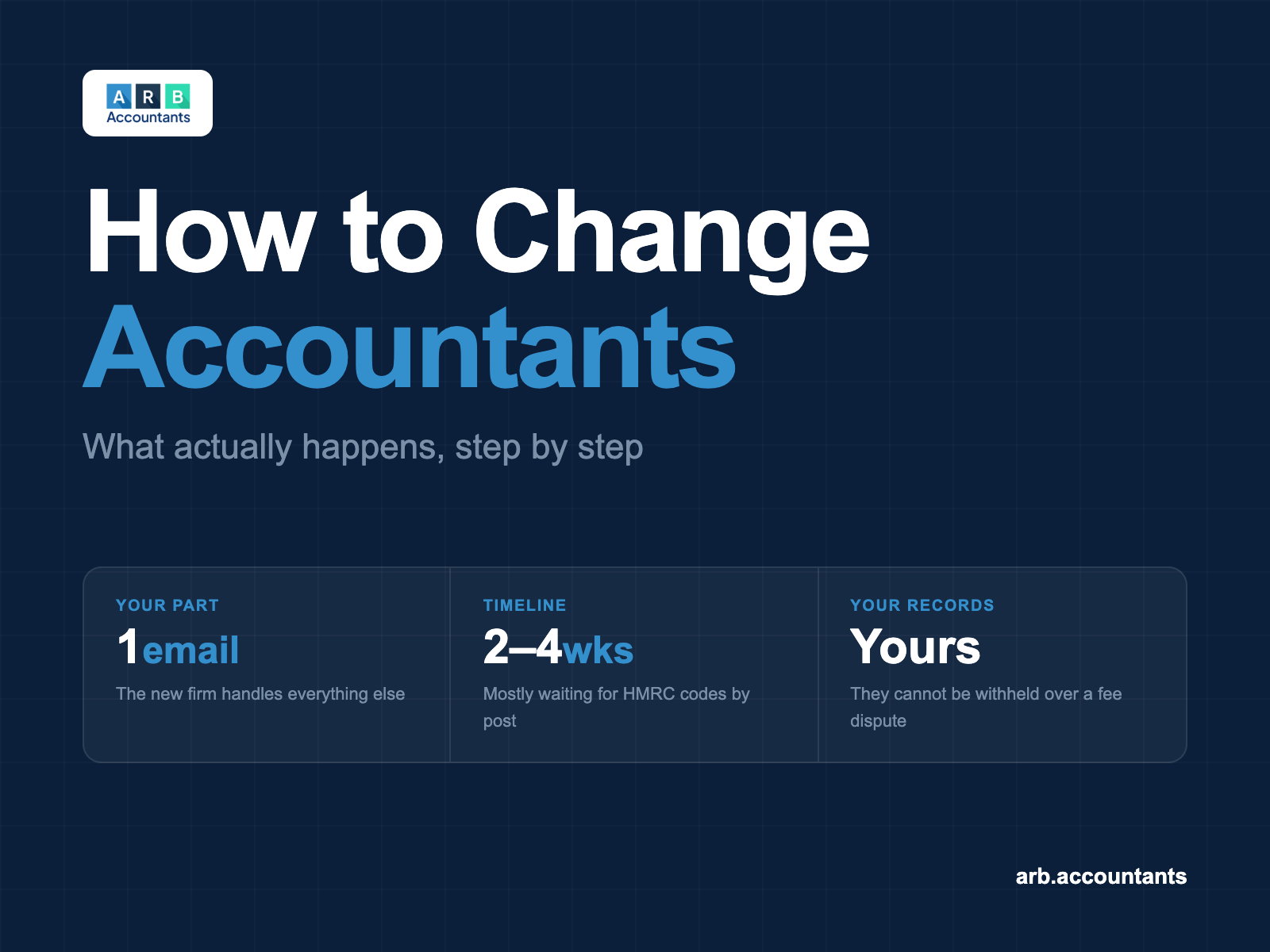
You appoint the new firm, then send one short email to your current accountant saying you're moving, naming the new firm, and authorising them to respond to the professional enquiry and release your records. Everything after that is the new accountant's job: professional clearance, HMRC authorisations, and collecting the handover pack. It typically takes two to four weeks, most of which is waiting for HMRC authorisation codes in the post. There's no notice to HMRC, no penalty, and no effect on your filing deadlines.
Changing accountants at a glance
- Your total involvement: one email, plus passing on HMRC codes.
- Typical timeline: two to four weeks.
- Professional clearance is between the two firms, not something you arrange.
- Your old accountant cannot withhold your own records.
- Switching does not trigger an HMRC enquiry.
Table Of Contents
- Why This Feels Harder Than It Is
- Step by Step: What Actually Happens
- What You Have to Do
- Professional Clearance Explained
- HMRC Agent Authorisation
- The Handover Pack
- What Can Go Wrong
- Can They Hold My Records Hostage?
- When to Switch
- The Email You Need to Send
- Thinking About Moving to Us?
Why This Feels Harder Than It Is
Most people who change accountants have been thinking about it for a year or more. The reasons are consistent: a tax bill that arrived without warning, emails that go unanswered, a penalty for a missed deadline, or the slow realisation that the business has outgrown the service.
What stops people acting isn’t doubt about whether to move. It’s the imagined logistics: records scattered across a firm you’re about to annoy, HMRC authorisations you don’t understand, a half-finished year, and the fear that something falls through the gap and lands as a penalty.
That fear is mostly misplaced. The profession has a standard process for this. It runs thousands of times a week, it’s governed by professional body guidance, and the client’s part in it is genuinely one email.
There’s also an awkwardness that nobody mentions. Small firm relationships are personal, and the outgoing accountant may have done your first set of accounts cheaply when you were starting out. You don’t owe anyone a business relationship in perpetuity, and a short, polite, factual email is the kindest way to handle it. Long explanations invite negotiation.
Step by Step: What Actually Happens
| Step | Who does it | Typical time |
|---|---|---|
| 1. Check your engagement letter | You | 10 minutes |
| 2. Appoint the new firm, sign engagement letter, AML checks | You and new firm | 1 to 3 days |
| 3. Email your existing accountant | You | 5 minutes |
| 4. Professional enquiry sent and answered | Between the two firms | 3 to 21 days |
| 5. HMRC agent authorisation | New firm, with codes via you | 1 to 2 weeks |
| 6. Records handed over | Old firm to new firm | 1 to 2 weeks |
| 7. Disengagement letter | Old firm | Alongside handover |
Steps 4, 5 and 6 overlap, which is why the whole thing usually lands inside a month. The only sequential dependency is that nothing starts until step 3.
What You Have to Do
Your entire involvement:
- Sign the new firm’s engagement letter and complete their identity checks. This is an anti money laundering requirement, not bureaucracy for its own sake, and no firm can act without it.
- Send one email to your current accountant. Template at the end of this page.
- Pass on HMRC authorisation codes when they arrive in the post. Do this promptly, because they expire.
- Hand over anything you hold personally: your Companies House authentication code if you have it, logins for bookkeeping software, and any HMRC correspondence sitting in a drawer.
That’s it. You don’t contact HMRC. You don’t notify Companies House. You don’t chase your old accountant for records, because that’s the new firm’s job and they do it every week.
Professional Clearance Explained
The incoming accountant writes to the outgoing one asking whether there's any professional reason they shouldn't accept the appointment. It's universally called professional clearance, but that name is misleading: the outgoing firm has no power to grant or withhold permission. The decision to accept is the incoming firm's alone.
What the letter is actually for is disclosure. Is there an unresolved dispute with HMRC? A reason to doubt the integrity of the information? Something the incoming firm should know before taking on the work? In the overwhelming majority of cases the answer is a short reply saying there’s nothing to report.
Two things worth knowing:
- It needs your authority. Both firms need your permission: the incoming one to make the enquiry, the outgoing one to respond. Your email covers both, which is why it’s the thing that unblocks everything else.
- Silence doesn’t block it. Professional body guidance is clear that the outgoing accountant shouldn’t unreasonably delay. If there’s no response within a reasonable period, commonly taken as around 21 days, the incoming firm can proceed provided they document their attempts.
If you’re worried your current accountant will be obstructive, this is the reassurance: the process is designed so that they can’t be, beyond slowing it down.
HMRC Agent Authorisation
The new firm needs authority to act for each tax. This is done through form 64-8 or, more usually now, HMRC’s online authorisation service.
Online is standard. The new firm requests authorisation, HMRC posts a code to you, and you pass it to your accountant. A separate code is needed for each tax: Self Assessment, Corporation Tax, PAYE and VAT.
Two practical points that cause most of the delays:
- The codes expire. They’re time limited, and if one lapses the request has to start again. Pass them on the day they arrive.
- They come by post. This is the slowest element of the whole switch and there’s no way to speed it up, which is why a two week estimate is realistic rather than pessimistic.
Authorising a new agent does not automatically remove the old one for every tax. Ask the new firm to confirm the old authorisation has been removed once the switch completes, so your former accountant isn’t still receiving your correspondence.
The Handover Pack
What the new firm will request from the old one:
- Last two to three years of accounts and tax returns, ideally with computations
- Tax references: UTR, VAT number, PAYE reference, Corporation Tax reference
- Companies House authentication code
- Trial balance and the bookkeeping file or software access
- Capital allowances and fixed asset schedules, including which assets carried full expensing
- Payroll records, P11Ds, pension scheme details
- VAT returns and workings
- Director’s loan account history
- Recent HMRC correspondence, particularly anything unresolved
The schedules are the part worth checking arrives properly. Capital allowances pools, losses carried forward, and a director’s loan account history are laborious to reconstruct and easy to get wrong, and errors there surface years later.
If your bookkeeping is on cloud software you control, such as Xero or QuickBooks, most of this is moot: you simply add the new firm as an adviser and remove the old one. That’s one of the quiet advantages of owning your own subscription rather than sitting on your accountant’s licence, and it’s worth arranging even if you’re not switching.
What Can Go Wrong
Being straight about the genuine risks, which are few:
Delay, not disaster. By far the most common problem is an outgoing firm that’s slow. It stretches the timeline. It doesn’t stop the switch and it doesn’t affect your filing obligations.
Incomplete schedules. Capital allowances pools and loss memoranda sometimes arrive incomplete or not at all. A competent incoming firm will notice and chase. This is the main reason to use a qualified firm rather than an unregulated bookkeeper.
A deadline in the gap. If you switch two weeks before a filing deadline, the new firm may not have authorisation in time. Avoid switching in the fortnight before 31 January or your accounts filing date. Any other time is fine.
An outstanding fee dispute. This slows record release. Covered below.
Something the old firm never told you. Occasionally a handover reveals a problem: an unfiled return, an unresolved HMRC query, a director’s loan nobody mentioned. Unpleasant, but finding out is the point. Our guides to s455 tax on director’s loans and HMRC compliance checks cover the two most common discoveries.
What doesn’t go wrong: HMRC enquiries triggered by switching, penalties for changing agent, or lost filing history. None of those are things that happen.
Can They Hold My Records Hostage?
Not your own records, no. An accountant may have a lien over documents they created, such as working papers, where fees are genuinely outstanding. That never extends to your own books and records, which remain yours regardless of any fee dispute.
In practice this rarely becomes a real problem, because most of what the new firm needs is either yours by right, held by HMRC and Companies House, or reconstructable.
If you hit it:
- Pay anything genuinely owed. A disputed £400 invoice is not worth a month of friction.
- Ask for the specific basis of any retention. Firms sometimes assert a broader lien than they actually have.
- Get what you can elsewhere. Filed accounts are on the Companies House register. Tax returns and liabilities are in your HMRC online account. A Companies House authentication code can be requested again directly.
- Escalate if needed. If the firm is regulated by ICAEW, ACCA or another body, that body has a complaints process, and firms are generally keen to avoid it.
When to Switch
The clean answer is shortly after a year’s accounts and tax return have been filed, so the new firm starts on a fresh period with everything settled.
The honest answer is that waiting for the perfect moment is the single most common reason people stay somewhere for years. Mid-year switches happen constantly and work fine. The only timing genuinely worth avoiding is the fortnight before a major filing deadline.
One consideration for sole traders and landlords: Making Tax Digital for Income Tax went live in April 2026 for qualifying income above £50,000, which means quarterly updates rather than one annual return. That makes the gaps between reporting points shorter, and it’s a reason to switch promptly if you’re going to rather than drifting into a quarter with nobody clearly responsible. See our guide to MTD for ITSA.
The Email You Need to Send
Short is better. Long explanations invite a conversation you don’t want to have.
Hi [Name],
I’ve decided to move my accounting work to [New firm]. Please treat this as notice under our engagement letter.
I authorise you to respond to their professional enquiry and to release my records and information to them.
Please also confirm anything outstanding on my account.
Thanks for your work over the years.
[Your name]
You don’t have to give a reason. If asked, “we’ve decided to go a different way” is a complete answer. You’re not obliged to justify the decision or to sit through a retention conversation, and a firm that presses after a clear instruction is confirming the decision rather than changing it.
Thinking About Moving to Us?
If you’re reading this because someone recommended us, the honest summary is that the process above is what happens, we do it most weeks, and your part really is one email.
What we’d do first is ask what went wrong at the last firm, because that determines whether we’re actually a better fit or just different. If you need monthly management accounts and someone who picks up the phone, we do that. If you need a bigger firm with a specialist corporate finance team, we’ll say so.
We take over the handover from the point you send the email: professional enquiry, HMRC authorisations, chasing schedules, and checking that what arrives is complete rather than just present.
Thinking about moving?
Free 60-minute consultation, with no obligation and no pressure. Tell us what isn't working now and we'll tell you honestly whether we'd do it better. If the answer is no, we'll say so. ACCA-chartered. Fixed fees agreed upfront.
"ARB Accountants helped me resolve an issue with HMRC that had been dragging on for months. Their knowledge and persistence saved me a lot of stress — and money. I can't recommend them enough." Jay Sach · Google Review (Tax Audit)
Read next
- Management accounts: what most businesses discover they were missing
- How to choose an accountant: what to ask before you appoint
- S455 tax on director’s loans: a common handover discovery
- HMRC compliance checks: switching mid-enquiry
Frequently Asked Questions
How do I change accountants?
Appoint the new firm, then send one short email to your current accountant saying you are moving, naming the new firm and authorising them to respond to the professional enquiry and release your records. The new accountant handles professional clearance, HMRC authorisations and the handover. Your part is genuinely one email.
Do I have to tell my old accountant myself?
Yes, and it is the only part you cannot delegate. The incoming accountant needs your authority before contacting the outgoing firm, and the outgoing firm needs your authority before releasing information. A short written message covers both.
What is professional clearance?
The letter the new accountant sends the old one asking whether there is any professional reason not to accept the appointment. The name is misleading: the outgoing accountant cannot grant or withhold permission, and the decision to accept is the incoming firm's alone. Professional bodies expect the request to be answered promptly.
Can my old accountant refuse to release my records?
They cannot withhold your own books and records. They may have a lien over documents they produced, such as working papers, where fees are genuinely outstanding. Even then, the underlying records belong to you. In practice, settling any legitimate outstanding fee removes the issue entirely.
What if my accountant ignores the clearance request?
The incoming firm follows up, and if there is no response within a reasonable period, typically around 21 days, they can proceed without a reply provided they document their attempts. A silent outgoing accountant delays the process but does not block it.
How long does it take to change accountants?
Usually two to four weeks. The professional enquiry and record handover take days. The slowest part is HMRC agent authorisation, because the codes are posted to you and can take a week or so to arrive, and they expire if not used.
When is the best time to switch?
Shortly after your accounts and tax return for a year have been filed, so the new firm starts with a clean period. That said, waiting for a perfect moment is the most common reason people stay somewhere for years. Any time works, and mid-year switches happen constantly.
Will changing accountants trigger an HMRC enquiry?
No. Changing agent is routine and HMRC processes thousands of authorisations a week. There is no link between switching and enquiry selection. This is one of the most common worries and it is unfounded.
Do I have to pay my old accountant to leave?
You pay for work already done, and for anything covered by your notice period under the engagement letter. Some monthly fee arrangements run to the end of a billing period. There should be no separate charge simply for leaving, though a reasonable fee for preparing handover information is sometimes charged.
What records should I get from my old accountant?
The last two or three years of accounts and tax returns, your tax references (UTR, VAT and PAYE numbers), the Companies House authentication code, payroll records including P11Ds, VAT returns and workings, the trial balance and any bookkeeping file, capital allowances and fixed asset schedules, and relevant HMRC correspondence.
Can I change accountants mid tax year?
Yes, and it is very common. The new firm picks up from where the records stand. It usually means a slightly longer handover because the year is incomplete, but nothing about it is problematic, and waiting for a year end is rarely worth the delay.
What if I am part way through an HMRC enquiry?
You can still switch, but tell the incoming firm before they accept the appointment, because it affects the work involved and the fee. Continuity matters in an enquiry, so the handover needs to be thorough. It is sometimes worth completing a live enquiry first, though not if the reason for switching is how the enquiry is being handled.
About The Author

Saurabh Bedi | Director
Saurabh is a tax advisor at ARB Accountants, specialising in Self-Assessment and small business tax. He's dedicated to making tax simple and stress-free, helping clients stay compliant and confident with HMRC.
Qualifications & Experience
- Fellow of Chartered Certified Accountants (ACCA)
- MSc Chartered Certified Accountancy 2008
- Working in accountancy since 2008