Public Limited Company (PLC) in the UK: What It Is, Requirements and Tax
What is a public limited company (PLC) in the UK?
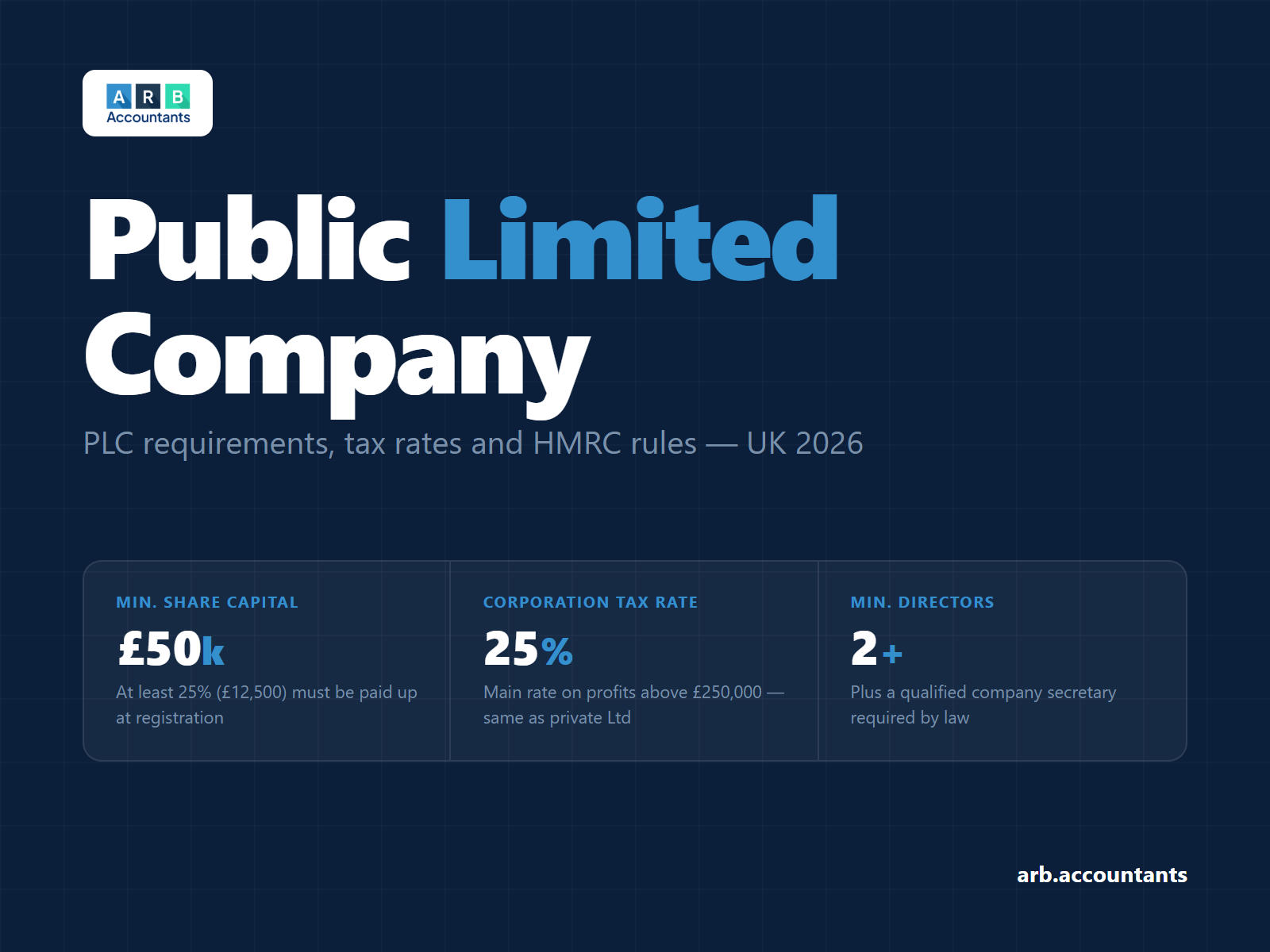
A public limited company (PLC) is a UK company whose shares can be offered and sold to the general public. Under the Companies Act 2006, a PLC must have at least two directors, a qualified company secretary, and a minimum of £50,000 share capital with at least 25% paid up. It cannot trade until Companies House issues a trading certificate. PLCs pay corporation tax at the same rates as private limited companies: 19% on profits up to £50,000, 25% on profits above £250,000, and marginal relief on profits in between.
A public limited company is the only UK company structure that can legally sell shares to the public. That one difference (public share offering) creates a cascade of additional legal requirements, compliance obligations, and regulatory scrutiny that make a PLC quite different from the private limited company that most UK businesses use. This guide explains what a PLC is, how to form one, how it is taxed and when the structure actually makes sense.
What is a public limited company?
A public limited company is a UK company incorporated under the Companies Act 2006 that is legally permitted to offer its shares to the public. It carries the letters "plc" or the words "Public Limited Company" at the end of its registered name. The key right a PLC enjoys over a private limited company is the ability to raise capital from any member of the public, either directly or through a listing on a recognised investment exchange such as the London Stock Exchange or AIM.
Being a PLC does not mean the company is listed. Many PLCs are incorporated without immediately listing their shares. These are called unlisted or private PLCs. The PLC structure is simply the legal prerequisite for a potential listing. A private limited company cannot list on a stock exchange; a PLC can, but is not required to.
Like all limited companies, a PLC gives its shareholders limited liability: shareholders are only liable for the amount they paid, or committed to pay, for their shares. If the company fails, creditors cannot pursue shareholders’ personal assets beyond the value of their shares.
Public limited company requirements
To incorporate and trade as a PLC, the following must be in place:
| Requirement | PLC | Private Ltd (for comparison) |
|---|---|---|
| Minimum share capital | £50,000 | £1 |
| Paid-up share capital at registration | At least 25% (£12,500) | No minimum |
| Minimum directors | 2 | 1 |
| Company secretary | Required: must be qualified | Optional |
| Trading certificate before trading | Yes (form SH50) | Not required |
| Annual General Meeting | Mandatory within 6 months of year end | Not required |
| Statutory audit | Required every year | Only above audit threshold |
| Filing deadline for accounts | 6 months after year end | 9 months after year end |
| Name ending | PLC or Public Limited Company | Limited or Ltd |
The trading certificate: the step most people miss
Even after Companies House registers the PLC and issues a certificate of incorporation, the company cannot trade, sign contracts, or borrow money until it holds a trading certificate. The application (form SH50) confirms that the minimum share capital requirement is met. Without this certificate, any contracts the PLC enters may be unenforceable, and the directors may face personal liability for resulting losses. This requirement applies only to PLCs. A private limited company can trade immediately after incorporation.
Qualified company secretary
A PLC’s company secretary must meet one of these formal qualifications:
- Member of the Chartered Governance Institute (ICSA/CGIUKI)
- Chartered accountant (ACA, ACCA, CIMA or CIPFA)
- Solicitor or barrister
- Someone who held the role of company secretary at a PLC in the five years preceding their appointment
The secretary can also be one of the directors, but the role cannot be left vacant.
How to form a public limited company
The process from decision to being able to trade involves six steps:
- Choose a name ending in “PLC” or “Public Limited Company” and confirm it is available on Companies House.
- Appoint two directors and a qualified company secretary.
- Allot at least £50,000 of share capital with a minimum of £12,500 (25%) paid up at registration. Shares must be denominated in sterling or euros.
- Prepare a memorandum and articles of association. Model articles for PLCs are set out in Schedule 3 of SI 2008/3229, or you can use bespoke articles drafted by a solicitor.
- File the IN01 registration form with Companies House. The certificate of incorporation is issued but the company still cannot trade.
- Apply for a trading certificate using form SH50. Only once Companies House issues this can the PLC legally operate.
If an existing private limited company wants to convert to a PLC, the process uses form RR01 (re-registration) alongside a special resolution passed by at least 75% of shareholders. The company must meet all PLC requirements, including minimum share capital, before conversion completes.
Public limited company tax
There is no special tax rate for public limited companies. A PLC pays corporation tax at the same rates as a private limited company: 19% on profits up to £50,000, 25% on profits above £250,000, and marginal relief on profits in between. The company type (PLC or Ltd) has no bearing on the rate. Because most PLCs are large businesses, they typically pay the 25% main rate.
Corporation tax
For the financial year starting 1 April 2026, the rates are:
| Annual profit | Corporation tax rate |
|---|---|
| Up to £50,000 | 19% (small profits rate) |
| £50,001 to £250,000 | Marginal relief applies, effective rate between 19% and 25% |
| Over £250,000 | 25% (main rate) |
The thresholds are divided by the number of associated companies (companies under common control) plus one. A PLC within a large group will typically see these thresholds reduced significantly, meaning the full 25% main rate applies almost immediately.
Large companies (broadly those with profits above £1.5 million) must pay corporation tax in quarterly instalments rather than as a single payment nine months and one day after the year end. Almost all listed PLCs fall within the quarterly instalment regime.
VAT
A PLC registers for and files VAT returns in exactly the same way as a private company. The registration threshold is £90,000 of taxable turnover in any rolling 12-month period. No PLC-specific rate, exemption or treatment exists.
PAYE and national insurance
If the PLC employs staff or pays director salaries, it must operate PAYE and deduct income tax and national insurance contributions. Employer NICs apply at the standard rate (currently 15% above the secondary threshold). No PLC-specific employer NIC rules apply.
Dividend tax
Dividends paid by a PLC are paid out of post-tax profits. They are not deductible for the company. Shareholders pay income tax on dividends received at the standard dividend rates (8.75% basic, 33.75% higher, 39.35% additional) after the annual £500 dividend allowance. Shareholders of listed PLCs who hold shares inside an ISA or SIPP pay no dividend tax on those holdings.
Stamp duty reserve tax (SDRT)
When investors buy shares in a listed PLC electronically through CREST, the buyer pays SDRT at 0.5% of the purchase price. This is a cost borne by the investor, not the company. It is a factor in the liquidity and attractiveness of the company’s shares.
HMRC obligations for a public limited company
A PLC carries the same core HMRC obligations as any UK limited company, with one meaningful addition: the statutory audit requirement:
- Register for corporation tax at HMRC within three months of commencing trade.
- File a CT600 (corporation tax return) annually, with any tax due paid nine months and one day after the accounting period end. Large companies pay in quarterly instalments.
- Operate PAYE via Real Time Information (RTI) for all employees and directors on payroll.
- Register for VAT and file returns once taxable turnover exceeds £90,000, or voluntarily.
- Submit P11D forms by 6 July after each tax year for any benefits in kind.
- Report persons with significant control (PSC) to Companies House via the confirmation statement.
- File full audited accounts with Companies House within six months of the year end. The audit must be carried out by a registered auditor. No size exemptions apply to PLCs.
Large listed PLCs typically fall within HMRC’s Large Business directorate, which assigns a dedicated Customer Compliance Manager (CCM) to manage the tax relationship on an ongoing basis. Very large multinational PLCs may also have transfer pricing obligations and may need to file a country-by-country report if the group’s total revenue exceeds €750 million.
Advantages of a public limited company
Access to public capital The defining advantage. A listed PLC can raise funds from millions of investors by issuing shares or bonds on the open market. This scale of capital is unavailable to private companies, which can only raise money from a defined group of investors.
Easier exit for shareholders Shares in a listed PLC can be bought and sold freely on the stock exchange. Early investors, including venture capital funds, angel investors and founders, can exit without having to find a buyer directly. This liquidity is why many private equity-backed businesses ultimately aim for a PLC structure and listing.
Enhanced credibility and profile The PLC designation signals scale, governance and regulatory oversight. Suppliers extend larger credit lines. Enterprise clients sign longer contracts. The brand carries more weight in competitive pitches. Many businesses adopt the PLC structure for the prestige alone, without immediate plans to list.
Employee share incentive schemes Listed PLCs can offer employees Share Incentive Plans (SIPs), Save As You Earn (SAYE) schemes, Long-Term Incentive Plans (LTIPs) and other arrangements using tradable shares. This is a powerful recruitment and retention tool, particularly in sectors where talent is scarce.
Acquisition currency A PLC can use its own shares as currency to acquire other businesses. Instead of paying cash, the acquiring PLC offers shares in itself, meaning acquisitions can be structured without depleting cash reserves. This is a significant strategic lever unavailable to private companies.
Disadvantages of a public limited company
Loss of control Any member of the public can buy shares in a listed PLC. A shareholder or group that accumulates more than 50% of voting shares can influence or control the company outright. Hostile takeovers are a genuine risk. Founders and original owners typically see their ownership percentage diluted as more shares are issued.
Compliance and reporting costs A PLC is legally required to publish full audited accounts, hold an annual general meeting, disclose material information to the market, and comply with Companies House filing deadlines. Listed companies must also comply with FCA Disclosure and Transparency Rules and the UK Corporate Governance Code. These obligations require dedicated legal, audit and investor relations resource.
Public scrutiny Every director’s remuneration, every significant contract and every profit warning is published and examined by analysts, journalists and competitors. This level of transparency is incompatible with certain business strategies and can constrain commercial flexibility.
Higher set-up and ongoing costs Listing fees, prospectus preparation, underwriter fees, legal counsel and ongoing regulatory compliance all add significant cost that private companies avoid entirely. The minimum share capital requirement (£50,000 with £12,500 paid up) is itself a barrier that private limited companies do not face.
Short-term market pressure Publicly traded PLCs face pressure from shareholders and analysts to report results and meet earnings expectations. This can create tension between short-term performance management and long-term investment in the business. It is a pressure that does not exist for private company directors.
Public limited company list UK
The largest UK PLCs are listed on the London Stock Exchange and form the major indices:
Selected FTSE 100 PLCs
- HSBC Holdings plc
- AstraZeneca plc
- BP plc
- Unilever plc
- Diageo plc
- BT Group plc
- Rolls-Royce Holdings plc
- Barclays plc
These companies are incorporated as PLCs, listed on the main market of the London Stock Exchange, and subject to the full range of FCA and LSE reporting requirements. Many smaller UK companies list on AIM (the Alternative Investment Market), which has lighter regulatory requirements but still requires a PLC structure.
You can search the full register of all UK public limited companies, listed and unlisted, via the Companies House company search.
Is a PLC right for your business?
For most businesses, the answer is no, not at the current stage. The compliance overhead, audit requirement, two-director rule, qualified company secretary, trading certificate process and minimum share capital make a PLC unsuitable for small and medium businesses. A private limited company delivers limited liability, flexible profit extraction, and professional credibility at a fraction of the cost.
A PLC becomes relevant when you are preparing to raise capital from the public, planning an IPO on the main market or AIM, or when the business has grown to the point where the liquidity and acquisition-currency benefits of a listing outweigh the compliance burden.
If you are at that stage, or converting an existing Ltd to a PLC, the tax and structural planning required to make the transition efficiently is significant. Getting advice early avoids costly restructuring later.
Read next
- Sole trader to limited company: when and how to incorporate as a private limited company first
- Salary vs dividends: structuring income from a limited company
- Business Asset Disposal Relief: the tax relief available on disposal of a qualifying business
- Employee Ownership Trust: an alternative exit and succession structure to a public listing
- Associated companies and marginal relief: how the corporation tax thresholds interact across a group
Frequently Asked Questions
What is a public limited company in the UK?
A public limited company (PLC) is a type of limited liability company incorporated under the Companies Act 2006 whose shares can legally be offered to the general public. It must have 'PLC' or 'Public Limited Company' in its name, at least two directors, a qualified company secretary, and a minimum of £50,000 share capital with 25% paid up. Only a PLC can apply to list its shares on the London Stock Exchange or AIM.
What is the difference between a PLC and a private limited company?
The core difference is that a PLC can offer shares to the public; a private limited company cannot. A PLC must have at least two directors, a qualified company secretary, and £50,000 minimum share capital with 25% paid up. A private company needs only one director, no company secretary, and just one share worth £1. PLCs must hold an AGM and file full audited accounts. Private companies are exempt from AGMs and from mandatory audits below the statutory threshold.
What is the public limited company tax rate in the UK?
There is no special PLC tax rate. A public limited company pays corporation tax at exactly the same rates as any other UK limited company: 19% on profits up to £50,000 (small profits rate) and 25% on profits above £250,000 (main rate), with marginal relief between those thresholds. Because most PLCs are large businesses, they typically pay the 25% main rate. Dividends paid to shareholders are taxed in the hands of the recipient using standard dividend tax rates.
Do public limited companies pay VAT?
Yes. A PLC must register for VAT if its taxable turnover in any rolling 12-month period exceeds £90,000, and may register voluntarily below that threshold. Standard VAT rules apply. There is no PLC-specific rate, exemption or registration requirement.
What are the HMRC obligations for a public limited company?
A PLC has the same core HMRC obligations as a private limited company: register for corporation tax within three months of starting to trade, file a CT600 and pay any tax due nine months and one day after the year end, run PAYE and national insurance for all employees and directors, file VAT returns if registered, and submit P11D forms for benefits in kind. Additionally, PLCs are required by law to have a full statutory audit each year, which many smaller private companies can avoid.
Does a public limited company have to be listed on the stock exchange?
No. A PLC can be incorporated without listing its shares. This is called an unlisted or private PLC. The PLC structure is simply the legal prerequisite for a future listing. Many PLCs are formed in preparation for an IPO but are not required to list. If you want to list on the London Stock Exchange or AIM, you must first be a PLC.
Can a small business be a public limited company?
Technically yes. There is no minimum turnover requirement. In practice, the compliance costs (mandatory audit, two directors, qualified company secretary, annual AGM, full public accounts, trading certificate) make a PLC unsuitable and disproportionately expensive for most small businesses. The vast majority of small businesses incorporate as private limited companies instead.
What is a UK public limited company list?
The largest UK public limited companies are listed on the London Stock Exchange and include HSBC Holdings plc, AstraZeneca plc, BP plc, Unilever plc, Diageo plc, Rolls-Royce Holdings plc and BT Group plc, many of which form the FTSE 100. Smaller PLCs list on AIM. The full register of all UK PLCs is searchable via Companies House.
How does HMRC treat public limited companies differently from private companies?
For tax calculation purposes, HMRC treats PLCs identically to private limited companies. The same corporation tax rates and rules apply. The practical difference is that large PLCs fall within HMRC's Large Business directorate, which assigns a dedicated Customer Compliance Manager to manage the relationship on an ongoing basis, rather than the risk-triggered approach used for smaller companies. Very large PLCs may also face transfer pricing obligations and country-by-country reporting requirements.
About The Author

Saurabh Bedi | Director
Saurabh is a tax advisor at ARB Accountants, specialising in Self-Assessment and small business tax. He's dedicated to making tax simple and stress-free, helping clients stay compliant and confident with HMRC.
Qualifications & Experience
- Fellow of Chartered Certified Accountants (ACCA)
- MSc Chartered Certified Accountancy 2008
- Working in accountancy since 2008